No post today, I’m out of town this weekend. See you on Monday!
Source: Digital Initiative
Out of Town

No post today, I’m out of town this weekend. See you on Monday!
Source: Digital Initiative
Out of Town

I really, really hate grinding. It’s one of the quickest ways to get me to stop caring about a game. Some people love it, just turning their brain off and chipping away at something, but it always bugs me.
It stems from my love of finding creative solutions to problems. I’m not a brute force type, and grinding always feels like a brute force method. I’d rather find a complex problem and come up with a functional, creative solution to it than do a bunch of mindless repetitive work. Most of the people I know who either don’t mind or actively enjoy grinding tend to talk about doing “something else” while grinding, usually netflix or something. I get the concept, but it doesn’t work for me.
I like to fully immerse myself in my entertainment. I very rarely mix entertainment media, and when I do one of them is starkly on the back burner, and is barely getting any attention. The only one of these I can think of is FFV, at certain points, where I realize I can grind some levels or AP by setting up an autobattle engine (I’m playing on iOS) and literally not looking at the screen for 20 minutes while I do something else. If it’s taking up more attention than that, I want to be giving it my full attention. I don’t tend to listen to my own music when I’m playing a game, nor do I watch TV while gaming. I’ve talked to people who read a book with the TV or some music on in the background and it’s something I can’t fathom.
As a kind of adjunct to this, I tend to do poorly with games that don’t fully engage me. A great example of this is Diablo, which a lot of people love and I’m fairly ambivalent about. Moment-to-moment combat isn’t quite deep enough to keep me engaged, and there’s nothing in the game EXCEPT combat, so I don’t get the activity variance that I do in, say, MMOs. Similarly, Warhammer tabletop wargames tend to fall under the engagement threshold for me– there isn’t enough gameplay ‘meat’ for me to sink my teeth into, it boils down into “roll a whole bunch of dice” rather than relying on tactics or clever application of special abilities.
Little bit of a ramble today, but it’s something I’m thinking about.
Source: Digital Initiative
Grinding and Engagement

Last night I got a little piece of advice from Syp, who said that I should take care of myself and that no one would care if I took a few days off. I greatly appreciate the sentiment, and while I feel like this is probably the most brilliant idea… I am not likely to do it. In part this “every morning” thing is a much needed routine in my life. Much like dreams are a way for us to sort through the days events, in many ways this morning blog post is a way to reorder my thoughts before I start a new day. While it started with the goal of “write more content” It has wound up somewhere in a therapeutic space. Getting up every morning and writing something… is important to me in ways I don’t fully grasp. Additionally I have now done this two and a half years roughly, so another part of me simply does not want to “break the chain”. I am however likely to fiddle with my format a bit until my wrist is fully healed.
 Right now we are in this limbo area where people are still in the process of gearing in order to be able to do higher level content. To do Alexander the first raid you must be ilevel 170, which means you need to have a full set of Tomestone of Law gear with at least one upgraded item. Since I only hit 60 a few days ago I am not quite there yet. As of last night I managed to hit ilvl 166 and in theory should be able to upgrade another piece of gear tonight if I manage to get any play time. For awhile now I have filled in for the Wednesday night raid group, which was admittedly a bit of an imposition when I was still raiding in World of Warcraft… but now is not so much. Wednesday night is generally speaking a pretty good night for me to raid considering that my wife is off at church for a large chunk of it. So as we move forward into Heavensward I am probably going to offer myself as a more permanent part of that group. Since we could not do Alexander we set our sights last night on Bismarck Extreme, which only has a requirement that individuals be level 60.
The fight is in essence a series of dps checks, because apparently the island we are standing on gets more and more battered as the fight goes on. At a base level the fight works pretty much the same as it does on hard, except for the fact that you realistically need to get down the back scale during the first chain phase. I feel like Wulf and I made a lot of progress on learning this fight as tanks, with the hardest part being the elemental snake swap. The snakes send out a debuff that makes it so that players need to be dpsing the snake of the opposite color of the buff they currently have. This means tanks also need to swap targets, and at first we were trying to meet in the middle and trade off, but it seems that quite honestly this is a job for provoke. Right before a potential swap Wulf and I would target each others snakes and then hit the taunt if we saw that we needed to. Thankfully it seems to work magically, because normally speaking “just taunting” has minimal effect in this game when it comes to swapping targets.
 While we beat the first dps check, we consistently failed at the second one… which is burning down the elemental snakes before hitting the point of no return where the skies to dark… and Bismarck nukes us into oblivion. Thankfully each of us still has a lot more gear we can get so we are simply hitting a gear wall. I think if we get enough upgrade pieces in the next week we will totally rock this fight and down us the first extreme primal of the expansion. Then we will move on to Ravana Extreme… that happens to drop the best weapons in the game currently. I have to say I had a blast with the fight, and it was awesome working with Wulf. The few times I had tanked for the WoW raid, it was when he happened to be out for the night, so I think this might be the first time we have actually worked together in progression content. In part I somewhat hope we have the people to pull this together for an attempt on Saturday during the pre-podcast raid block.
Source: Tales of the Aggronaut
Extreme Whales

Some thoughts on Fun, because they’re rattling around in my head.

Raph Koster’s A Theory of Fun describes fun in terms of how challenged your brain is. Forming new patterns, he says, is fun, provided they’re new and different enough to engage you but not so nonsensical as to frustrate your efforts in finding the patterns. Essentially, “fun” is the point at which you are still learning new things and are neither bored because you already know them or frustrated because they’re beyond your grasp. It’s an angle that people don’t tend to talk about much, for a variety of reasons, and that I’ve heard a lot of people disagree with. For my part, I generally agree with Raph on this one, but it’s one of those how-the-sausage-is-made things that people don’t like to think about.
A lot of people tend to think of fun as an ephemeral concept, a very “know it when you see it” sort of thing, and, flatly, I think they’re wrong. It’s not hard to pinpoint fun, or know what makes certain things fun, but it follows a sort of uncertainty principle. You can either be having fun with something, or know from someone else that something is fun, but very rarely both. It’s why the concept of “overhyping” something exists– enough people tell you that you’ll enjoy it and the odds of you actually enjoying it drop. It’s also why the term “visionary” is thrown around great game designers– they “see” something that no one else does. I’m convinced that the reality is that you simply can’t tell people that what you’re making is fun, because the very act of doing so will diminish their enjoyment of it. Fun is a sort of manipulation, and people hate being manipulated if they know it’s happening. Fun needs to be discovered on a person’s own terms.

I’ve seen this in action while working on various games. Certain parts of the project will be pushed really, really hard, with the message of “this is going to be the fun part”, and it almost never is. Instead, the fun appears elsewhere, in the little projects that people try out in private until they’re functional enough for ‘primetime’. These little projects come as a surprise to a lot of people, who discover them and, in so doing, find themselves having fun.
Discovery is an important part of fun, it’s that part of you that’s learning something new, and sparkling in your brain. Mastery is another part of fun, that part of you that loves the feeling of pulling off something that you figured out previously. These things tug at one another, and it’s really easy to mess up the balance. If you spoil the ending to something for someone, you’ve just short-circuited that discovery, and robbed them of the fun of discovering it on their own. On the other hand, some people don’t mind spoilers and actively seek them out, so that instead of finding fun in discovery, they find fun in mastery.
I think that Raph’s spectrum of challenge is apt, but is missing an important axis. Fun is, I think, a plane along three axes. The first axis is the challenge axis, with unthinking mastery on one end and impenetrable frustration at the other. On one end of this axis, you know something inside and out, and can do it in your sleep. Your brain probably doesn’t even engage, and you’re likely bored if that’s all you’re doing. On the other end, the patterns simply won’t form, they’re out of your grasp, and it’s frustrating because you fail repeatedly without knowing why; there’s no learning occurring because you don’t have any handholds. The second axis is the comfort axis, where at the one extreme end you’re perfectly comfortable with what you’re doing and on the other you’re pushing your limits. This is separate from the challenge axis, because it’s an emotional measure, not an analytic one. It’s about where you feel safe, not necessarily how much you’re learning. The third axis is, of course, fun itself, where the peak of the plane is wherever you’re having the most fun.
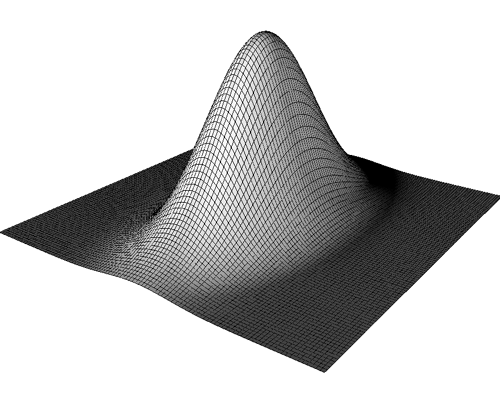
To illustrate this a bit, I’ll use myself. I crave the experience of learning new things. I’m fundamentally unsatisfied if whatever I’m doing isn’t driving me to learn something new. If I’m not picking up a new skill, or new knowledge, or some kind of new experience, I’m not having fun. In MMOs, getting new abilities and discovering new stories are far and away the most motivating things– it satisfies my desire to accumulate more things to master and to learn more about the world I’m playing in. Notably, as soon as I’m not learning something new, I’m starting to get bored. I have very low stamina for grinding, even repeatedly doing very difficult content. Difficulty alone doesn’t thrill me, I need the new. On the other axis, however, I err slightly towards the side of comfort. I want to learn lots of new things, but I want to do so at my own pace without other people interfering. It makes me bad at playing in a group, because I lack the time and space to process the new things I’m learning, and it often forces me to push myself more than I feel safe doing.
I have a few friends who lean heavily towards the “mastery” side of things. One friend of mine is similar to me– he likes to amass new knowledge at an incredible rate but does so in a position of total comfort, and is generally unhappy if pushed outside of his comfort zone. Another friend finds a ton of fun in mastery, and wants to consistently challenge himself in that sphere, facing experiences that force him to prove his mastery by pulling him out of his comfort zone. Yet another friend wants to exhibit mastery in a comfortable space; she frequently returns to older games that she’s played and beaten numerous times and knows inside and out. I have another friend who exclusively tries to learn new things well outside of her comfort zone; she’s a thrill-seeker in real life and the kind of person who picks up a game she’s never played before and cranks it up to the highest difficulty before even trying.

These four people all fall in different quadrants, and what’s fun for one of them may not be for another. It’s not simply about the analytical view of challenge and learning, but it’s about the emotional view of comfort and boundary-pushing. What I find interesting is that I’ve rarely run into someone who genuinely only has fun in one quadrant. A lot of people find their quadrant and stick to it, seeking out experiences they already know they’ll like, but for the people who actively move around, I’ve seen a lot of ‘surprise’ fun being had. It isn’t just people pushing their boundaries, either. I’ve seen the hardest of hardcore PvP junkies sit down with Bejeweled, an intensely casual single-player game, and get hooked in the simple, comfortable mastery of a game that neither pulls them out of their comfort zone nor challenges them significantly– despite those two things being their primary source of fun.
The frustrating part for me is that I can’t tell anyone this and have them believe me. It’s that fun uncertainty principle at work again. I know that I have a hard time enjoying anything someone suggests I might like, because I didn’t discover it myself, and my knowledge of psychology and people-management suggests to me that I’m not alone in this. Trying to move someone to a quadrant they aren’t familiar with doesn’t work, and while they might enjoy it if they find it on their own, they almost certainly won’t if pushed there.
My takeaway here is twofold: try new things, pick something you don’t think you’ll enjoy and try it, just in case. Also, let people discover what they like on their own– a lot of fun is in the discovery and you don’t want to rob someone of that fun. I have had more success in getting people to try things (games, shows, whatever) by trying them myself and keeping a neutral, descriptive tone about what I’ve experienced than I ever have by gushing at someone about how much I love something. I’ve gotten avowed PvP-hating players to try Archeage simply by saying “hm, this is interesting and not what I expected”, yet to date I have been able to dive deep into Thief or Hitman with exactly one person, more than a decade ago. Much as you might love to talk about something, that even tone that leaves room for discovery works wonders.
Source: Digital Initiative
The Fun Plane