On Mini Giant Robots

LBX is a 3DS game about fighting model robots. It’s a recent release in North America and Europe, but it’s a 3-year-old remake of a remake of a game that came out in 2011 in Japan. It’s kind of cheesy and clearly intended for a younger audience, but I love it anyway. The fighting itself has elements of games like Virtual On, and the structure of the game reminds me of Mega Man Battle Network, both games which I enjoyed a lot. More than that, the entire concept reminds me of one of my favorite games on the Game Boy when I was younger: Power Quest.
On Mini Giant Robots

Tiny Fighting Robots

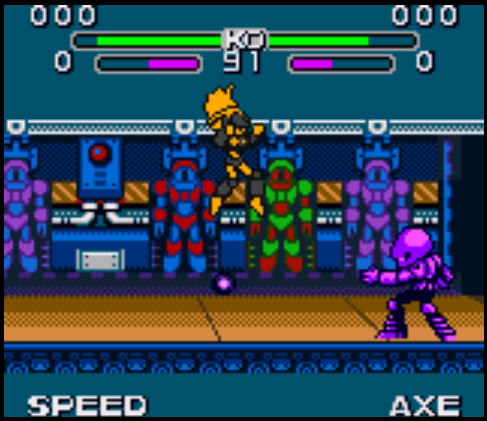
Power Quest was one of the early games for the Game Boy Color, and I got it as a Christmas gift when I turned 12. It is also a game about fighting model robots, but the core gameplay is a fighting game.The game itself involved you roaming around town, earning money to upgrade your model (by beating people around town in duels), and occasionally getting interrupted by the plot, which is mostly nonsensical and involves the Bad Hyenas Gang and your best friend. At the end of the game you fight in a tournament and defeat a masked wrestler to end the game. I probably wouldn’t consider it a very good game at this point, but on reflection it’s the first fighting game I got heavily invested in. I’d played Street fighter 2, but I didn’t really know how things worked until later.


While the plot is largely an excuse to fight robots, one thing that stuck with me is that about halfway through the game, your best friend moves away. Thanks to timing, I played this game shortly after I moved halfway across town (which might as well be halfway around the world when you’re 12). Another thing worth mentioning is the soundtrack, which was incredibly good for a Game Boy game.
On Mini Giant Robots

Bigger Fighting Robots

LBX turns out to have a surprising amount of surprisingly well-done voice acting, and has an actual plot. It’s a lot like Pokémon in that an organization is using these things for evil (so of course you have to use them to put a stop to it), but there’s also a hint of a Last Starfighter-esque plot where this turns out to be training for actual giant robots down the line. (This is in the opening, so I don’t consider it a spoiler.) It also leans heavily on Defeat Means Friendship, so it’s not uncommon to be fighting alongside bosses after you beat them. Your own robot is quite customizable, so while you start with Achilles, you can eventually use almost anything you want. I’m eager to see where this one’s going, because I really like it so far. There’s also a cross-media element that might be a bit dangerous, but more on that later.
On Mini Giant Robots

Mystara Monday: Module B2 – The Keep on the Borderlands

Here it is, arguably the most well-known adventure module in D&D history. Today we're taking a look at Dungeons & Dragons adventure module B2: The Keep on the Borderlands.

Mystara Monday: Module B2 - The Keep on the Borderlands

The Keep on the Borderlands was written by Gary Gygax as a new introductory module to go with the D&D Basic Rules. It replaced In Search of the Unknown in the original Basic Rules set and was included with the Moldvay edition of the Basic Rules throughout its publication run. The Mentzer revision of the Basic Rules did away with module B2 in favor of the castle adventure included in the Dungeon Masters Rulebook. If I had to guess, I'd bet that it was decided that a simpler adventure should be included due to the younger audience that edition was aimed at.

Being an introductory module, the first few pages consist of much the same information that was provided at the beginning of module B1; advice for the dungeon master, information on tracking time, how to divide treasure and compute experience, and so forth. Of particular note, it's stated that the module is designed for 6 to 9 players, and is intended to require multiple sessions to complete. B2 has a reputation as a challenging adventure and I'd bet that more than a few under-manned parties found themselves in way over their heads. The adventure adamantly states that smaller parties must have the services of several men-at-arms made available to them and should be advised to keep to the lower caves.

The eponymous Keep is presented as a base of operations for the players situated near the border of 'The Realm' where the forces of Chaos are forever trying to invade. Shops, temples and so on are detailed with NPCs to interact with (although not a single one is given an actual name, titles only here). The intention is clearly that the players can use the keep as a staging point to first clear out the nearby Caves of Chaos and then go further afield to whatever dungeons the DM comes up with next. In practice, I suspect a lot of parties began murdering their way through the keep for all the nifty magical loot within.

The actual adventure area is made up of nearly a dozen caves scattered in a sort of box canyon area not far from the keep. Most of the caves are populated with humanoid tribes of various types who have ongoing alliances and enmities with each other that the players can take advantage of if they're particularly clever. It's easy for the players to get in over their heads here since a lot of the tribes will call others to their aid if given a chance; in particular the goblin tribe has an agreement with a nearby ogre who is entirely capable of making some level 1 characters exceptionally dead. There's also one cave populated by an owlbear and three grey oozes.

Mystara Monday: Module B2 - The Keep on the Borderlands
You'd be cranky too if you looked like that.
We're still very much in the old school of D&D here; the players are sent out to kill monsters and take their stuff without any real plot beyond 'they're monsters, they have cool stuff'. B2 is a step up from B1 though in that it sets up opportunities for some memorable encounters (the aforementioned mercenary ogre, an evil priest with a veritable army of undead, an imprisoned medusa, and so on).

We're still quite a few years away from Mystara coming into existence at this point, but it's worth noting that the Keep was given an official location in the Mystara campaign world. Like most low level adventures it's placed in the Grand Duchy of Karameikos, in this case in the mountainous region in the far north of the Duchy.

Unlike module B1, I've run Keep on the Borderlands a few times. Not many, as I tend to prefer to either use more plot-driven modules or write my own for early play, but I've definitely made use of the Caves of Chaos. Curiously enough, the parties I ran it for were actually pretty competent so I don't have any stories of utter PC failure in the face of overwhelming odds. Knowing when to retreat is, I think, the most important lesson this module teaches; there's no way an adventuring party will clear the entire cave complex in a single attempt and some encounters really require the players to be prepared ahead of time to realistically handle them.

Next week we'll continue our trek through the B-series modules with a rather infamous one. Join me for a look at Adventure Module B3 - Palace of the Silver Princess and learn why the terrifying decapus is a whole lot creepier than you might have thought.

Demon Hunting

Digital Resurrection

Demon Hunting
Not the Culprit, but a close cousin

Yesterday was the day of me bringing back machines from the dead.  During the week my secondary machine gave up the ghost, the one that I use to remote in from work on a regular basis and the one that I use to manage my media server.  I came home from work on Tuesday and and my second machine was screaming, literally.  Emitting an insanely loud noise, but I really did not have time to investigate it so I put that off until the weekend.  My immediate thought was the processor fan, and that the system had overheated.  Luckily I happened to have a spare one of these because I thought this processor fan had gone out before.  Turns out that when I popped it open on my table, it was not the processor fan at all but the video card.  The Asus 550 ti finally gave up the ghost and thankfully I have a whole slew of video cards to attempt.  So I threw in my lowest power consumption, lowest heat card…  which was a HD 7500 series card that came with an older machine that I replaced.  Sure enough machine booted up just fine and the box is working once again.

For my second act of machine resurrection I decided to go a bit further back.  In October 2014 my y500 laptop with SLI 650 gtx cards died.  Well died is the wrong term, because it simply just stopped booting.  It would hang on the Lenovo bios screen and refused to go any further.  After spending a few weeks without ANY help from Lenovo or any other source…  I ended up purchasing a really good deal of a laptop in a Lenovo y580 from Craigslist and moved on with my life.  Problem being…  this has been a bit of an obsession in my life.  Every few months I go on a binge of searching for other people who have had the same problem.  Numerous people had reported that it was the SSD, and when I cracked mine open I seemed to only have the one hard drive.  I even went so far as replacing the hard drive with another one that I had laying around and nothing.  Turns out there is a different kind of SSD than I even realized existed…  a caching SSD which looks a lot like a funky RAM chip.  While I was fiddling with machines yesterday I cracked open my laptop and saw the little SDD chip… removed it… and then BOOM it booted.  In fact right now I am writing this blog post on the laptop.  It seems perfectly fine, but just boots a little slower.  Spending today patching things up to see which of the laptops actually performs faster.  My theory is it will be this one because for the games that COULD support SLI it ran quite a bit faster.

Demon Hunter

Demon Hunting

As far as gaming goes, yesterday I spent my day piddling around in Diablo 3.  For some reason I got the desire to start a new character and as of last night I got it to 40.  I had never really played a demon hunter before yesterday, but I have to say I kinda dig it.  I am playing a largely degenerate build where I am doing whatever I can to keep up the ability of Rapid Fire.  I have heard this ability becomes less awesome as gain levels…  but for the time being it is an insane machine gun ability that whittles down mobs quickly.  Mostly this all came about as I was working my way through farming materials by doing bounties.  I figured I might as well get the benefit of leveling as well, so I rolled a new character and once I hit 10 proceeded to spend my time doing bounty after bounty.  This seems like an insanely fast way to level a character.  Not sure how much I will actually play the demon hunter in the long run, but for the time being it is a fun diversion.  I am not really sure why I am so drawn to Diablo at the moment.  There are things I should probably be doing in Final Fantasy XIV, and other things I should be doing in Wildstar.  However for the time being this seems to be the right amount of interactivity.  Diablo I can just shut my mind off and play, and that seems extremely intoxicating at the moment.  It also lets me hang out downstairs and watch stuff on the chromecast, because I guess I need the relaxation.


On Mini Giant Robots

LBX is a 3DS game about fighting model robots. It’s a recent release in North America and Europe, but it’s a 3-year-old remake of a remake of a game that came out in 2011 in Japan. It’s kind of cheesy and clearly intended for a younger audience, but I love it anyway. The fighting itself has elements of games like Virtual On, and the structure of the game reminds me of Mega Man Battle Network, both games which I enjoyed a lot. More than that, the entire concept reminds me of one of my favorite games on the Game Boy when I was younger: Power Quest.
On Mini Giant Robots

Tiny Fighting Robots

Power Quest was one of the early games for the Game Boy Color, and I got it as a Christmas gift when I turned 12. It is also a game about fighting model robots, but the core gameplay is a fighting game.The game itself involved you roaming around town, earning money to upgrade your model (by beating people around town in duels), and occasionally getting interrupted by the plot, which is mostly nonsensical and involves the Bad Hyenas Gang and your best friend. At the end of the game you fight in a tournament and defeat a masked wrestler to end the game. I probably wouldn’t consider it a very good game at this point, but on reflection it’s the first fighting game I got heavily invested in. I’d played Street fighter 2, but I didn’t really know how things worked until later.

While the plot is largely an excuse to fight robots, one thing that stuck with me is that about halfway through the game, your best friend moves away. Thanks to timing, I played this game shortly after I moved halfway across town (which might as well be halfway around the world when you’re 12). Another thing worth mentioning is the soundtrack, which was incredibly good for a Game Boy game.
On Mini Giant Robots

Bigger Fighting Robots

LBX turns out to have a surprising amount of surprisingly well-done voice acting, and has an actual plot. It’s a lot like Pokémon in that an organization is using these things for evil (so of course you have to use them to put a stop to it), but there’s also a hint of a Last Starfighter-esque plot where this turns out to be training for actual giant robots down the line. (This is in the opening, so I don’t consider it a spoiler.) It also leans heavily on Defeat Means Friendship, so it’s not uncommon to be fighting alongside bosses after you beat them. Your own robot is quite customizable, so while you start with Achilles, you can eventually use almost anything you want. I’m eager to see where this one’s going, because I really like it so far. There’s also a cross-media element that might be a bit dangerous, but more on that later.
On Mini Giant Robots