Endings

game-over

I watched The Wind Rises again last night. It’s a movie I really enjoy, though I’ve heard criticism (and heard it again last night) that the ending is weak. It reminds me of another conversation I had about the endings of long-running shows, and which ‘delivered’ and which didn’t.

It got me thinking about endings in general, for any kind of media. I think I’ve come to prefer the endings that acknowledge that time goes on after the events you’re watching have run their course, rather than the kind that tie everything up neatly and leave nothing left to worry about, until the Next Big Thing occurs (read: sequel).

It’s hard to put words to this preference. I can sense the shape of it, but it’s hard for me to define. It would be easy and simple to say that “time goes on” endings are more ‘realistic’, but that’s not really it. Nor is it accurate to say that I feel some kind of rebellious urge against the concept of “happily ever after”, though that’s not entirely wrong either.

I think it’s because I relate with things that don’t clean up nicely, but that you have to move on from anyway. I read a blog recently written by someone who had been blogging her weight loss over something like two hundred pounds. Her goal was to be in the 120-130 range from being over 300, and as of the writing of the post I read, she’d accomplished it. Rather than a victory cry, though, the post read as a profound statement of loss and uncertainty. For months or years she had blogged about weight loss, working ever closer to a goal that seemed impossible, and when she accomplished it, she realized that it doesn’t end. She couldn’t just relax, or she’d backslide. It wasn’t an ending.

When I was growing up, I used to come up with games for my friends and I to play (it’s honestly shocking that I never played D&D growing up), and when I started seriously pursuing work in the games industry, my drive was to make a big game– one people had heard of and that all of my friends would play. It was my dream, and one that seemed impossibly far off.

Last year, I did it, and the question arose: what now? I accomplished my dream, I proved to myself I could do it. I could keep doing it, but I wasn’t sure if that was what I really wanted to do. When I took a moment to relax and really think, I realized that I’d put many, many things on hold for that dream and it wasn’t like credits rolled and everyone went home afterwards. Time went on, and there are other things I want to do. I developed skills working in games that I want to build on and explore, that I didn’t realize I had, and weren’t really an important part of the job I was doing.

It’s not a story I talk about often, because I don’t feel like telling it in a nice, compact way is really accurate. There’s no real ending, and it doesn’t tie itself up cleanly. It’s an experience I value too much to reduce to a one-and-done story.

I think I like my stories that way as well. I value the experience more when I feel like there’s more to it that I’m not seeing, that comes after the end. My favorite games have extended epilogues that suggest that more happens that I don’t see, but can imagine.

I like that. Time goes on.


Source: Digital Initiative
Endings

Successful Organization With Three (double-edged) Swords

swords03

Organizing people is hard. No matter the number of people, organization is the place where many otherwise noble endeavours fall down. I’ve had the privilege of being a part of and sometimes helping form and lead a goodly number of organizations of varying types, ranging from professional teams of 5-10 people all the way up to massive disconnected virtual teams of up to 100. They’ve all had their strengths and weaknesses, and some have fallen apart while others have come together to accomplish something awesome. Having an organization fall apart can be painful, and it’s worse when everyone involved (particularly those in charge) are trying to hold everything together. A group that works well can stay close for years or decades, and a group where everyone is invested but still winds up shredded can linger for a long time.

I’d like to talk a little bit about what I’ve learned while trying to bring people together to accomplish various goals. I’ve been reading a lot of management books as part of my studies, and they often talk about what it takes to be a successful leader. While I think that’s important, I think that the organization itself is more important than its leader, because if it can’t function without its leader it wasn’t a very solid organization to begin with.

In the various things I’ve read, there’s been a few recurring concepts that are touted as important things for a leader to develop. I think they make a good set of pillars for an organization as well, but I also think they’re double-edged swords. Everything requires moderation, and these ‘swords’ can help your organization cut through obstacles in its path or they can shred your group to pieces.

Here are the ‘swords’ that need to be wielded by successful organizations:

communication-minunderstand-communication-cake-demotivational-posters-1308257790

Communication

This is the first, most important thing. Everyone in the group needs to be able to communicate. The more open the communication, the better, to a point. Organizations with insufficient communication see drama, siloing, and inefficiencies borne of a lack of spread knowledge. We live in a world where a quick chat with someone should be a couple of keystrokes away, but we often fall into patterns of noncommunication for various reasons.

A healthy organization needs to be able to communicate, which is more than just status reports. Praise and criticism need to be available, and the most successful groups I’ve worked with are able to handle both. This isn’t something a leader can accomplish on their own; it requires that the group develop an atmosphere where speaking one’s mind, whether that’s to praise someone, provide constructive criticism, or ask for help is not just allowed but encouraged. Sometimes, this communication may need to be private or anonymous, but the the very best groups it doesn’t need to be, and either way it should exist.

Communication has a downside, though. There is a time to talk and a time to act, and any organization needs to know the difference. Planning is very important, but it’s vital not to get bogged down. One of my rules as a raid leader is that any explanation of any boss fight can last no longer than thirty seconds. I’ve (frequently) made exceptions to this, and they’ve always been mistakes. Often we face encounters that require more than thirty seconds of explanation, but this doesn’t change the rule. I’ll explain everything I can in thirty seconds, we’ll take a crack at it, fail, and move forward with another thirty seconds of explanation. More than that and people lose interest.

As the stakes get higher (in, say, a professional environment with money on the line), that threshold increases, but there’s still a limit to how much talking can occur before most people tune out. Agile development operates on a similar concept, with “sprints” being a small subset of a larger picture and covering that attention threshold. In the raid, we explain a bit, pull, wipe, then course correct. In Agile development, you plan a bit, execute for a few weeks, then come back, see what worked, then course correct. Same strategy, broader application.

sw_leadership

Direction

This is almost as important as communication, and is kind of a “well, duh” concept. A group needs a task, a goal that it’s working towards. This can be as specific as “complete this assignment” or “defeat this boss” or it can be as vague as “make a place to call home” or “support each other through hard times”. A really solid group can be pointed in a direction and go, getting everything necessary done along the way.

An idea that I’ve found difficult to internalize is that a lot of times, simply telling people what to do is extremely effective. I’ve been a part of and even led a lot of groups that have fallen apart because the directing force is too weak. Sometimes it’s trying too hard to accommodate everyone’s schedules, or it’s overly worried about what everyone in the group wants to do, and winds up doing nothing. I personally spend a lot of time trying to work out what everyone in my groups wants if I’m leading them, and sometimes I just need to tell people what’s going on and let them figure out the details for themselves. The key to this is to respect and appreciate the people on your team, understanding that they’re often trying to make things work. A secret I’ve found out about myself, and that I suspect is true of others, is that when I’m told where to be, what to do, and when, and I have to change my plans to make that work, I’m a lot more invested in what happens, so I’m more into it.

The dark side of this is twofold. When direction is wielded as a weapon, it leads to micromanagement or closed communication. People in the organization should be capable of knowing what needs to be done and doing it without needing excessive oversight– if this isn’t the case, that’s what training is for. If direction is used to excessively shut out avenues of communication or topics raised, it closes communication lines. Obviously some suggestions, comments, and ideas won’t work or aren’t appropriate, but there’s a line between staying focused and clamping down that shouldn’t be crossed.

Demotivational-pictures-motivation

Motivation

Motivation is the last ‘sword’, and it’s the trickiest one. It’s important that everyone in the group is motivated, but it’s also important that the motivation is genuine and not forced. When I posted a few weeks ago about limiting my raid’s focus on a given encounter to two weeks at a time and no more (there’s that direction thing again), it was the result of a vibe I was getting that mirrored my own feelings. We weren’t making progress because we were all bored of the same thing, but we wanted to raid together and so were all forcing the motivation.

In the past few weeks, we’ve hit other targets, and beaten every single one. We’ve progressed through a ton of bosses that we’d never seen before, and when we returned to the original boss we’d been fighting, we instantly made progress into a portion of the fight we’d never really cracked open. I’m confident that we’ll have the boss down soon, just from the break and the breather we’ve had.

My motivation for the “two weeks” rule was partly selfish. I was getting bored of the same boss week after week, and at the time I wondered if I was misreading the vibe I was getting– projecting my lack of motivation onto everyone else. As the group’s leader, I’m not sure there’s a difference. Motivation in a group often trickles down from the leadership, and I think it’s significantly more important as a leader to motivate yourself than try to motivate your team when you aren’t fully invested yourself.

This can backfire on you– you need to be empathetic to your group’s needs and desires beyond your own– this much is obvious. Trying to force motivation is the more insidious trap, though. Every group needs to be motivated, but trying to force it feels shallow and will quickly make your team bitter, which undermines both your communication and your direction. Motivating people is often about being motivated yourself and letting that energy flow outwards, rather than trying to create it from nothing. In a good group, however, this can often become a positive feedback loop, which is ideal.

tip-of-an-iceberg

This is just scratching the surface of my take on managing an organization, but hopefully it was interesting for someone.


Source: Digital Initiative
Successful Organization With Three (double-edged) Swords

Tam Suggests: Kentucky Route Zero


Some of the best games I’ve played recently have been recommended to me by other people. I know my tastes, and I’m pretty proactive about finding games I know I’ll like, and as a result I tend not to listen to the games people suggest for me. A few things slip by, usually stuff that isn’t in my usual wheelhouse, and I usually get them from other people or the occasional errant thing I read on the web.

I’d like to add a feature where I suggest games I’ve played that I think are worth looking into for one reason or another. These will be “Tam Suggests” games, and I’ll be following up with another feature called “Tam Tries” which will be more of a standard review, done my way.

I’ll lead these off with a disclaimer: The game I suggest here are worth playing. This doesn’t necessarily make them good, and I don’t necessarily think everyone will like them. I’ll talk about why I think they’re worth playing, but don’t expect a lot of hard criteria-checking. In a review, I’ll be looking at the game holistically. For the Suggests series, I’m going to be focused on a small number of reasons that, despite its flaws, the game is worth your time.

Let’s start with one that’s been lodged in my brain for a few years now. Here we go.

2015-05-11_23-08-02

Kentucky Route Zero is a weird game. Aggressively, intensely weird. So weird it’s able to drive the casual observer far away.

Kentucky Route Zero is one of the best examples of art in videogames I’ve ever seen.

The premise is very, very simple. You are a deliveryman, driving through Kentucky and trying to get to your last stop of the night, and you’re fairly far away. On your way, you find yourself taking a supernatural shortcut, a mysterious route called Route Zero, or just “the Zero” by those in the know.

It’s played like an old-style point-and-click adventure game, and you move around solving puzzles and exploring, seeing the sights and pushing ever onwards towards your goal. You meet interesting people who’re going the same way you are, and sometimes make friends. The whole thing is done in an almost impressionistic art style, shadow play and simple shapes hinting at what’s there, rather than showing you outright. Here’s the trailer, see for yourself:

Things get weird pretty fast. Then they get really weird, even faster. I have a pretty high threshold for strange, so it didn’t really faze me, but I’ve spoken to people who’ve tried the game and couldn’t handle how strange it gets. I don’t think it’s nonsensical, it’s just a little bit sideways, and the logic of Route Zero is more Through The Looking-Glass than you might expect, complete with weird, non-Euclidean geometries.

It’s worth playing for the art alone, but the sound design deserves a mention (in fact, its sound design has won awards). It flits between the dreamlike and the ominous, but keeps the running theme of “it’s late and it’s lonely out here on the road” going strong. I’ve commented before that there’s no alone like 5am, and KRZ captures that feeling very well.

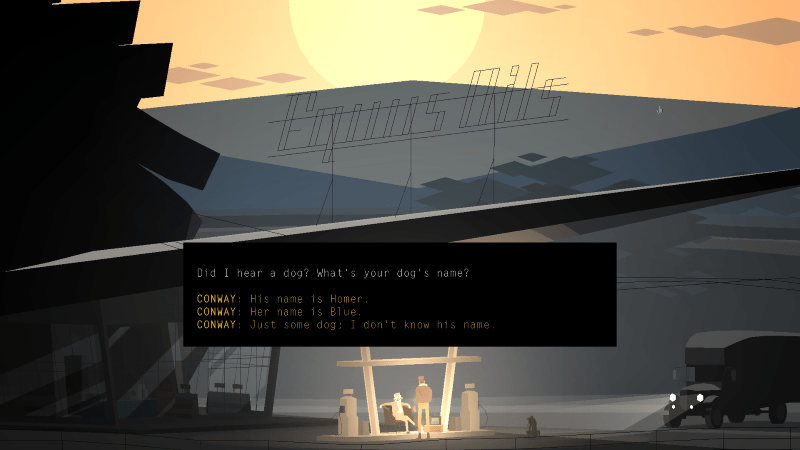
It’s got great visuals and music, though that’s not why I think it’s worth playing. It’s worth playing because it does some very creative things with game narratives that only games can do. A lot of games, even very beloved ones, imitate movies for their storytelling; one-sided projections of the story to the audience. Kentucky Route Zero appears to do that until the first time you talk with an NPC. It shows you what to prepare for by introducing your dog.

KRZ

It’s a simple, apparently meaningless choice. When you pick a name for the dog, a short blurb about the dog’s personality follows, and for the rest of the game, that’s the dog’s name and personality. Later, it comes up again, only you already know the dog’s name and whether or not the dog is friendly towards other people you meet is no longer your choice.

It’s a really simple concept as shown here, but it slowly gets deeper. When talking to NPCs, I can pick which conversation options tell which parts of the story I want to tell. It gets more complicated when I’m getting to choose what both sides of the conversation are saying, or even what multiple people in my slowly growing party have to say and when. Who interrupts whom, and who’s quiet while the others talk?

Eventually people will ask about your motivations, and this can lead into entire varied asides and different sorts of paths and conversations based on what you choose to say. At one point, I was helping set up a TV for someone, and at a certain point I could reminisce in a couple different ways about my parents and how they felt about TVs, or I could brusquely say “I know how to set up a TV”. I chose the latter, favoring action and displays of competence, and I was able to set up the TV without help. Later, a similar conversation came up and I opted to comment about my background as a mechanic and fix what needed fixing, rather than talking about it. The min-maxer in me enjoyed being able to just be good at whatever I wanted to say I was good at.

Some time later, two of the characters talked about how standoffish and aloof I’d been as Conway, and that control over the conversation came up again. I could have them argue, or mutually decide they didn’t like Conway, or show compassion.

As the game unfolds, you see more and more of the surrounding story– the colour gets filled in, if you will, but which colours you see vary based on your choices. It tells a very complex, winding story, but does so in a way that lets you explore it– not just the physical space, but the relationships with the characters.

It’s not for everyone, and it takes some excruciatingly weird turns, but the way in which it’s presented is really interesting, and I find myself looking forward to new chapters so that I can see where the story goes –where I can take it– next. It’s an experience I can’t really have outside games, and it shows off what the medium is capable of.

It may not be your cup of tea, but I think it’s worth a look.


Source: Digital Initiative
Tam Suggests: Kentucky Route Zero

A Follow-The-Money Problem

Games journalism. It’s not really about ethics. It’s about money. Shocker, I know.

You can get to the heart of almost any organization’s strengths, weaknesses, issues, and successes by following the money. If you’re looking for motivation of almost any business, follow the money. Specifically, figure out where the money is coming from and where it’s going. If there’s something happening that you don’t like, it’s probably because you are not the part of the group that’s the primary contributor of money to the organization in question.

money

If you’re looking at a company that’s doing things that you don’t like, things that fundamentally don’t align with your interests, it’s pretty likely that you’re not the target audience (and thus not giving them any money) or you’re not the customer, you’re the product. You can rail against this, but no matter how loud you get, it’s not going to change unless the flow of money changes.

The common saying is that money is the root of all evil, which I honestly find to be something of a cop-out. Everyone needs to pay the bills, keep the lights on, keep food on the table, and keep a roof over their heads. These aren’t easy things to do. If you’re looking at a professional games journalism site, something that posts multiple times a day (every other hour? more?) and that you can rely upon for coverage of a large number of events, you’re looking at someone, usually quite a few someones, who need to make enough money to essentially spend all day posting. Odds are good you don’t pay a dime to any games site– most don’t even give you the option. So, you’re looking at something you consume for free, that takes up someone’s entire workday, who needs to pay the bills somehow. Follow the money.

If you’re not paying, someone is, or no one would be writing. So, who would want to give someone money to write about games? First, advertisers, though too many ads and you, the reader, won’t read the site anymore, so getting all your money from ads isn’t likely. Second, game publishers, who want people to know about their games and know that games sites are a good marketing platform. Both of these groups have money and motivation. This is all pretty obvious, but it’s where the whole “ethics” question gets thrown into the mix.

What conflict of interest?! I work here in my spare time.

Is there a conflict of interest when it comes to accepting money directly from the people you are reporting on? Certainly. Pretty much every type of enthusiast press deals with this. Why? Well, what’s the alternative? Gotta keep the lights on somehow, gotta keep food on the table. The relationship pretty much has to run this way because otherwise you don’t have the money to keep the site up. Does this absolve the enthusiast press of the conflict of interest? No, but “real journalism” is going to take a backseat to “paying the bills” any day of the week. Because it’s enthusiast press and not life-and-death reporting, there’s no value in martyring yourself to report on “big issues” because this is entertainment media; “big issues” pretty much don’t exist.

There’s an alternative model that’s been suggested for games reporting sites: Webcartoonists. The vast majority of webcartoonists don’t sustain themselves on their comic alone; it’s a very rare few who can focus exclusively on their work, and they’re almost all solo endeavours. They also post, at most, once a day, usually less often than that. Not counting sponsored posts and reposts, Kotaku posted ten times today (Sunday, May 10). Destructoid posted 11 times. MassivelyOP, a niche site, posted 9 times today. BlizzardWatch, an even more niche site than Massively, posted 7 times. It’s not a coincidence that those numbers are all really close to one another. While a webcomic can update once a day or less to remain relevant, a games site needs to update multiple times a day– in some cases upwards of ten(!) to stay relevant– that’s where the market equilibrium is happening. The model doesn’t seem to work.

I originally planned on making a graph to show this off, comparing today’s pageviews to the number of posts made. Pageviews are relevant because that’s what gets people to see the advertisements and the marketing that funds the site. Your eyes looking at these sites is the traffic that drives revenue (you are the product). However, the divide between games sites is pretty stark. The readership of sites with 10 or more posts versus the readership of sites with less than 10 posts in a given day is STARK. We’re talking orders of magnitude here, it makes for a silly looking graph. I don’t have a complete picture of the data to support this, but I strongly suspect that if a site updated, say, 15 times a day, they wouldn’t see a significant increase past about 10 or so posts. I do have some supporting data, however.

IGN.com updated 32 times this past Sunday. Here’s their Alexa rank:

ign

IGN.com, Alexa ranking

For comparison, here’s Kotaku, with less than a third of their post count:

kotaku.com, Alexa ranking

kotaku.com, Alexa ranking

As a final point, here’s the Escapist, with 4 posts:

escapistmagazine.com, Alexa ranking

escapistmagazine.com, Alexa ranking

These are all pan-media outlets with a focus on gaming. They all have relatively similar curves, with a spike of readers in the last quarter of 2014 and then some levelling off, and all taking a dive in April (as news hits the doldrums). The Escapist is notably even more pan-media than Kotaku, but Kotaku is right in the 500-700 rank, whereas the Escapist is between 4000 and 5000; an order of magnitude. IGN only gains 300 or so rank over Kotaku, a fairly meager gain in absolute terms, particularly for triple the output. I’m not suggesting that post count is the only (or even necessarily the most important) factor in readership, but there’s definitely a correlation, and all of these sites are posting FAR more than once a day or a few times a week.

The difficulty is finding a model that supports the interests of the audience while providing enough income to support the sites themselves. It seems unlikely that readers are going to be willing to pay for access to games news sites– the current games news sites are the old game magazines, which almost wholly died out with the advent of the internet. The audience was more than happy to become the product in return for getting content for free.

Cory Doctorow in his hot air balloon

Cory Doctorow in his hot air balloon

The other model I’ve seen is the very egalitarian, very grassroots “bloggers can be the new games journalists”, suggesting that the content created by bloggers, in aggregate, can cover the news and be honest and reader-oriented about it because there’s no real money in it for them. It’s the same concept that drives the idea of twitter-as-international news. I’m not sure if it can work; the idea of crowdsourced reporting is still really young and I suspect there will be barriers to entry put in place by both existing games sites (who want exclusive coverage) and game publishers themselves (who want to be able to control what people say about them). It’s definitely a problem with the Youtube scene by most reports– people either allow themselves to be bought or are shut out.

I’m not sure what the future of games reporting is going to look like, but I think the first place to look to see where it’s headed is the flow of money. You can boil a lot of things down to a follow-the-money problem, and if you figure out how that flow is working, you can get a picture of how it’s likely to change and what would need to be different to get what you’re looking for.

I suspect that a site with no advertising, that charged a $10/month subscription fee and managed to get a critical mass of readers would deliver some really top-notch reporting, but I also doubt there are enough people willing to pay for that.


Source: Digital Initiative
A Follow-The-Money Problem