Systems vs Story, and PvP

I’ve put a bunch of time into Archeage over the last week, and it’s been interesting to see what that game is doing systemically vs narratively. Archeage is, at the meta level, a sandbox within which you can forge your own path. What this means is that there are massive systems in place to give you things to do. By necessity, this means that the narrative takes something of a back seat. There’s limited time to make a game, so you lose some fidelity in the process.

ArcheAge_Logo

Archeage quests fall into a handful of categories: “main story”, “local area”, “travel”, and “busywork”. These are in descending order of quality– the main story quests have voiced cutscenes, a focus on story, and (generally speaking) interesting mechanics at work. The “local area” quests are the side stories, the location-based “what’s going on in this specific area” quests that you’re used to from WoW’s hub-and-spoke model. Travel quests are just that– an excuse to move you from one place to another. Often referred to as FedEx quests, these are used to guide people to the next bit of relevant content, so you aren’t lost and wondering where it might be worthwhile to go next. The last set of quests, the busywork quests, are the straight “kill X” quests– go here, fight mobs, done.

I mentioned that Archeage is a systems game, and you can see it in how their quests are delivered. The “busywork” quests, where you just go out and kill mobs, tend to come from bounty boards or are “hidden” quests– you hit the bounty board (which is a daily) and go do your fighting, and as soon as you kill your last mob, you get the rewards and can move on, no going back to a questgiver and unnecessarily chatting about how you’ve “done us all a great service by thinning the [monsters] in this area”. The game doesn’t waste time with unnecessary storytelling, focusing those efforts instead on the stories it wants to tell. These aren’t always amazing, but they tend to be worth reading. I’m legitimately curious where my main story is going, and I’ve had a few quests in areas that make me want to know more about the world.

archeagebountyboard

That having been said, in terms of pure quest content, Archeage is lighter than many games– by cutting out unnecessary storytelling, it also removes a lot of story content that would be in other games. This is where the sandbox comes in. A game with a lot of interlocking systems that are all working in tandem becomes a story engine; your experiences with the systems become stories you write yourself. It’s also where the PvP comes in, and why it’s important. Almost everyone I’ve talked to that has avoided the game cites “open-world PvP” as their reason not to play. Given the kinds of PvP experiences you get in games that aren’t systemically driven, this is wholly understandable. A lot of people hear “open-world PvP” and imagine wandering around flagged in Stranglethorn Vale, where they’re at risk of being killed at random for some other player’s jollies, and possibly camped and griefed as well, because it provokes a reaction (and given WoW’s mechanism for rezzing, is very easy to do).

Here’s why good systems matter: In WoW, when you die, you have to run back to your body as a ghost and resurrect at low health and mana, then spend some time recovering, or you resurrect at a graveyard at a severe “convenience” penalty. If someone kills you in PvP, in the open world, they are almost certainly assured a second kill if they simply wait around for a bit– the death system and the PvP system are aligned such that this is not only possible, but easy and rewarding. This is systemically rather bad. Compare to a game like Archeage: You die, you are returned (whole!) to a graveyard, and given a significant (10%) stat boost as a pick-me-up after death. Graveyards have a “safe zone” around them, so you can resurrect and restore yourself even if your killer(s) are standing around. You can teleport out of the area and there’s nothing anyone can do about it. Rather than death and PvP being disconnected systems, they interlock in such a way as to minimize grief.

archeageportal

To tie this into the storytelling, we can look at those FedEx quests. One extremely popular activity in Archeage is running trade routes. You create a bundle of trade goods and carry them to a different location than you made them in to sell. Some areas want different trade goods than others, and the farther you travel to deliver the goods, the better the reward is. Furthermore, there are significant systems built up around this mechanic– multiple types of vehicles exist to help you cart around goods, and simply carrying goods around slows you immensely, so while you’re carrying a trade pack, you’re vulnerable. You can put down a trade pack at any time, anywhere in the world, but other players can steal it if you do so. As a result, there are different kinds of trade runs: reliable but low-paying ones that run through safe territory and lucrative but dangerous ones that deliver across long distances through contested zones. These are FedEx quests, delivered to you without even quest text for context, and in a game like WoW or FFXIV, they would be incredibly boring. You’d autorun from one location to the next and resent the game every step of the way.

In Archeage, there are decision points to be made. There’s risk in a simple delivery, which makes the event more interesting. The systems in place in the game turn a boring delivery quest into an event that’s both repeatable and potentially interesting every single time. They also bring players together: some groups run trade caravans, bringing large groups of armed players to defend a big group of traders, often covering very long distances for maximum rewards. Smaller groups of players may travel in groups, one or two traders with an armed escort.

tumblr_inline_ndszz9VCF21t1vjhq

This also builds a reason to PvP, rather than just for jollies. It *can* happen anywhere, but because there are good reasons to do it, it’s pretty rare for it to actually happen anywhere. To put it another way, in 25 levels, I have seen precisely zero PvP. There’s no one griefing newbies, there’s no one waiting on the road to gank someone twenty levels below them, nothing. There’s no reason to do so, not when you could be getting real rewards elsewhere.

I’ve often commented that I feel like WoW has poisoned the well on a number of gameplay mechanics– certainly the latest difficulty with flying mounts should say something about how you need to come up with a system for things, rather than just “hit a button, fly wherever you like”. Flight in WoW has serious problems; it’s essentially a GM cheat code that every player gets to use. There’re no systems governing its use, no skills to pick up or decisions to make: just hit button, fly effortlessly. Now they’ve realized how much of a problem that is but can’t throttle it back; their playerbase is raging over the suggestion that they might not be able to have GM cheat codes anymore.
Gms

It may seem frustrating to put friction in a system, but it’s that friction that makes the environment that much more compelling, and makes even little things meaningful and interesting. PvP is just a system, it’s effectively that wandering Devilsaur that you didn’t see that aggros you and kills you. The difference between good PvP and bad PvP is what happens next. What do you lose, besides time? What can you do to prevent it happening again? If, as in WoW, the answer is a catch-22 between “take a 10min break with an awful debuff” or “get corpse camped”, that’s a bad decision. If you can more easily wipe your hands clean and move on, it’s that Devilsaur– just say “welp” and move on. You might run into another one again, but it’s unlikely to become a permanent fixture in your playtime.


Source: Digital Initiative
Systems vs Story, and PvP

AggroChat #61 – Bloody Happy Place

ARCHEAGE 2015-06-14 01-03-43-47

Tonight we are down a handful of people with Thalen and Grace being gone, but by that same token it is mostly a cast of original AggroChat folks.  Kodra is back from his traveling and it was awesome to get to spend the night hanging out with him again.  We have all been spending quite a bit of time in ArcheAge as we have been taking a break from Final Fantasy XIV right before the launch of Heavensward.  We talk about our further impressions of the game, and Kodra talks about his since he quite literally just started today.  From there we talk about our expectations for the coming launch of Heavensward and how Ashgar and I apparently have enough faith in the release of this expansion to have taken the day off work.  From there we meander into talk about the upcoming Four Job Fiesta, and how all of our listeners should really take Ashgar’s money, since he has put up $5 for every AggroChat listener to defeat the game during the event.  There was talk of Wildstar and Tam injuring himself, but we had a grand time just chatting about the games we had been playing.

As promised in the podcast… I now give you Kodra as Fred from Scooby Doo…  he does it so perfectly.

KodraAsFred


Depth vs Breadth

In one of the very early computer science courses I took, the concept of a “depth-first search” vs a “breadth-first search” came up. It’s something that stuck with me, not because I’m deeply invested into search functions, but because it struck me as a good metaphor for how to approach life.

traversal

I am not highly skilled at terribly many of the things I do. I’ve very frequently been second- or third-best in competitions I’m serious about, rarely cracking the top of the charts despite the effort I put in. In my FFXIV raid, I am not the best healer, or the best DPS, and certainly not hte best tank; there are people who are far more focused than I am in all of those categories. I can, however, competently do all three. I have regularly swapped between the healing and DPS roles so much that I’ve lagged behind in gear quality compared to others, simply because I’m splitting my focus. Despite apparent evidence to the contrary, I’ve tanked Coil raid content and extreme-mode primals; my avoidance of the tank role is more an affectation at this point than anything. I’m not the best at any of these roles, or even necessarily great, but I can do all of them and I lean on my breadth of knowledge to give me shortcuts.

Kodra sometimes likes to talk about his experience trying to surpass me as a rogue in World of Warcraft, while we were raiding. I was able to regularly and easily put out the most damage of the group at very low risk. This has (not incorrectly) been attributed to my weapon choice– having done some testing, I used a dagger in my off hand as part of a sword-based specialization; counterintuitive at best, suboptimal at worst. It was a specific dagger I used, that essentially let me exploit a particular effect that was rather redundant if the dagger was the primary weapon, but unlocked some obscenely powerful chains if it wasn’t. Where I got the idea from was a discussion I’d read about warriors, a class I didn’t even play, that was talking about the value of accuracy (+hit%) for generating their combat resource. If I could hit more often, I could deal significantly more damage, and one of the special properties of the dagger is that it could, on occasion, cause me to hit perfectly for a very brief window. I focused on my accuracy, getting more of those hits to land and getting the dagger to work its magic more often, and I skyrocketed to the top of the charts, not by becoming a better rogue, but by becoming a better warrior.

100845felstriker

Kodra is nodding right about now, but there’s a second half of this story. One of our other rogues spent months trying to imitate my playstyle and finally got the (admittedly extraordinarily rare) dagger to drop. For him, it was a disaster. His damage spiked, but it was unreliable and he would do too much damage, pull the attention of whatever enemy we were fighting, and wind up in the dirt… or the dagger wouldn’t trigger often enough to be worthwhile. He found it very frustrating, and fairly quickly shoved the dagger in the bank and never looked back. What he wasn’t doing was the other half of my strategy. Even though I didn’t play other classes, I made an effort to understand what they were all doing in various fights. I knew when our tanks had plenty of control over the fight and when they had less, I knew when our healers had spare cycles for raid healing and when they didn’t, and I knew which transitions were touchy and which weren’t. I ruthlessly exploited these, often taking unnecessary damage or stacking a debuff further than I should have, pushing harder when I knew it was safe and pulling back (and often, slightly to the side if there were other overzealous rogues around) when it wasn’t. A statistic that was frequently brought up was the number of deaths in the raid– how many times someone had pushed a little bit too hard and failed. What was much less frequently checked on was the amount of damage taken per death. I very rarely died, but I took enormous amounts of damage: far more than almost any other rogue in the group. I knew when healers could afford to heal me and when they couldn’t, and when they could I put myself in harm’s way to keep on the enemy.

I never mastered rogue rotations or timings or specific boss strategies. I relied in instinct and a wide breadth of knowledge about when and how to run risks. Often, this breadth of knowledge acts as a surrogate for depth of experience, letting me pull ideas from many unrelated places to solve a particular problem.

Infinity-4

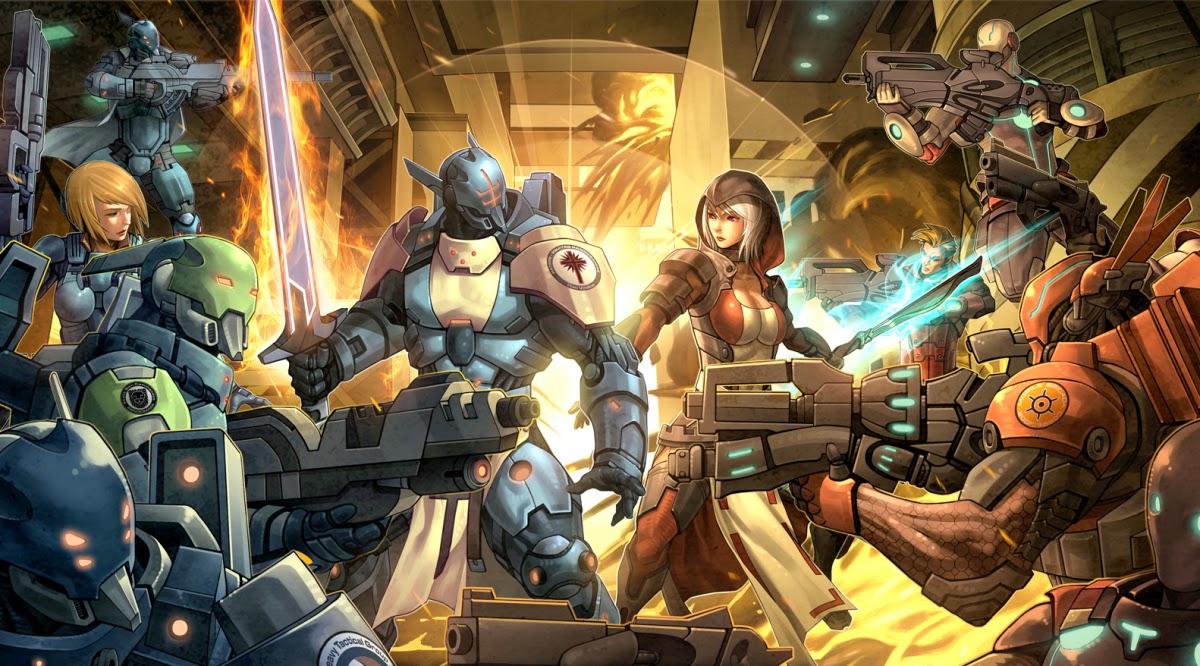
One of my favorite games is Infinity, which makes it easy for me to amass a wide breadth of experience. I’ve rarely if ever played the same list twice, never spending the time and effort to master a particular build, but being able to draw upon a very broad knowledge of the game has given me the ability to take almost any list I run and perform fairly well with it. I still fall short when I face players who are highly skilled and focus and refine a single list to a honed edge, but I’m not so far behind them that I can’t acquit myself respectably.

It’s a large part of the reason I don’t have a lot of patience for bullet hell shooters. They demand a tight, specific focus, that you memorize patterns and execute them. There’s no room for instinct, no room for ad-libbing, and no way for me to draw a breadth of skills in. They’re the antithesis of how I learn and operate, and I have a huge amount of difficulty with them. Fighting games are similar, asking for a very specific focus and a certain amount of depth in specific skills.

Sai_touhou_motivator_1

When I’m in charge of a group, I tend to surround myself with people who focus on depth. They’re almost always better at me at the things they choose to do, and it gives me opportunities to learn from them. I benefit both from the depth of their skill and the shortcuts I learn that add to my breadth of experience. Little things fascinate me: how gestures in other countries differ from the ones I’m used to; which turns of phrase in English have analogues in other languages, and how the meanings change; how a tank builds threat and when; where healers prefer to stand relative to everyone else. These little things all give me perspective, so that no matter what I’m doing I can pull in *something* to build on whatever I’m working on and imitate depth.

This habit is something that’s bothered me a lot in the past. I would look at any individual thing I did and be frustrated that I wasn’t better at it. I could be good– good enough that people would respect my abilities, but rarely the best. It took me years to see the bigger picture, that I was good at a lot of things, and that even if I wasn’t the best in any single one, in aggregate I had a very broad skillset and knowledge base. I’ve never been a depth-first person; until something hooks my interest or makes its value apparent, I don’t drill down and focus on something (though on occasion I have done this).

I've caught myself thinking this.

I’ve caught myself thinking this.

I don’t have a particular conclusion to draw from here, just a meditation on how I think and the kinds of things I focus on. I think a source of frustration for me lately has been that I’ve had few opportunities to expand the breadth of my knowledge, partly due to a lack of resources and partly due to a lack of opportunity. I have a new appreciation for the classwork I’m doing and the perspectives it exposes me to; it’s an opportunity that I relish, and in this lull between quarters I quickly find that I miss it.


Source: Digital Initiative
Depth vs Breadth

Whitespace

A friend of mine made a comment recently that really resonated with me. She commented how she found it frustrating that J.K. Rowling was being asked to “clarify” things about the Harry Potter world, and how asking for that kind of clarity devalued imagination.

241153480-30235112

It’s a thought that’s stuck with me. I think about the stories I’ve gotten deeply invested in, and I realize that so many of them leave questions unanswered, little details left up to the imagination. If the story and setting are rich enough and robust enough, the actual story told feels like a snapshot, a thin line cutting through a much larger unwoven tapestry. All of this blank space leaves room for the imagination to play, where you can tell stories to yourself or other people about what’s going on in that unseen space. Sometimes this is just your own thoughts on what’s happening over there, or a conversation with a friend. Sometimes it’s more involved: some fanfiction, a fan film, Knights of the Old Republic.

I’ve thought a lot about the settings that really hook me, and they’re often ones where I can feel the story spiraling outwards, beyond the bounds of the actual narrative. In media studies, we refer to that ‘actual narrative’ as the text of the work, the actual, literal words and scenes that are happening on the page, or on the screen, or through whatever medium. That uncharted territory that gets filled in by your imagination is whitespace, a blank canvas for you to fill in your mind, based on the snippets given in the text.

I’ve been watching a lot of anime lately, and it’s striking to me how much whitespace most anime leaves in its worlds. Even very simple worlds are explicit about the scope of their stories, and generate lots of little questions and curiosities that go unanswered– by design. It’s a stark contrast to the way western media does things. We want to know the answers, we want those answers to be the right ones. An offhanded comment by an author about what she thinks might happen off-camera sparks a searing argument, and can drive people from a formerly beloved property. I know many people who were driven away from Star Wars by the prequels. Too much was explained in unsatisfactory ways, and it tainted what had come before; it filled the whitespace when it didn’t need filling.

I think a lot of this was the appeal of early MMOs, and some of what drove that deep attachment I and many others formed. The low fidelity of the storytelling and the world itself left a lot of whitespace for us to fill in our minds, that we could directly play a part in. Even before I started seriously roleplaying, I had an image in my mind of my character– one-dimensional and not fleshed out, but there was a faint persona there that was me filling that whitespace in a small way. In Vanilla WoW, the storytelling was a little more explicit, enough to give me hooks around which to build a fully realized character, and the things I did weaved in and out of the narrative I’d come up with. I felt attached to those characters, enough that I can still tell stories about them, rather than stories about myself as a player.

563560_830575457968_770960531_n

I find myself sometimes wanting to know too much about a setting, wanting to fill in that whitespace until I’m satisfied that it’s full and “correct”. Sometimes I’m able to do this, and my interest in that setting drops off dramatically. There’s no more room for my imagination to play, and the world seems small. With MMOs, I’ve often felt constrained by the story being told. Rift is a really good example in my case– the introduction of the game establishes a very specific, narrow path that says a lot about my character and his or her background, and separates me from the world. I’m important to the game’s story, but only in the context of me performing heroics and stopping threats; I don’t really belong in that world. As our fidelity in MMO storytelling has risen, we’ve gotten more specific and more personal with our stories, and in so doing we reduce the whitespace we have to play in, and lose that hook that keeps us invested and attached.

It’s been ages since I’ve played an MMO that I’ve seriously roleplayed in, and it’s telling that my attachment to various MMOs has dropped off dramatically. There are other reasons for it, but in the past few months those reasons have evaporated and yet I haven’t returned to one of my favorite hobbies, despite having both the time and the mental energy to do so.

WoW-server

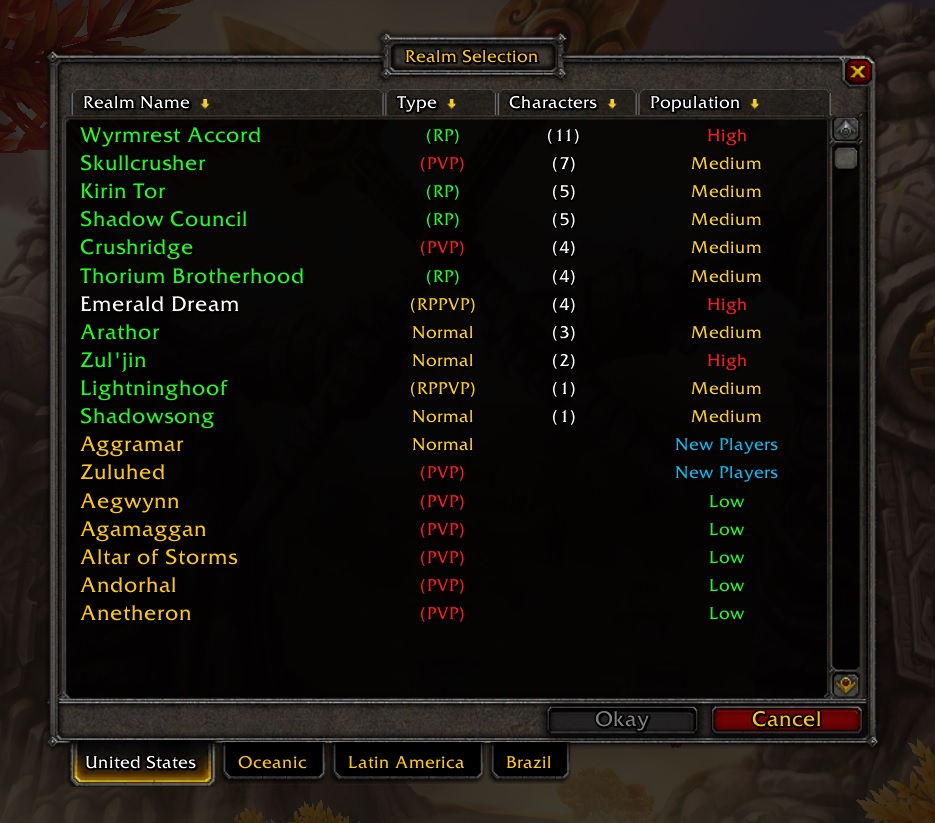
I understand why, from a business standpoint, a lot of MMOs have stopped giving servers explicit “RP” tags, but it’s something I dearly miss. It gave me a space where I knew I could play and fill in that whitespace with my own thoughts. I made a special effort to roll on the (unofficial) RP server in Archeage, just because I think I want to try to find some like-minded folks. I’m a bit worried that I’m coming into things too late to really take part, but the possibility is there.

I like my worlds large, full of uncharted space with stories that are never “officially” told. It sparks the imagination and keeps me thinking about what might be happening elsewhere in that world. I think that’s a big part of why Harry Potter was such a big hit– it painted a small picture of a world that was much, much larger than what you got to see. There were little hints that there was a lot going on that was never explicitly told, so you could fill in those blanks yourself. It’s a world full of stories, in which Harry Potter himself is a relatively small part. It’s a good world, because it’s big. We don’t need that whitespace filled– in fact, it’s better that it’s not filled.

Pursue the stories untold, paint your own pictures in that blank space. Fight the urge to fill it up and make the world you love small and cramped.


Source: Digital Initiative
Whitespace