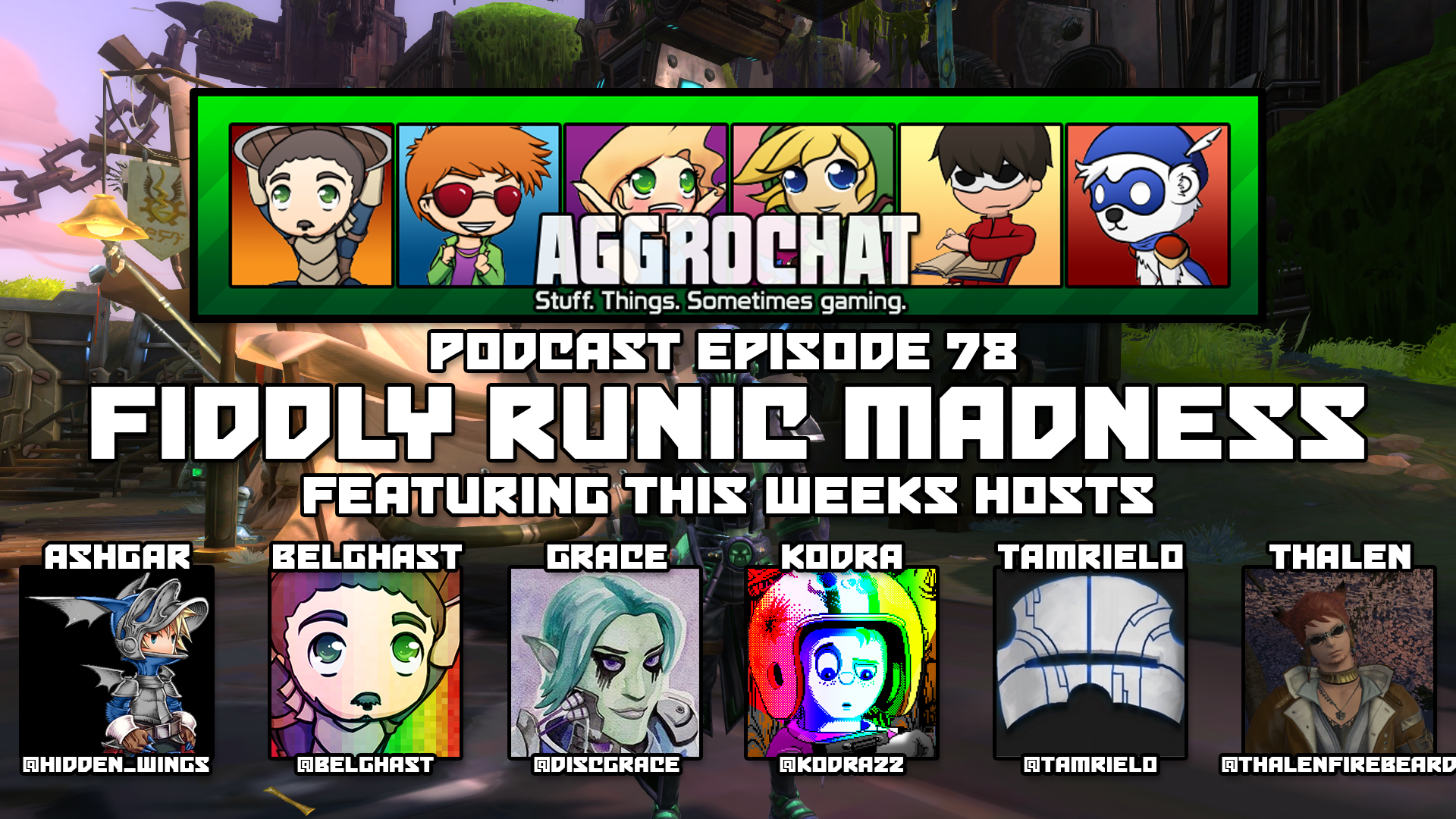
AggroChat #78 – Fiddly Runic Madness

aggrochat_episode78

This week we once again have the full AggroChat crew, and a long list of things to discuss.  The challenge with every episode however is always coming up with a title, and this weeks honor goes to a lengthy discussion we happened to have about the new rune system in Wildstar.  We could however just as easily given this a Star Wars title because we spent a huge chunk of the game discussing various pieces of that universe as well between Star Wars the Old Republic, Battlefront, X-Wing Minatures and our upcoming Star Wars pen and paper game.  The show ran a little long, but we had what felt like a bunch of interesting conversations about lots of different games.

  • Star Realms
  • Star Wars Battlefront
  • The Beginner’s Guide
  • Undertale
  • Eighty Days
  • Wildstar
  • Secrets of Grindea
  • Star Wars the Old Republic
  • X-Wing Miniatures Game
  • Fallout New Vegas
  • Marvel Heroes
  • FTL
  • Mega Man Battle Network
  • Star Wars Pen and Paper
  • Destiny
  • Rockband 4
  • Playstation 4

SWTOR Class Story Reviews (Part 2)

More on SWTOR class stories today, as I finished another one last night which gives me a nice grouping to work with. I wanted to talk about these thematically, starting with the “member of a military organization” pair, because I think they work well as story pairs. Part of this is the duality of Republic vs Sith, but really I think it has to do with source material and inspirations.

SWTOR Class Story Reviews (Part 2)

For this part, I want to go into the Sith Inquisitor and Sith Warrior stories. These two have the clearest source material– Emperor Palpatine and Darth Vader, respectively, and I feel like they live up to their inspirations in interesting ways. They’re also two stories written VERY differently, which I want to talk about a bit, because it’ll come up later when I’m less kind about a particular class story. As before, expect spoilers here.

Without further ado:

SWTOR Class Story Reviews (Part 2)

SITH WARRIOR

Sith Warrior is, among other things, a story about privilege. You start as an acolyte who is sped through the Sith training process, handed everything on a silver platter, and disliked intensely by your rival, who by all accounts worked hard to get to where he is. From here you move to being the favored apprentice of a powerful Darth, given both free reign and high-profile assignments.

Your first three companions exacerbate this– Vette is a former slave, Quinn is bound by military discipline, and Jaesa is wrapped up in Jedi teachings. You have none of their limitations, which is the source of both their interest in you and conflicts between you and these party members. I bring up companions here because the Sith Warrior’s story is bound into its companions more than any of the others I’ve played. The entirety of Act 1 is a lead-in to Jaesa– you first hear about her at level 13 or 14, and finally acquire her as a party member around level 30, as the crowning finale of Act 1. You are Darth Vader, tempting Luke Skywalker over to the Dark Side, and it takes quite a bit of doing.

This Darth Vader throughline lasts throughout the entire story, and it’s great. You get a lot of moments that feel like you’re a powerful Sith Lord without taking directly from any of the movies. What I get a lot of from the Sith Warrior storyline as well is a sense that my choices matter. Of all of the classes, this is the one I’m most likely to play a second time, because the variance between the Light Side and Dark Side feels pretty significant. Depending on how far to one side or the other you are, the outcome of Act 1 can change drastically, giving you a literally different Jaesa depending on what your choice is.

SWTOR Class Story Reviews (Part 2)

Act 2 moves in a different direction, with you working to turn the cold war between Republic and Sith into all-out war, at Darth Baras’ direction. You’ve gotten hints all through Act 1 that Baras has plans within plans, and in Act 2 it starts to become apparent that not only is he manipulating the two sides into war, he’s also using the conflict to push his own agenda. Your role in this is eliminating key Republic officials to get the ball rolling and ensure the Sith have a strong position, and by the end of Act 2 you’ve openly gotten a war started, and fought alongside another of Baras’ apprentices to eliminate Baras’ superior and propel him onto the Dark Council. Throughout all of this, Baras is more and more open about how much of a pawn you are, up to and including taking credit for your work when you’re not around. For all that he’s given you, it’s the point where you start to resent him.

Act 3 ramps this up: in your very first mission you’re set up and left to die in a bombed-out cave. It’s blatant that Baras is behind it and expect you to have died, and this Act centers mostly around revenge. You’ve dealt with/heard about a lot of people who have a bone to pick with Baras, and in this chapter you’re working with them to bring down your former master. The timing here is great. Right at the point where you’re tired of taking orders from Baras, you start working against him directly. In this chapter, a bunch of Sith mysticism stuff starts to come into play, but it’s an extremely light touch. Mostly you’re disrupting Baras’ power base, so the details of the mysticism he’s employing aren’t terribly important insofar as you can ruin it.

SWTOR Class Story Reviews (Part 2)

One of the things I like a lot about Act 3 here is that it inverts a lot of what you’ve gotten used to in the rest of the story. Throughout the storyline’s first and second acts, you land on a planet and get immediate respect and obedience from everyone you talk to, because they’re afraid of Baras, if not you. Starting in Act 3, you no longer have that buffer and people will openly defy you, forcing you to take other routes. It’s a bit of friction that works really well in the story and drives home that underlying theme. No longer propped up by the system, you start working outside of it to get your goals accomplished.

There’s a note about the Sith Warrior that I want to make before moving onto the Inquisitor. This storyline, despite being about a lightsaber-wielding Sith Lord in a Star Wars game, is a fully fleshed out story on its own. You don’t need to know anything about Star Wars to appreciate the story, it stands on its own without the trappings of the setting (much like the Agent and Trooper stories do). Put another way, it’s a good story that happens to be in the Star Wars universe, not good Star Wars that happens to be formed into a story. Moving on:

SWTOR Class Story Reviews (Part 2)

SITH INQUISITOR

This is a fascinating story when compared to the Sith Warrior, because it’s the opposite in many ways. You start as a slave, who happens to have a talent for the Force and thus gets shuttled off to be a Sith acolyte. Whereas the Sith Warrior is handed success on a silver platter, the Sith Inquisitor is set up for failure from the word go, with an overseer who is openly prejudiced against you and is trying to keep you down. It’s a stark contrast, and when you get matched up with a Darth, there’s the distinct impression that it’s because of your perseverance in the face of adversity, not your raw awesomeness that overcomes your flaws.

Whereas the Sith Warrior presents you with a position that you can be proud of, with others fearing and respecting you, even once you’ve made it as the apprentice of Darth Zash, you’re still criticized and disrespected by other Sith. Zash isn’t as feared or respected as Baras, and as her apprentice you’re even less respected. As a point of comparison– when you first land on Dromund Kaas as a Sith Warrior, you’re met by a groveling servant whose biggest fear is that you won’t tell Baras he did well. As an Inquisitor, your welcome is a face-to-face with another Darth, who threatens you and then laughs in your face if you speak up against him.

SWTOR Class Story Reviews (Part 2)

Act 1 of the Inquisitor storyline is all about setting the groundwork for a ritual for Zash. Unlike Baras, who is pretty clear in his authority, Zash is almost cloyingly sweet to you unless you back-talk her directly, and you’re warned multiple times, sometimes explicitly, that Zash is going to betray you. This starts early, before level 20, when you wind up in a tomb facing an ancestor of yours. As it turns out, you’re the ancestor of an old Sith Lord whose ghost is interested in maintaining its legacy through you, and helps you out through the story. He warns you first of Zash’s impending betrayal and while you’re working through setting up for Zash’s ritual (which she promises will make you incredibly powerful), he’s providing you defenses against her. Ultimately, when the ritual occurs, it turns out it was a possession ritual– Zash knows you’ll be more powerful than she is so seeks to possess your body, combining her knowledge and your talent. Instead, she winds up possessing one of your companions. More on this a bit later.

The “communing with ghosts” theme runs through the story, and it’s one of the most-criticized aspects of the Sith Inquisitor storyline. Frankly, I think it works– the idea that you’re digging for more power through ancient mysticism is a pretty reasonable one, and since you can’t take power the usual way because the system is keeping you down, you take a more obscure path.

Act 2 of the Inquisitor storyline is about gaining power. Zash’s power play attracted the attention of another Darth, a hyper-traditionalist who seeks to discredit and dishonor Zash and eliminate her entire power base as a posthumous punishment for her arrogance. This includes you, and the start of Act 2 is this new Darth, called Thanaton, trying to get you killed. When this fails, you return and fight him directly and he beats you down pretty thoroughly, using powers you have no real defense against. Act 2 then becomes about finding defenses against Thanaton’s powers, which in this case involves enlisting the aid of other spirits beyond your ancestor. Essentially, you’re taking an extreme shortcut to power by robbing the dead.

SWTOR Class Story Reviews (Part 2)

It’s at this point that I want to go off on a tangent and talk a bit about the Sith Inquisitor’s companions and supporting NPCs. The companions are (unfortunately) mostly forgettable, and you’re stuck with your first one for quite a while. This companion is a big monster in a loincloth who is disagreeable, talks down to you, and ultimately winds up getting possessed by Zash, which both he and she resent. This companion represents my biggest criticism of the Sith Inquisitor storyline, which comes up a lot. Your first companion, Khem Val, is something called a Dashade, which is some kind of Force-resistant something something Sith assassin something something ancient Sith Lord something. It’s a one-shot of obscure Star Wars lore that’s largely irrelevant to the story but feels like a reference to some obscure piece of Star Wars mythos. This kind of thing litters the Sith Inquisitor storyline, and I think leads to the “ghostbusters” critique you see a lot. On the other hand, a lot of the incidental people you meet on various planets are rather important to the story and quite interesting, and you return to them quite a bit in Act 3. I particularly like the cult you start as a quick route to acquiring an artifact, which keeps returning and being relevant later on.

While the overall arc for the Sith Inquisitor is very good, it suffers from a lot of these one-shot lore bombs, where you’re told about some obscure bit of Star Wars backstory whose only relevance to the story is that it’s the next thing you’re going to go collect. As a result of this, Acts 1 and 2 can feel like a long fetch-quest with some interesting bits laced throughout, because really you’re just going and acquiring ancient power for the first forty levels or so. It boils down to “go to planet, collect artifact/ghost” six or seven times in a row, making the first two arcs feel very repetitive if you aren’t bought into the lore. If you are bought into the lore, it’s a cool lens into some obscure Star Wars mythos, which is where I draw the distinction between the Sith Warrior and Sith Inquisitor storylines. Sith Inquisitor is a bunch of good Star Wars lore mashed together into a story, rather than a good story set in the Star Wars universe.

SWTOR Class Story Reviews (Part 2)

This changes in Act 3. Having proven that you can stand up to Darth Thanaton and survive at the end of Act 2, Act 3 is about consolidating your powerbase and facing Thanaton for good. There’s a bit of a snag, though, in that your extremely quick route to power is destroying you. While fending off Thanaton and building a solid powerbase, you’re trying to find a cure for the degeneration your stolen power is causing. This takes things in a new direction, where rather than acquiring tchotchkes, you’re following vague hints and scraps of lore for notes. The thread of “obscure Star Wars mythos” continues in this chapter, but it’s directly tied to the story and completely relevant, so they feel a lot more meaningful. Effectively, you’re seeing a technological and spiritual cure for your condition, and as you do so you’re putting together a front against Thanaton.

The Inquisitor Act 3 is an interesting inversion of the Sith Warrior. Up to that point, you’re kind of disrespected as a Sith and often have to use force to get any kind of consideration. In Act 3, between your powerbase and your increasing allies, you’re taken more and more seriously as a legitimate rival to Thanaton, and get the according respect and assistance you might require. You go from being outside the system and the machinations of the Sith to playing a direct part in them, and your allies and powerbase are helping you the entire way through. You finish the story having earned a place on the Dark Council, which is notably a step further than even the Sith Warrior gets. While the Warrior is a lone badass operating outside the lines, the Sith Inquisitor is a legitimate member of the Dark Council with a network of allies and agents spanning quite a few planets.

SWTOR Class Story Reviews (Part 2)

The big difference in the two that I want to call attention to is that the Inquisitor’s main storyline is possibly the least interesting thing about the class. The writing of the individual planets is far stronger than the overall thread, and the incidental characters you meet are interesting and fun, even when they’re temporary or short-lived. Whereas Sith Warrior has a compelling thread all throughout, Sith Inquisitor has a lot of good moments, even without the thread. Inquisitor’s Act 3 pulls everything together quite nicely, which is also somewhat rare; I tend to dislike Belsavis and Voss on most characters, whereas they’re interesting on the Inquisitor and feel more tied into the class story, as opposed to incidental (they feel INCREDIBLY incidental to the Sith Warrior and Trooper stories).

Of the two, I like the Sith Warrior more, but Inquisitor is also rather good if you buy into the Star Wars mythos it’s built on. I think the use of mysticism is generally fine, but I think Act 3’s direct link between action and lore is stronger than the Acts 1 and 2 lore tie-ins that mostly serve to make it feel like going to a planet and finding some macguffin or another is more interesting. That being said, both deliver on the feeling of being a powerful Vader-type character or a shadowy, schemeing Palpatine figure extremely well, particularly with the payoffs at the end.

The Price of Failure

I’ve been running tabletop games more or less continuously for the last five or six years, and on and off before that. I take my role as DM fairly seriously, and most of my larger campaigns are a few hundred pages’ worth of notes and reference material. A big part of that involves layers of failure– what happens if my players don’t succeed at whatever their goals are at a given time?

The Price of Failure

For all the pages of content, I wind up using about 15-20% of it. To use a recent example, I just wrapped up the first chapter of a Shadowrun game, and I think about a third of the NPCs I created for the game wound up getting used, and of those, a goodly fraction wound up appearing once and never again, not playing an important role in the game. I’m not bothered by this “wasted” work; I leave my games and the approaches my players take very open, and I rarely see a reason to force an NPC on my party if he or she doesn’t make the game more fun and align with the party’s goals. I do my best not to be a ‘railroading’ DM, and I provide story hooks but rarely explicit tunnels. At pretty much any point, my players can say “nope, not going to do that” and they’ll wind up going down some different, alternate path.

I can get away with this because I’m gifted with a group of players who aren’t actively trying to break the game world or intentionally derail the story. I can throw interesting and varied challenges at them and they’ll be taken seriously, but still approached creatively. I haven’t killed a player-character in years. I haven’t needed to, although it’s been close a few times in particularly scary combat encounters. Outside of combat, though, I don’t gun for my PCs– I generally feel like killing a player character is so trivial a job for a DM that there’s no real reason to do it except to curb game-destructive behavior.

The Price of Failure

As an example: I’m not going to kill a PC because the party forgot to disable one of ten security systems, or because a hacking attempt went badly and they got noticed, or what have you. It’s way too easy to create “gotcha” moments where something the party could never have anticipated comes out and kills them. I will cause problems if a danger they should have discovered and neutralized goes ignored, but again, I’m not killing anyone because they overlooked some detail. On the other hand, if I have a party member start openly trying to break the game or turn it into their personal playground to the detriment of people taking the game more seriously, I will and have punished that kind of destructive behavior by killing that character. At one point, I had a player (not in my usual group) make a point of cutting in and mocking every NPC the party talked to. At first, NPCs ignored this, then they started getting insulted and treating the party less well, but this didn’t curb the behavior. Eventually, they ran into a particularly powerful NPC who intended to make a deal with them. She got instantly insulted by the player, gestured once, and the player was cut down by sniper fire, at which point she turned back to the party to continue the conversation.

This brings me back to the concept of failure. I’m unlikely to kill players for failure; that’s not terribly interesting. They may be inconvenienced, but if I’m going to make a legitimately challenging encounter, I think it’s unfair of me to start killing players because dice randomness didn’t go their way in a particular session. Instead, I go down a different story path; failure is interesting, and winning all the time gets dull.

The Price of Failure

What’s interesting to me is that my current party has become highly risk-averse. In the last several games, there’s been a pretty strong reticence to take anything other than the most calculated risks, and any situation in which they might delve into the unknown leads to quick paralysis and inaction. At least in Shadowrun, I feel like the game system is oppressive enough and lethal enough that taking anything but a very carefully measured approach is very dangerous, but I’ve also seen relatively little risk-taking elsewhere. Powerful artifacts are left alone or returned to their owners, dangerous encounters are avoided rather than turned to an advantage, and moving forward without as complete knowledge as possible is rare.

I consider this a failure on my part in two ways. First, I haven’t made it clear enough that failure and death are not synonymous, and that the game will go on (and potentially be interesting with interesting hooks!) even if a particular quest or mission or fight goes badly. Second, I’ve been a little too balanced in my encounter design. I keep very careful tabs on what I know the party is capable of, and I never put them in situations that I don’t think they have a statistically significant chance of winning (75% or more). Combined with my players’ penchant for coming up with clever combos and creative solutions, I haven’t actually seen a failed encounter in quite a while now– there’s pretty much been a string of resounding successes, often well beyond what I expect.

The Price of Failure

As a result of all of this, I’ve started looking into systems that have failure as a built-in mechanic. I always look at Burning Wheel as a compelling system; it creates fantastic stories and has some really interesting character creation and advancement, but there’s a ton of crunch involved and it’s a really impenetrable and lethal system. I think a couple of my players would love it and the rest would get bogged down in the mire of rules.

I’d thought that my group disliked the new Fantasy Flight Star Wars system, which I’d always thought was a pity because it builds degrees of success and failure into the basic dice rolls in (I think) interesting ways. I found out recently that pretty much everyone is interested in getting into it, so I’m excited to give it a whirl. I think the system does a great job of making you feel like your die rolls are more than binary success/failure, and gives me a lot of interesting buttons to push and levers to pull on the DM side. On top of that, it’s not a very lethal game– even losing the entire party in combat isn’t necessarily a death sentence, unlike… pretty much every other game I’ve played.

My biggest concern is that the power level of starting characters in the system is very low. It can be hard to succeed at much of anything on your first try, and you want to work together and try to get bonuses from a variety of sources to try really difficult things. Failure is still interesting and moves things forward, but you are going to fail quite a lot, and the game will keep moving. I’m worried this is going to result in people hyperspecializing, to maximize success in a single given category, and then avoid using that skill at all if the key person who’s “good at it” isn’t around. I may have to do a bit more splitting of the party than I usually do.

The Price of Failure

That being said, the premise is interesting (force-sensitives before and during Episode IV), and I’m excited to see what kinds of characters I’ll be writing for. I have a very loose sketch of the early parts of the game, but I don’t like writing until I know what my players are playing, so I can weave their ideas into the story. I’ll have about a week to start fleshing things out, which should be enough to get a few sessions going.

SWTOR Class Story Reviews (Part 1)

This week I want to spend some time talking about the SWTOR class stories. I’ve played through most of them and should be catching up on the last ones soon. There will probably be some spoilers, so feel free to skip these if you don’t want to hear them. Part of this is going to be recap, part of it is going to be review, and part of it is going to be “what I would have done differently”. It’s worth noting that I think the writing in the main storylines of the game in general is top notch, and while I’m going to be game-dev critical (read: harsh) in some places, I think that even the less-interesting stories are well-written and have some great moments, which I’m going to try to call out.

SWTOR Class Story Reviews (Part 1)

The first two I want to talk about are the Republic Trooper and the Imperial Agent. I want to start with these two because they were the two classes I was the LEAST interested in playing, and I’d heard quite a lot about them. I also want to start this series with some absolutely unmitigated praise. Without further ado:

SWTOR Class Story Reviews (Part 1)

Imperial Agent

Holy wow, this class story. There is some absolutely top-notch storytelling going on here, and for a class I didn’t actually enjoy the gameplay mechanics of, I was hooked through all 50 levels of main story. Even if I don’t come back to it later, it was worth the ride, and by itself was probably worth my resubscription money. I’d play it as a standalone game.

Let me break it down: You are an Imperial spy. The tutorial is a mission in which you pretend to be a notorious criminal (with a hilariously awful American accent) in order to manipulate some behind-the-scenes Hutt politics. It’s a pretty straightforward affair, with you befriending a close contact of the Hutt’s and working with him to clean up some messes and get him looking good for his Hutt master, who wants an edge over his rival, some other Hutt. It doesn’t matter, the main friend you make is this beefy older guy who is happy to have you around and who you are lying through your teeth to the entire time.

SWTOR Class Story Reviews (Part 1)

It’s a great setup, and right around the time you’re getting to like your new buddy, a call comes in from HQ, informing you that an accident has happened to the guy’s two sons and that you need to kill him before he finds out the Imperials caused the accident. It’s the kind of little-detail wrench in the works that tipped me off that there’s a lot of thought put into the Agent story. It forces your hand; you have to either do your job and kill the guy you’re after or set him free, but make everyone think he’s dead. The story changes the op on the fly, and you get a taste of how your support team at HQ handles situations– professionally and effectively, if ruthlessly.

This is a continuing theme throughout the Agent storyline, and it’s extremely well done. Keeping your humanity or being a soulless murderer and liar is a continual question; what are you willing to do for the Greater Good? Each of the planets you land on as an Agent is a separate mission, with its own characters and parameters, and with you pretending to be someone different each time. After a terrorist attack against a Sith Lord and his personal battleship right over the Sith capital, Imperial Intelligence becomes dead set on hunting down the terrorists who did it, which comprises the majority of your Act 1 arcs. Each mission you do gives you bits and pieces of who and what you’re looking for, while you dismantle the terrorist organization in a variety of ways.

The story also starts slipping in suggestions that you shouldn’t trust anyone, mostly from unreliable sources. It comes off as the kind of thing that desperate people would say to make you doubt yourself, especially considering that your handlers have your back pretty much the whole time. It’s a very effective setup, and though you do ultimately find out WHY people are saying this, it’s ambiguous enough that you can still decide if you think they’re right.

SWTOR Class Story Reviews (Part 1)

In the meantime, you dismantle a terrorist organization through a serious of classic spy tropes on various planets. You’re like a mix of James Bond, Jason Bourne, and Agent 47, with plenty of ways to express each of them. Act 1 ends with a bang, giving you one of the hardest choices in the entire game across any of the stories and really making you FEEL the impact of that decision. It seems like it could play out in a huge number of ways, and I only saw one of them. I won’t lie, I’m tempted to play another Agent just to see some of the rest.

After the Act 1 finale, however, I expected the story to take something of a downturn. The “mission on each planet” theme had just about worn out its welcome, and the Act 1 finale was so good I couldn’t imagine the game topping it. I was horribly wrong.

The Agent Act 2 begins with you being inserted as a double agent. It instantly and totally changes your main contacts and the kinds of decisions you make throughout the second arc. You’re working for the Republic while trying not to cause too much damage to the Empire but also not blow your cover… and that’s just the setup for every mission. It turns the structure of the story on its head and hands you several compelling new characters, a few of whom introduce a twist to make you despise them. Act 2 becomes about working undercover while subtly working towards Imperial interests, all while juggling these new, compellingly awful characters who need to believe you’re on their side.

The Act 2 finale, weak for most classes, is surprisingly strong for the Agent, allowing you to finish off your double-agent career and put a stop to the plans of this Republic spy force you’ve been working with. One of them escapes, however, and you realize that he’s much more than just a Republic spy.

SWTOR Class Story Reviews (Part 1)

The third act of Agent is about chasing down this incredibly elusive character, who has given you a ton of reason to hate him. He’s got a ton of resources mysteriously at his disposal and is perfectly willing to use your own past against you. Throughout Act 3, I would get ambushed by the agents of characters I’d dealt with previously, who were tipped off to my location and out for revenge. The looming threat of having my identity publicly exposed was a spectre throughout the third Act, and the secretive spy I was hunting for would frequently call in to gloat, Handsome Jack style. It was fantastically compelling and an absolute pleasure to reach the final conclusion, which is the second most satisfying finale of any class story I’ve played.

I’ve got a lot of good things to say about the Agent, and very little criticism. The biggest criticism I have is that the Sniper subclass is relatively uninspiring compared to the others. It hits hard, and that’s about it. The only other major criticism (that you’ll see a lot of) is that the Agent takes FOREVER to get companions, getting the standard first one on its starting planet then not seeing another until Tattooine. It does, however, have some of the most interesting companions, and while I don’t love all of them, I’m at least interested in them. I just wish I’d gotten them sooner.

SWTOR Class Story Reviews (Part 1)

Republic Trooper

Talk about a class I had zero interest in playing. I don’t go in much for the whole military-dude-in-power-armor thing; I’ve never liked Halo and I have Opinions about Warhammer 40k, so the Trooper seemed like it was going to be dead in the water for me. I was extremely wrong.

The Trooper story begins with a mission on Ord Mantell, a backwater planet. You’re a part of the elite Republic Special Forces, nicknamed Havoc Squad, and you meet the rest of your team, who are all welcoming but not super personable. This is fine, you work with them, work on recovering a nasty bomb, have to make some choices between being dutiful and being humane (the running theme of the class), and honestly this is where Trooper always stalled out for me. The finale on Ord Mantell revolves around your squad betraying you and defecting. You’re the only one left, things have gone pear-shaped, and your commanding officer is Not Happy, and trying to keep the wholesale defection of Havoc Squad off the record.

To this end, the majority of Act 1 is hunting down the defectors. This wouldn’t be so interesting if it weren’t so characterful. You meet a LOT of interesting characters, and make a lot of decisions between doing the right thing and pissing off your CO, who really wants the Mission To Be Adhered To, Dammit. Some of the defectors can be captured, some have to be killed, one even escapes, and ultimately you face off against the leader, whose plan is falling apart thanks to your work. There’re a lot of interesting characters and mini-arcs as you find the various defectors, and I found myself really interested in finding out the stories of the defectors and the people I met.

The strength of the Trooper story is in its characters and in the choices you can make in dialogue; there’s some really funny stuff in there, and the characters are compelling and interesting. I really want to call out the male Trooper romance here. Elara Dorne has a fascinating companion storyline that meshes really well into the rest of the plot, and the romance between her and your trooper has some serious hurdles to get over, due to that whole “fraternizing with a squadmate” thing. More interestingly, it’s not glossed over the way it is in other class stories, partly because of Elara’s by-the-book personality. I really like the resolution there, and the entire arc feels a lot more adult and mature than a majority of the other romances, where the primary conflict pretty much gets resolved at the point both you and your companion decide you’re into one another.

SWTOR Class Story Reviews (Part 1)

There’s a common trope in romances in media where the biggest conflict two lovers face is confessing their love for one another, and that things are pretty much smooth sailing from there. Once the “main couple” is together and settled, it seems, everything else falls into place and most of their interactions revolve around being sappy and lovey at one another. Indeed, most of the romances in SWTOR follow this arc, and there are very, very few examples I can think of where that isn’t the case (honestly, it’s one of the reasons I like SAO as much as I do). The Trooper storyline doesn’t do this anywhere near as much, and the most significant relationship conflicts actually happen AFTER you’re together with Elara. It’s a detail I like quite a bit; it makes the whole thing more believable and richer for me, and less like a “hit buttons, get romance” thing.

Trooper Act 2 is interesting, because it revolves around you bringing Havoc Squad up to full strength to take down an Imperial superweapon. It’s a neat concept, and the character focus switches from hunting down defectors to the new characters you’ll get to recruit. You need particular experts and specialists, and the story takes you to some remote planets to retrieve them. The interesting twist here involves their COs, who often aren’t thrilled to part with the best person under their command and sometimes work against you as best they can.

The Act 2 finale is even better than the Act 1, with your entire squad taking part and you working directly alongside a couple of members yourself to get the mission done. It’s fantastically scripted and makes you feel like there’s a full team effort going on. There’s no Big Bad to deal with here, but there doesn’t need to be, because your team provides the characterization you want to work with. Funnily enough, I suspect this superweapon might be adjacent to the one that appears in the Sith Inquisitor storyline, but I might be wrong.

SWTOR Class Story Reviews (Part 1)

Act 3 is where the Trooper story loses me. It’s analogous to Act 2, in that I’m going from planet to planet to retrieve key personnel, but the personnel in question aren’t characterized as well. It would be a great opportunity to focus on a particular Big Bad, and there is one, but he doesn’t get a lot of screen time, so I’m not terribly interested. It’s a telling rather than showing problem; I’m told this Imperial guy is really bad, but I barely see him and he doesn’t do a lot to convince me I should care.

I feel like the Trooper story would have benefitted from a better throughline connecting the Acts. If the Imperial Admiral in Act 3 had been the contact of the original defecting Havoc Squad, and more closely connected with the superweapon, he could have been sending agents to personally hunt Havoc Squad, which would give him more face time and make him a more compelling villain. As it stands, I’m not terribly interested in this guy other than from the standpoint of “my CO is telling me he’s bad and I should fight him, so that’s what I’m doing because I AM SOLDIER”. Without the compelling characterization or the thought-provoking choices of the first two Acts, Act 3 falls quite a bit short, and even at 12x XP I managed to stall out on Voss for a while.

I wouldn’t have played either of these characters were it not for the rave reviews I’d heard from other people, and I’m really glad I came back to SWTOR to play them. Even if the third Act of Trooper fell a bit flat, the first two Acts were great and Act 3 still has some great moments. Imperial Agent was fantastic from start to finish, excellently written, excellently paced, and honestly worth my subscription fee by itself.