Progression and Achievement

I used to be a bleeding-edge-of-content type. At various points in my MMO-playing career, I’ve pushed hard against the wall of the most advanced content in various games at various times, and I’ve reached a point where I no longer feel the need to chase that. That having been said, I still love the sense of accomplishment of beating something legitimately difficult, even if I’m not doing it the fastest, or the hardest possible way.

ffxiv_08032015_185103

Last night, we beat Turn 13, finishing out the Binding Coil of Bahamut in its entirety. Even at the expansion power level, the final boss isn’t a trivial encounter, and took us more tries to beat than the first section of Alexander (expansion raid content, which we did immediately after T13). Part of this has to do with how shallow the power curve is in FFXIV– we’re not looking at orders of magnitude of power increases for the most part. The other part is that the mechanics of the fight are very, very nasty. Even on “easy”, it will happily wreck you if you don’t know what you’re doing.

What I like about this pace of content is that it keeps everything fun. Sure, we’re not going to be the first to beat everything, but we can and will beat it all, and we’ll do it without burning ourselves out. The only time I’ve been fatigued with the regular raid we run has been when we were bashing our heads against Turn 9, and even that was much less nasty than the severe burnout I was feeling doing Naxx40 in Vanilla WoW, or some of the plane raids as they came out in EQ, or hardmode Soa in SWTOR.
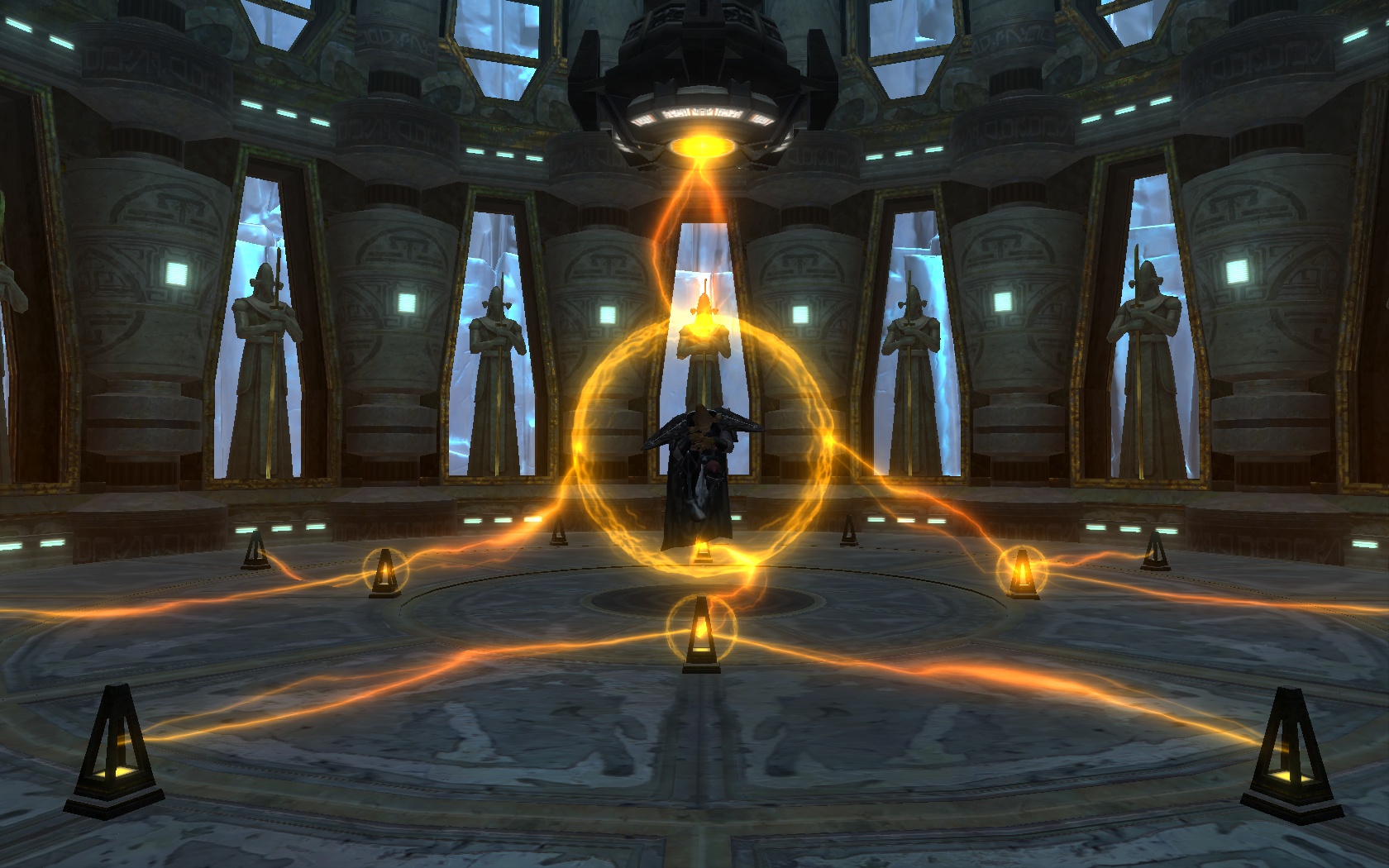
this picture is titled "swtor-soa-bug-fix" which should tell you a lot about the frustrations with that awful, awful fight.

this picture is titled “swtor-soa-bug-fix” which should tell you a lot about the frustrations with that awful, awful fight.

I think a big part of it is that I feel like I’m getting a reward that’s more than an item or a title or an achievement for beating a boss. I’m getting a solid, notable chunk of story. The cutscene following the defeat of Arthas in Wrath of the Lich King is basically par for the course for FFXIV raids; every Coil ends with a cutscene like that, and there are also a goodly number of equally significant ones scattered throughout the progression. I’m getting a big chunk of interesting story that means a lot more to me than a fancy new sword or a piece of armor that will be outdated with the next release.

Indeed, at no point while we were raiding Coil were any of the drops going to be relevant for us. They look cool, and that’s about it; we were never going to see upgrades out of there. I think it helped things, and made our experience a lot smoother and more fun. We did each thing as often as we wanted to, rather than grinding them repeatedly just to get drops to gear up for the next one.
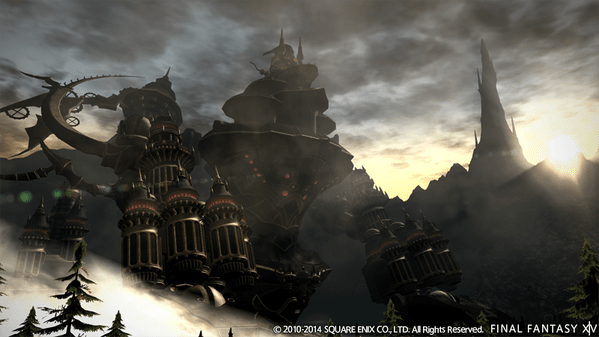
AlexanderInGame

As for myself, I got a little burned out getting my gear level up high enough to take on Alexander, grinding Law tomestones to get upgrades. I haven’t had the desire to log in and grind more dungeons, and I’ve been holding off on raiding Alexander on my own until I can see all the pieces of it with my team. I’m looking forward to new dungeons and new story quests to keep moving things forward, but in the meantime I’m branching out into a few other games. I may make a return to Archeage and muck about with that, although as mentioned before I’ve been fairly deep in SAO: Hollow Fragment.

After a fairly long period of being a bit uninterested in the games I had available to me, it’s exciting to have things I want to play again.


Source: Digital Initiative
Progression and Achievement

Thinking in Abstractions

I’m continuing to work on teaching myself Japanese, which has been a fascinating process. It’s been described to me as an extremely difficult language to learn, and as I familiarize myself with it, I’m starting to understand why.

hiragana-stroke-chart

Japanese is, in a lot of ways, a very straightforward, regular language, with very few exceptions to its rules and a surprisingly comprehensible set of grammatical rules. It’s difficult because almost none of these things map to English. I used to wonder how older (and some recent) translations of games and shows could be so incredibly bad, and I’m discovering that it’s because there’s really no direct translation. As I start to parse sentences, it feels a bit like one of the old Magic Eye pictures, where you have to look at it indirectly to allow your brain to see the hidden picture, and if you try to focus on it too much you lose it.

I can’t translate what I want to say in English directly to Japanese; I have to turn the sentence into an abstract thought, and communicate that. It’s made me a lot more aware of how I construct sentences in English, and I’ve started trying to think of English sentences as abstract thoughts to get a better handle on how to better express myself. In English, it’s easy for me to construct elaborate walls of words, adding complexity and waxing poetic to make a very simple thought seem like something a lot more ornate than it actually is. It’s a tendency that’s made it very difficult for me to learn languages in the past. I’ve made attempts at Spanish, and while I can understand it very well, I don’t have the breadth of vocabulary or understanding of complex forms to translate what I want to say from English into Spanish. Faced with Japanese, a language where I can’t make that translation, I’m finding that relying on my intuition to pick up meaning from sentences is really effective.

JP20130729_4

It makes me think a lot about games and the comfort zones we play in. I had a discussion with a guildmate recently who was intensely frustrated by Summoner, because (as he put it) “you’re always guessing at what you should do next so it’s a constant panic”. He loves rotation-based classes, where he can plan his next moves multiple steps ahead, and couldn’t understand why I, someone who has the same love for planning, liked the class so much. For me it’s because the Summoner playstyle is an abstraction of what a rotation is trying to accomplish– having all of the right things happening at the right times. I’m never guessing at what I need to do next on my Summoner, because I’ve developed a feel for how things should go. I’m not thinking in terms of “this ability, then this one, then this one”, it’s more like “right now feels like the right time to use this”.

Similarly, I watched someone pick up a controller for the first time this past week. He’d been playing games on the PC for twenty years, but had never owned a console. I could see the frustration as he played a game he knew well (FFXIV) via a control scheme he wasn’t familiar with. He knew what he wanted to do, but couldn’t make the buttons respond quite the right way. His intuition about how to control the game was thrown completely off.

ps4-frontview

Both things map to language learning for me. Speaking a new language is like trying to play a game through an unfamiliar control scheme, and understanding it is like making sense of a game by feel. I could, if I wanted, break down when to use every Summoner ability with a clock during a fight, so that you could work out a ‘rotation’ that mapped to when everything needed to be used. It would be like trying to translate through English for every sentence in Japanese– doable, but you lose a lot and you’ll never be as quick as if you can internalize the abstraction and just maneuver by feel.

Different people find different things difficult. I have two friends nearby, both from China. One of them speaks English with almost no accent, but sticks to relatively simply constructed sentences and misses a lot of nuance in other people’s speech. The other has a very heavy accent, but a much broader use of vocabulary and sentence construction, but struggles with making her actual words understandable. I’ve had the opportunity to speak with both of them via text over the internet, and their speech patterns are starkly different– both are very eloquent and have a firm grasp of the language. They’re both playing a game with a control scheme they aren’t yet used to, but taking different approaches.

meiko_texting__kind_of_by_mysterycycle-d60dnla

In the meantime, I’ve reached the point in about two weeks of study where I can almost read hiragana and I can hear the shape of sentences– I can’t understand them, but I know enough to pick up pieces and figure out what the subject, topic, verb, etc all are even if I don’t know what they mean. It’s going to be a long time, if ever, before I can hold myself to the same standard in Japanese as I do in English, but the process is giving me a lot of insight into how I speak in English, and how I can improve.


Source: Digital Initiative
Thinking in Abstractions

Thinking in Abstractions

I’m continuing to work on teaching myself Japanese, which has been a fascinating process. It’s been described to me as an extremely difficult language to learn, and as I familiarize myself with it, I’m starting to understand why.

Japanese is, in a lot of ways, a very straightforward, regular language, with very few exceptions to its rules and a surprisingly comprehensible set of grammatical rules. It’s difficult because almost none of these things map to English. I used to wonder how older (and some recent) translations of games and shows could be so incredibly bad, and I’m discovering that it’s because there’s really no direct translation. As I start to parse sentences, it feels a bit like one of the old Magic Eye pictures, where you have to look at it indirectly to allow your brain to see the hidden picture, and if you try to focus on it too much you lose it.

I can’t translate what I want to say in English directly to Japanese; I have to turn the sentence into an abstract thought, and communicate that. It’s made me a lot more aware of how I construct sentences in English, and I’ve started trying to think of English sentences as abstract thoughts to get a better handle on how to better express myself. In English, it’s easy for me to construct elaborate walls of words, adding complexity and waxing poetic to make a very simple thought seem like something a lot more ornate than it actually is. It’s a tendency that’s made it very difficult for me to learn languages in the past. I’ve made attempts at Spanish, and while I can understand it very well, I don’t have the breadth of vocabulary or understanding of complex forms to translate what I want to say from English into Spanish. Faced with Japanese, a language where I can’t make that translation, I’m finding that relying on my intuition to pick up meaning from sentences is really effective.

Thinking in Abstractions

It makes me think a lot about games and the comfort zones we play in. I had a discussion with a guildmate recently who was intensely frustrated by Summoner, because (as he put it) “you’re always guessing at what you should do next so it’s a constant panic”. He loves rotation-based classes, where he can plan his next moves multiple steps ahead, and couldn’t understand why I, someone who has the same love for planning, liked the class so much. For me it’s because the Summoner playstyle is an abstraction of what a rotation is trying to accomplish– having all of the right things happening at the right times. I’m never guessing at what I need to do next on my Summoner, because I’ve developed a feel for how things should go. I’m not thinking in terms of “this ability, then this one, then this one”, it’s more like “right now feels like the right time to use this”.

Similarly, I watched someone pick up a controller for the first time this past week. He’d been playing games on the PC for twenty years, but had never owned a console. I could see the frustration as he played a game he knew well (FFXIV) via a control scheme he wasn’t familiar with. He knew what he wanted to do, but couldn’t make the buttons respond quite the right way. His intuition about how to control the game was thrown completely off.

Thinking in Abstractions

Both things map to language learning for me. Speaking a new language is like trying to play a game through an unfamiliar control scheme, and understanding it is like making sense of a game by feel. I could, if I wanted, break down when to use every Summoner ability with a clock during a fight, so that you could work out a ‘rotation’ that mapped to when everything needed to be used. It would be like trying to translate through English for every sentence in Japanese– doable, but you lose a lot and you’ll never be as quick as if you can internalize the abstraction and just maneuver by feel.

Different people find different things difficult. I have two friends nearby, both from China. One of them speaks English with almost no accent, but sticks to relatively simply constructed sentences and misses a lot of nuance in other people’s speech. The other has a very heavy accent, but a much broader use of vocabulary and sentence construction, but struggles with making her actual words understandable. I’ve had the opportunity to speak with both of them via text over the internet, and their speech patterns are starkly different– both are very eloquent and have a firm grasp of the language. They’re both playing a game with a control scheme they aren’t yet used to, but taking different approaches.

Thinking in Abstractions

In the meantime, I’ve reached the point in about two weeks of study where I can almost read hiragana and I can hear the shape of sentences– I can’t understand them, but I know enough to pick up pieces and figure out what the subject, topic, verb, etc all are even if I don’t know what they mean. It’s going to be a long time, if ever, before I can hold myself to the same standard in Japanese as I do in English, but the process is giving me a lot of insight into how I speak in English, and how I can improve.

AggroChat #68 – Supportive Friends

psv-sword-art-online-import-english-chinese-ver24-555x314

Tonight we have Belghast, Ashgar, Thalen, Grace and Tam with Kodra having fun without the rest of us in GenCon.  Once again we return to the standard format of the show talking about the games we have been playing over the last week.  As always the bulk of us have been spending time in Final Fantasy XIV juggling leveling, the Law and Esoteric grind, and Alexander.  Ashgar managed to get his Paladin and Belghast his Dragoon to 60, giving them both a DPS and Tank at max level.  Grace has been focused on trying to play catch up on her relic weapon and is now in the midst of the nexus light grind.

In non FFXIV news Ashgar spent the week working on yet another play through of Final Fantasy V for the Four Job Fiesta.  Thalen spent time delving back into Kingdom Hearts getting the bug to replay it after seeing all the recent buzz surrounding Kingdom Hearts III.  Grace is using Blaugust as a good reason to write some Wildstar blogs, focusing on a guide to the Veteran Shiphand missions as a start.  Tam has been moving deeper into Anime and spent a good chunk of the week watching various shows, and also started playing the remastered Sword Art Online game on the Playstation 4.  Belghast talks a bit about the current state of Skyforge, and his journey into StormHold the time locked Everquest II server.  Bel also talks about his recent binge of Netflix watching including Sense8 and Bojack Horseman.

Finally we get on a discussion where the title comes from, talking about how each of us goes through phases where we need to extract ourselves from the world and how it helps so much to have supportive friends that understand when you are going through one of these phases.