Relationships in Cyberspace and Realspace

Advance warning: some feels in here. I haven’t told this story in a while.

I spent much of the weekend watching Sword Art Online with Kodra– as of this writing, we’ve watched everything that was available on Netflix, so the first two seasons. The central premise of the show focuses on the concept of a relationship borne of a game and a relationship borne of a real-life meeting. Specifically, the show’s underlying message is that while most people have a hard time understanding it, the relationships forged digitally are every bit as ‘real’ as ones forged in ‘real life’.

11876

I’m in a not-so-unique position to comment on this. Of my closest friends, nearly all of them are people I interact with digitally above all else. I have friends that I’m physically close to that I interact with more online than I do in real life. I’ve heard this described as ‘sad’, and I find that sort of dismissiveness irritating.

Let me tell you a story, of the first online friend I made. I was in high school, playing Everquest shortly after its launch. I had just hit level 29 on my Druid, which was an important level for that class as it unlocked a bunch of potent spells and let me travel and hunt like I hadn’t been able to previously. It was a big deal, and so I very quickly started using my new spells and got myself killed while soloing. Everquest had experience loss on death, so I was looking at a level drop to 28, locking me out of my new spells and setting me back days of progress. I was out in the middle of nowhere, on an island in one of the ocean zones, but I thought it was worth shouting for help, seeing if anyone could assist me. A reasonably-high level cleric could resurrect me, restoring enough XP to return my level to me. I didn’t really expect anything, and I told myself I’d wait an hour to see if anyone might come.
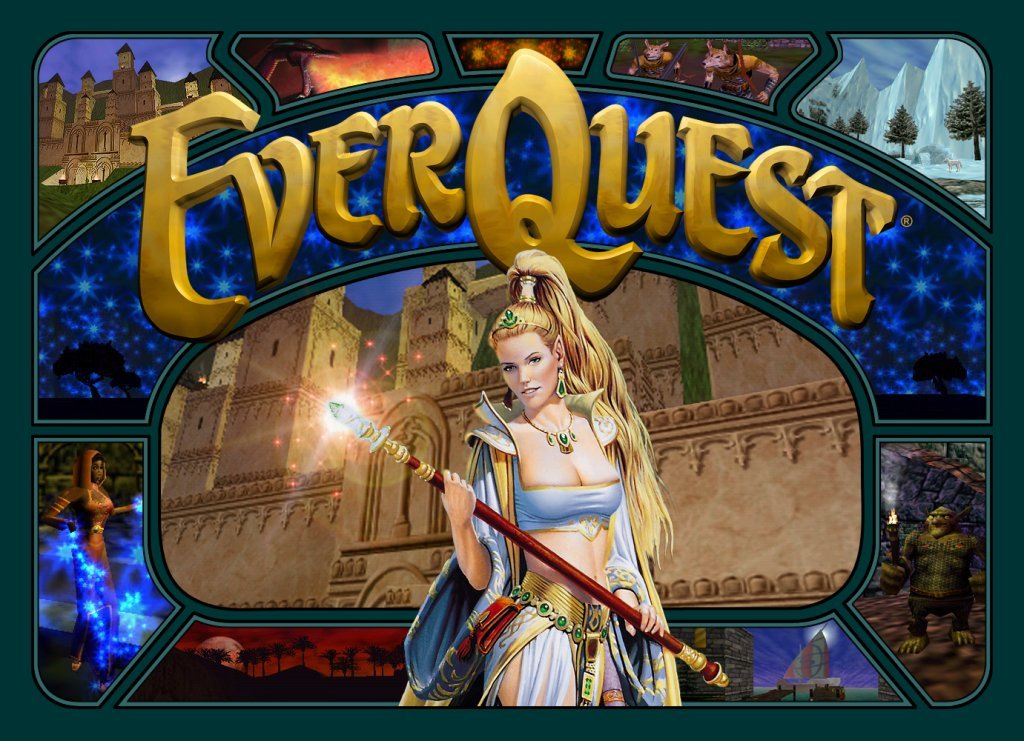
Everquest

Forty minutes in, I’d gotten ten or so private messages asking for my location, and each one had said “too far, sorry” when they found out how out-of-the-way I was. When I got a response that was simply “omw!” I was genuinely surprised. It took nearly an hour for the cleric to make it out to where I was– I was THAT far out of the way (anyone remember trying to navigate those EQ ocean zones, particularly the islands the boats DON’T go to?), and we chatted all the while. I kept half expecting to hear “ugh, this is ridiculous, sorry man” but it never came. Instead we joked about the boats, the sharks, how I died, how exciting level 29 was for Druids, etc.

When she got to me, he was pretty battered. She’d had a run-in with some wildlife (who largely didn’t bother me, a perk of being a Druid that I’d forgotten about) but was still okay. It took her a while to recover and then resurrect me, and bam, I had my level back. I could get us both out of there, and cheerfully did– using the (level 29!) Druid ports to get us to safety, near a major city. I went to tip the cleric, per the standard etiquette, only to find that he was trying to tip *me* for the port. We laughed about it, I expected we’d part ways, and got a last PM for the day: “oh hey, friend me? lemme know if you need a rez, if you don’t mind porting me sometimes :)”.

Ocean_of_Tears_Docks

We were never close in level (he was much higher level than I was, and he was gone by the time I got up in level), but we talked a lot, almost exclusively about game stuff. For the better part of a year, one of us would bug the other for a rez or a port and we’d come running to help out, often from the other side of the world, and we’d chat about whatever while we did so. I knew nothing about him in reality, but it didn’t matter– we were fast friends and the context of the game world gave us plenty to bond over. Instead of having lunch together and sharing the food experience, we’d chat while waiting on boats and bond over (lack of) inventory space.

Near the end of the year, I got a message from him: “hey, I’m probably gonna have to stop playing soon but I wanted to say thanks for hanging out with me. i know it’s rude to ask, but can i have your e-mail address? i want to send you something.”

Players left EQ on occasion; this was not a new concept for me. I was sad that he was leaving, but didn’t think much of it. This was the first time anyone who’d left had tried to make a connection after the fact, though, and I hesitated. Bridging that gap between game and ‘real life’ was sort of taboo– that was how all of the “abuses” and “scary people” on The World Wide Web got to you, to use the scare quotes of the late ’90s/early ’00s. This was my cleric friend, though, and if he’d been hiding his true self for a year, he’d done a really good job of it. With as much as we’d talked, it would’ve been very hard to hide anything, or so I told myself. I gave him my e-mail, not sure what to expect.

livejournal-logo1

The next morning, I woke up to an e-mail in my inbox from a “Julie”, which I didn’t expect, with a character name, class, set of items, and a bunch of other identifying information to prove that it was, in fact, from my cleric friend. At the bottom was a link “to some pictures, nothing bad, I promise” and a note “thanks for everything, I wanted to show you the real me”. Having spent a lot of time on the internet up to this point, I was leery of clicking any links I didn’t recognize, but it was a livejournal link (yep, one of those) so I figured it was safe.

The LJ page was someone named Julie, the cleric I’d spent a year hanging out with. She was wheelchair-bound and a cancer patient– every picture from the last year was of her in the hospital. The post I’d been linked to read simply: “To my druid friend Tam: Hi.” and included a bunch of pictures and links to old posts. I wound up reading her livejournal back entries, finding out about this girl’s struggle with cancer and the ways she took her mind off it, and started to realize that all of the references to “my best friend” were me.

We never spoke after that– when she left EQ she also dropped off the internet, and her LJ stopped updating. It was updated one more time, six months later, by her brother, with a “rest in peace, thanks for reading” message. At the very bottom of the post, there was a picture of her, happy, in her hospital bed. Next to it was a laminated picture, clearly a computer printout, taped up on the wall. It was a shot from Everquest, of a druid and cleric.

There’s nothing less real about online friendships than ones in physical space. RIP, Julie.


Source: Digital Initiative
Relationships in Cyberspace and Realspace

AggroChat #57 – Preparing for Heavensward

Tonight we have Belghast, Ashgar, Tamrielo, Kodra and Thalen and once again we felt like we didn’t have much to talk about.  However once we dug in a little bit I noticed a trend.  Each of us was busy working on this item or that in relationship to Final Fantasy XIV each with our own goals that we have been trying to finish before the expansion.  Ashgar just finished his Nexus weapon after the length grind, and talks about how it compared up against other grinds he has completed.  Kodra talks about working on Turn 9 with two different raid groups and how he hopes we can get through it within the coming weeks.  I talk about my own quest which involves me descending into the dark madness that is crafting and slowly stair stepping each and every crafting class five levels at a time.

In addition to this there is some more Shadowrun talk as we each continue our play throughs.  Kodra goes into yet another dark place by playing some Demon Souls and talks about those experiences.  He and Tam spent a good deal of time this week watching the first season of Sword Art Online and we get into a discussion about that as well.  I talk about my experiences working on the Blackhand encounter in World of Warcraft, and we talk a bit about the lackluster numbers released by NCSoft regarding Wildstar sales.  Yet another night of varried topics here on AggroChat.

Tam Tries: Dex (part 1 – initial impressions)

from http://www.dex-rpg.com/index_en.php

from http://www.dex-rpg.com/index_en.php

I started playing Dex tonight, a 2D cyberpunk sidescrolling RPG. As a bit of forewarning, I’ve only gotten a couple of hours into it, so this will not be a complete review. Expect more once I get more playtime in. Throughout this, there will be very mild spoilers, so be forewarned. I’m going to try to keep it light, but I can’t really critique a game without talking about what happens in it.

In Dex, you play as the girl on the left in the above picture. The game opens up very directly, with a short tutorial of you escaping some unknown assailants and being led to safety by a mysterious benefactor. It’s very The Matrix. I spent a little while unsure of what was going on because the initial tutorial doesn’t make it clear what I need to click on vs move through, and which of the three different interaction buttons was the appropriate one to use.

In general, I feel like the tutorial doesn’t adequately explain how to play competently, but this isn’t terribly important as the first segment of the game is extremely easy. I’m basically shunted into a quick dungeon run, as I work my way to safety through that ever so convenient escape route: the sewers. Thus far, I’ve met a grizzled old veteran who works a bar, a teenager-like hacker, and a mysterious, cryptic benefactor who everyone else reveres.

If this sounds a little cliché, you’re hearing my biggest criticism of the game thus far. It’s great that the dialogue is all voiced, but several of the characters feel like caricatures thus far, and the writing feels somewhat forced. There’s a lot of dialogue, but the quality is all over the place. Some is great, some is iffy at best. It feels like the game is trying to sell me on a dark, gritty, hedonistic future and is getting way too heavy handed with it. I’ve picked up three different items that suffice as the game’s “trash loot” that you sell to vendors for money that are all types of porn. Of the five vendors I’ve found in the game, three sell condoms for some reason. It isn’t quite enough to turn me off of the game quite yet, but the details feel very sophomoric.

That being said, the overall plot arc (such that I’ve seen) is interesting, and I want to find out what happens next. The characterizations are effective– I may dislike some of the characters but they’re better than vanilla, robotic dialogue. The biggest problem I have is that I feel like I can see the entire arc of the game within the first hour of playing it. I may be wrong, and I’m hoping I am. Expect more on that once I’ve played it a bit more.

On the other hand, the art is FANTASTIC. I’ll let it speak for itself, here’s the trailer:

The environments are evocative and stylish, the characters are varied and interesting, and the animations hit that old-school 2D platformer sweet spot– it all looks really good, and messages surprisingly well minus some of the details. I want to wander around the streets of this cyberpunk city, and that appears to be the point of the game, which is great.

The controls feel fairly tight and responsive. Movement feels fairly good, but I feel needs some more interesting options. I may be able to unlock those with time. My biggest issue is that enemies with melee weapons outrange my fists, causing me to awkwardly chase them around, but I also haven’t unlocked various weapons or anything, and the enemy variety is interesting and messaged well already, within the first hour of play. Combat is simple: attack, block, dodge-roll, with new options opening up as you level up. You can also get guns, though I haven’t figure out how to use the one I just got yet.

One of the other big gameplay features is the hacking game, which is a fairly full-featured minigame that’s akin to a scaled-down Geometry Wars. It might be interesting, but I haven’t seen enough of its features yet to make a judgement call. Currently it’s a bit underwhelming but I suspect it will scale up quickly– I haven’t done much with it yet.

As you play, you level up, and can put points into a variety of skills. These seem to have either noticeable flat bonuses (like more health) or new combos or special abilities. There are also a set of “special” skills, things like lockpicking, charisma, etc, that appear to be used to unlock additional options, whether that’s getting into a locked door or charming your way past someone. Me being me, my first two levels’ worth of skill points went into charisma and lockpicking. Thus far, I’ve already seen significant returns on these points. Multiple characters have had “charisma” dialogue options, and lockpicking has come up enough times that I’m glad I took it.

Right now, it’s a game I’m looking forward to putting more time into. It’s got some rough edges, and some questionable content choices, but none of it is enough to turn me off completely. I’ll be back with more once I’ve had more time to play it.


Source: Digital Initiative
Tam Tries: Dex (part 1 – initial impressions)

Endings

game-over

I watched The Wind Rises again last night. It’s a movie I really enjoy, though I’ve heard criticism (and heard it again last night) that the ending is weak. It reminds me of another conversation I had about the endings of long-running shows, and which ‘delivered’ and which didn’t.

It got me thinking about endings in general, for any kind of media. I think I’ve come to prefer the endings that acknowledge that time goes on after the events you’re watching have run their course, rather than the kind that tie everything up neatly and leave nothing left to worry about, until the Next Big Thing occurs (read: sequel).

It’s hard to put words to this preference. I can sense the shape of it, but it’s hard for me to define. It would be easy and simple to say that “time goes on” endings are more ‘realistic’, but that’s not really it. Nor is it accurate to say that I feel some kind of rebellious urge against the concept of “happily ever after”, though that’s not entirely wrong either.

I think it’s because I relate with things that don’t clean up nicely, but that you have to move on from anyway. I read a blog recently written by someone who had been blogging her weight loss over something like two hundred pounds. Her goal was to be in the 120-130 range from being over 300, and as of the writing of the post I read, she’d accomplished it. Rather than a victory cry, though, the post read as a profound statement of loss and uncertainty. For months or years she had blogged about weight loss, working ever closer to a goal that seemed impossible, and when she accomplished it, she realized that it doesn’t end. She couldn’t just relax, or she’d backslide. It wasn’t an ending.

When I was growing up, I used to come up with games for my friends and I to play (it’s honestly shocking that I never played D&D growing up), and when I started seriously pursuing work in the games industry, my drive was to make a big game– one people had heard of and that all of my friends would play. It was my dream, and one that seemed impossibly far off.

Last year, I did it, and the question arose: what now? I accomplished my dream, I proved to myself I could do it. I could keep doing it, but I wasn’t sure if that was what I really wanted to do. When I took a moment to relax and really think, I realized that I’d put many, many things on hold for that dream and it wasn’t like credits rolled and everyone went home afterwards. Time went on, and there are other things I want to do. I developed skills working in games that I want to build on and explore, that I didn’t realize I had, and weren’t really an important part of the job I was doing.

It’s not a story I talk about often, because I don’t feel like telling it in a nice, compact way is really accurate. There’s no real ending, and it doesn’t tie itself up cleanly. It’s an experience I value too much to reduce to a one-and-done story.

I think I like my stories that way as well. I value the experience more when I feel like there’s more to it that I’m not seeing, that comes after the end. My favorite games have extended epilogues that suggest that more happens that I don’t see, but can imagine.

I like that. Time goes on.


Source: Digital Initiative
Endings