Fives

Someone I used to work with used the “fives” metaphor for MMOs, though I’ve also heard it as “eights”. Basically, you need an answer to the question of “what is the player doing in five seconds?” “five minutes?” “five hours?” “five days?” “five weeks?” “five months?”. I think MMOs do some of these better than others. Five seconds is a combat moment, it’s that cool combo you pull off, that timely stun, that charged-up finisher. We’re pretty good at those in the hotbar space, but we’re still figuring them out in the more action-driven spaces. Five minutes is a quest step, or a few fights. It’s you scoping out a mob camp and figuring out how to take it on, or putting together something you’re crafting. Five hours is a level or two, or a zone, or collecting materials for an epic crafting pursuit. Each of these are like wheels, things that may turn multiple times in each five-[whatever] increment, enough to see the entire arc of gameplay in that block a few times.

Fives

OLYMPUS DIGITAL CAMERA

It starts to get a bit blurry after that. As more MMOs have come out, we’ve seen the levelling pace speed up. World of Warcraft has a lot to do with this. One of the things that WoW gave us was lots of people at max level, one of the first MMOs to really allow this. At WoW’s release, it took mere months to get to level 60; now it takes a few days. It’s set a breakneck levelling pace that other games have to at least appear to match, or feel painfully slow and dull by comparison. Now, five weeks is a max-level character, if it even takes that long. Five days for the most dedicated. I don’t think we even answer the “five months” question anymore; I can’t think of a game that gives me projects that take five months to accomplish anymore.

Other games do this as well. Very few talk about “weeks” or “months”; most non-MMO games don’t even pretend that people play them that long. 30 hours is a long time; 10-12 is more common. I put about 20-30 hours into Infamous: Second Son, and someone who worked on the game said that was a surprisingly long time. Very few games go past that 10-12 hour mark. I think it’s something of a sweet spot. As the average gamer age goes up further, games that absorb huge amounts of time are less popular. It might take the average player weeks to get through a 10-15 hour game, whereas earlier in their lives that represented a small chunk of a weekend, and they might have even gone to hang out with friends that same day.

Still, games keep an eye on those time blocks, and what you’re doing in them. Depending on who you talk to, they’re often referred to as “core gameplay loops”, which cover everything from a single button combo (sometimes called “moment-to-moment” gameplay) to an entire guild working together to build a city. If you have a game that feels weirdly unsatisfying, or that you like to play in short bursts but no longer than that, it’s usually because longer core gameplay loops aren’t supported. You’re hooked for five seconds, and five minutes, but maybe not five hours, and certainly not longer than that.

FivesFives

A few games that make me think of this concept: EvE Online has absolutely captivating five-day, five-week, and five month loops, but it can feel a bit aimless in five hours and I find the five-minute and five-second gameplay loops boring and unengaging. Guild Wars 2 has a pretty compelling five-second loop and a very solid five-minute loop, but starts to fall apart for me at the five-hour and five-day loops, before picking up again at the weeks/months level, when you’re talking about forging legendary items and the other various long-term progression paths.

I say all of this and keep coming back to that five hour play loop. It feels like a lot of games fall apart here, where the thing you’re doing in that span of time feels a little underwhelming. In a lot of MMOs, that’s about the timeframe in which you’re going back to town to sell and repair a few times, maybe find and equip some upgrades. In a fighting game, that’s about the loop for a campaign playthrough. It’s a Chapter in Call of Duty, or a handful of quests in Borderlands. There’s not often a lot to think about in that loop, just keep spinning the smaller loops as you work towards the bigger ones.

I remember a game that had a cycle at that scale. Star Wars Galaxies would ask you to go back to town and hang out at cantinas, get patched up by doctors, and otherwise rest over long periods of time out in the field. It wasn’t the most robust of systems, but it was about as well-integrated as a lot of the other systems in the game and gave shape to larger play sessions. Fallout, on Hardcore mode, will ask you to eat and find water to drink. It’s a kind of sustenance that you need to do a bit of work for, a sense of long-term planning that ties the very short term and the very long term goals together and is visible, unlike the usual “whoops, my gear is broken, time to talk to a repair guy” concept.

Fives

It’s a little thing that adds a bit of depth and forethought to the game, or can in theory do so. We don’t see a lot of it anymore, and I think it has a lot to do with our shift away from games as worlds and more towards games as narrative experiences. Minecraft certainly has loops from five seconds to five days, for example, whereas I don’t think most MMOs do anymore; they’ve compressed things down into “dailies” that don’t really offer a longer-term core loop, or try to turn the same series of quests into a single loop that you do each day, with a reward once you’ve done them enough times. There’s no planning taking place there, just logging in and doing.

The whole thing is an exercise I do a lot when playing games. I take a close look at what I’m doing at each of the “fives” and see which ones are strong and which aren’t. It’s yet another angle to consider and analyze games from. Food for thought.

Fives

Someone I used to work with used the “fives” metaphor for MMOs, though I’ve also heard it as “eights”. Basically, you need an answer to the question of “what is the player doing in five seconds?” “five minutes?” “five hours?” “five days?” “five weeks?” “five months?”. I think MMOs do some of these better than others. Five seconds is a combat moment, it’s that cool combo you pull off, that timely stun, that charged-up finisher. We’re pretty good at those in the hotbar space, but we’re still figuring them out in the more action-driven spaces. Five minutes is a quest step, or a few fights. It’s you scoping out a mob camp and figuring out how to take it on, or putting together something you’re crafting. Five hours is a level or two, or a zone, or collecting materials for an epic crafting pursuit. Each of these are like wheels, things that may turn multiple times in each five-[whatever] increment, enough to see the entire arc of gameplay in that block a few times.

Fives

OLYMPUS DIGITAL CAMERA

It starts to get a bit blurry after that. As more MMOs have come out, we’ve seen the levelling pace speed up. World of Warcraft has a lot to do with this. One of the things that WoW gave us was lots of people at max level, one of the first MMOs to really allow this. At WoW’s release, it took mere months to get to level 60; now it takes a few days. It’s set a breakneck levelling pace that other games have to at least appear to match, or feel painfully slow and dull by comparison. Now, five weeks is a max-level character, if it even takes that long. Five days for the most dedicated. I don’t think we even answer the “five months” question anymore; I can’t think of a game that gives me projects that take five months to accomplish anymore.

Other games do this as well. Very few talk about “weeks” or “months”; most non-MMO games don’t even pretend that people play them that long. 30 hours is a long time; 10-12 is more common. I put about 20-30 hours into Infamous: Second Son, and someone who worked on the game said that was a surprisingly long time. Very few games go past that 10-12 hour mark. I think it’s something of a sweet spot. As the average gamer age goes up further, games that absorb huge amounts of time are less popular. It might take the average player weeks to get through a 10-15 hour game, whereas earlier in their lives that represented a small chunk of a weekend, and they might have even gone to hang out with friends that same day.

Still, games keep an eye on those time blocks, and what you’re doing in them. Depending on who you talk to, they’re often referred to as “core gameplay loops”, which cover everything from a single button combo (sometimes called “moment-to-moment” gameplay) to an entire guild working together to build a city. If you have a game that feels weirdly unsatisfying, or that you like to play in short bursts but no longer than that, it’s usually because longer core gameplay loops aren’t supported. You’re hooked for five seconds, and five minutes, but maybe not five hours, and certainly not longer than that.

FivesFives

A few games that make me think of this concept: EvE Online has absolutely captivating five-day, five-week, and five month loops, but it can feel a bit aimless in five hours and I find the five-minute and five-second gameplay loops boring and unengaging. Guild Wars 2 has a pretty compelling five-second loop and a very solid five-minute loop, but starts to fall apart for me at the five-hour and five-day loops, before picking up again at the weeks/months level, when you’re talking about forging legendary items and the other various long-term progression paths.

I say all of this and keep coming back to that five hour play loop. It feels like a lot of games fall apart here, where the thing you’re doing in that span of time feels a little underwhelming. In a lot of MMOs, that’s about the timeframe in which you’re going back to town to sell and repair a few times, maybe find and equip some upgrades. In a fighting game, that’s about the loop for a campaign playthrough. It’s a Chapter in Call of Duty, or a handful of quests in Borderlands. There’s not often a lot to think about in that loop, just keep spinning the smaller loops as you work towards the bigger ones.

I remember a game that had a cycle at that scale. Star Wars Galaxies would ask you to go back to town and hang out at cantinas, get patched up by doctors, and otherwise rest over long periods of time out in the field. It wasn’t the most robust of systems, but it was about as well-integrated as a lot of the other systems in the game and gave shape to larger play sessions. Fallout, on Hardcore mode, will ask you to eat and find water to drink. It’s a kind of sustenance that you need to do a bit of work for, a sense of long-term planning that ties the very short term and the very long term goals together and is visible, unlike the usual “whoops, my gear is broken, time to talk to a repair guy” concept.

Fives

It’s a little thing that adds a bit of depth and forethought to the game, or can in theory do so. We don’t see a lot of it anymore, and I think it has a lot to do with our shift away from games as worlds and more towards games as narrative experiences. Minecraft certainly has loops from five seconds to five days, for example, whereas I don’t think most MMOs do anymore; they’ve compressed things down into “dailies” that don’t really offer a longer-term core loop, or try to turn the same series of quests into a single loop that you do each day, with a reward once you’ve done them enough times. There’s no planning taking place there, just logging in and doing.

The whole thing is an exercise I do a lot when playing games. I take a close look at what I’m doing at each of the “fives” and see which ones are strong and which aren’t. It’s yet another angle to consider and analyze games from. Food for thought.

Worth Sticking Around For

A friend of mine got to a boss she couldn’t beat and quit playing the game. Another friend of mine had a single bad experience at a restaurant and hasn’t been back since. Another friend of mine, a highly competitive gamer, had a frustrating match in a game and stopped playing it entirely. Yet another friend saw an episode of a show that she’d been following for thirty episodes, hated the episode, and never went back.

Worth Sticking Around For

I’ve done a lot of these things myself. It’s hard not to; why waste time on second chances? There are so many options out there — for everything — that it seems like there’s no reason to hang around if something frustrates or offends you. Flush it and move on, there’s always more where it came from. There are other games, other restaurants, other shows. It feels like a defense mechanism against the deluge of content to be ready and willing to shut down and give up on something at the first sign of trouble. We’ve all become highly sensitive to anything that provides a poor experience, so we can cut it out and move on, and not be bothered by it. We can “buy time” to experience other things by removing anything that fails us.

I’ve had the opportunity to go back and try a variety of things over the last year, that I’d otherwise abandoned or moved on from or what have you. Every time I do, one of my friends invariably goes “you’re playing THAT again? WHY?”

It’s a hard question to answer. The simple answer is that I’m looking for something fun to play, and a lot of this old stuff doesn’t cost me any money, or relatively little. More complicated is that I often don’t remember why I stopped playing them– I very rarely go back to games or books that I’ve finished and play them again, but I don’t finish all that many games, especially since I play a lot of MMOs, which defy completion.

Worth Sticking Around For

The more complicated answer is that I like to stick with my entertainment. I like games in a series, not one-shot, disposable titles. I like something I can get invested in, and both express myself through and make a part of myself. I’ve had this discussion with Kodra, but I often find board games, even the very high quality ones, a little too shallow and a little too ephemeral to really get into. There’s little to no self-expression in them, and no sense of long-term importance. I’m not unraveling a story that will stick with me, nor am I exploring a world that will inspire me. The majority of the board game experiences I’ve had have taken one of two forms. In one case, a bunch of friends and I sit down at a game none of us have ever played, learn the rules, then play together. These are the better experiences, but they tend to take hours. An hour or two or more to learn the rules and set up the game, and another two to three to actually play. In another case, I and others are playing a game that one or more people absolutely love, and have a bunch of experience with and are really excited to play with other people. I have yet to have an experience with a game like this that isn’t miserable; the games are dominated by the players who already know everything about it and I’m basically filling a chair so that they can play.

Worth Sticking Around For

These experiences have deeply informed how I introduce people to games that I like, and most of the time I don’t do it. I’d rather someone ask me about a game that I’m playing and love, at which point I can teach it to them, than try to push that game on someone. The only games I’ll openly suggest that I and others play are ones that I’m passingly familiar with, just barely enough to teach, and am still learning how to play. Even these are hit or miss.

It’s a big part of why I play minis games, and why I’m generally very selective about the minis games I play. The game pieces I use have stories, each one the result of one or many games, and these stories start to inform how the mini looks and feels. It’s a personal touch, and I feel like each addition to the collection is another potential set of stories. I run a lot of tabletop games, but I haven’t played in one in years; minis fill the kind of personalized game experience for me that someone’s character does in a tabletop game.

It’s also why I actively seek out entertainment media that I can stick with. I’ve found it’s hard to have an experience that’s deeply changing or otherwise significant without some amount of friction and investment. I’ve worked on intuiting the difference between something that’s interesting but difficult and something that’s simply unappealing; usually if it’s the former, it speaks more to something about myself than something about whatever I’m watching. I’m really interested in entertainment that forces me to self-evaluate.

Worth Sticking Around For

Case in point: Tales of Zestiria. In a lot of ways, it’s a fairly dark game, but it’s presented in a very upbeat, very cheerful way. I can feel myself reacting with annoyance– at the overly-chipper characters and what feels like a mood that doesn’t take things seriously. It would have been easy for me to check out already, citing tonal issues and childishness as reasons. The argument for quitting is easy, even as I write this it jumps to my lips. Instead, I’ve kept playing.

I have a hard time explaining why, just like I have a hard time answering “why” when someone asks me why I’ve jumped back into some old game that we quit in disgust. I think that’s what I find compelling, and ultimately rewarding. Tales of Zestiria has started speaking directly to my cynicism. X-Wing has proven shockingly deeper than my initial play (and dismissal) of it, years ago, and I’m fascinated to explore it more. Guild Wars 2 is a game that, years on, I finally understand, and it’s a very different kind of MMO than others out there. Each of those games have forced me to look at myself rather than the game to really appreciate them, and I have similar experiences with various shows.

Worth Sticking Around For

It’s something I’m continuing to work on, to fight that urge to drop something at the first bad experience and keep on exploring. I’ve very rarely been disappointed, when I manage to shed my defensiveness and ego and let myself enjoy things for what they are, it’s just hard to do. I’ve gotten good at a lot of games that I never would have thought I’d enjoy, and found a few favorite shows that I would otherwise have never looked twice at.

I just wish I had some way of sharing that experience with other people, but like pushing a new game that you’ve come to love on someone that’s never tried it, it’s too easy to just dominate the experience and make it unfun for them.

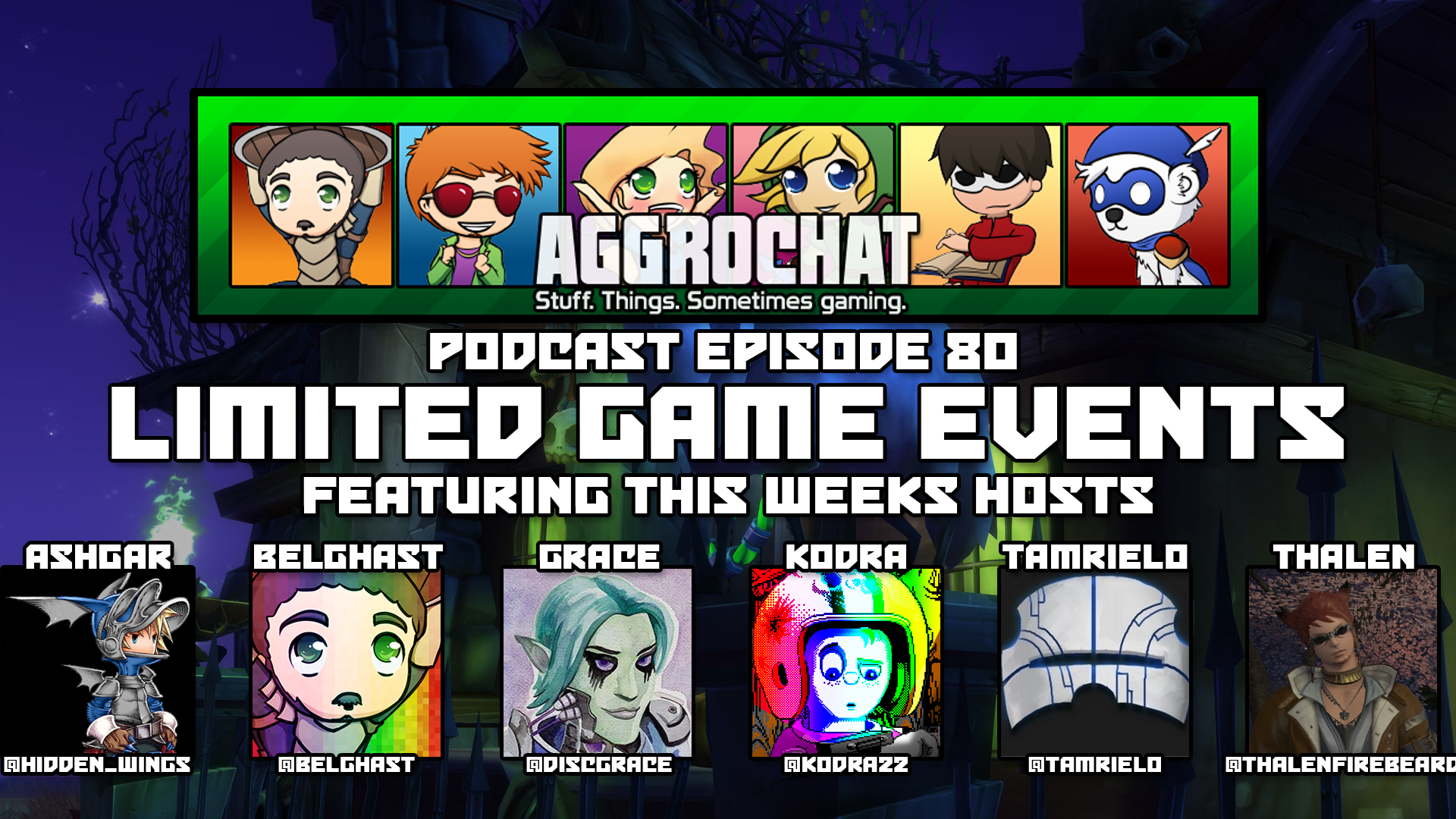
AggroChat #80 – Limited Game Events

AggroChat80

This week we continue our adventure into this new topic focused format, this time with the full AggroChat crew.  The big topic of the night we take on which is not specifically a single game… is limited game events like holidays or other expiring content.  We dig into the things we like about them and dislike about them, as well as provide some ideas in how to make the concept work better.

On this show we talk about…

  • Seasonal Events
  • Limited Game Events
  • Wildstar
  • Everquest 2
  • World of Warcraft
  • World Ends with You
  • Star Wars the Old Republic
  • Final Fantasy XIV
  • Tales of Zestiria
  • Destiny
  • Marvel Heroes
  • Keep Talking and Nobody Explodes
  • Space Team
  • Magic: the Gathering