Aggrochat Game of the Month: Astebreed

We talked about Astebreed over the weekend on the podcast, but as per usual I wanted to put a few more thoughts here.

Astebreed-Free-Download

I’m awful at memorizing things, which I’ve talked about a bit before. It’s kept me out of a lot of bullet hell shooters, because those are entire games around memorizing patterns and executing the right evasive maneuvers to match the patterns. I don’t really have the patience or interest to play the same level tens or hundreds of times just to get the pattern down. I like Astebreed because, for the most part, it lets me come up with my own solutions for each boss pattern without forcing me to memorize a specific set of “the right” moves.

Playing Astebreed, however, got me thinking about raid bosses in MMOs. They’re often pattern-driven, and almost always require that I memorize the associated attacks and the appropriate (highly specific) reactions to them. I like them, though, whereas I tend not to like the memorization-heavy bullet hell genre. The conceptual gap there bothered me, and I’ve spent a few days mulling over why I like one but not the other.

18adc0429bbf01d8e769394c892dbb8c

The two obvious answers are that MMOs involve other people and that they also are much less demanding and punitive than bullet hell shooters. Both of these lessen the impact, but don’t change the core concept. That being said, there are a lot of things where I don’t like the ‘pure’ version but dearly love the dilutions– the JRPG is a really good example of this. Similarly, I never really liked Forza, but I enjoy both Burnout and Mariokart, both pretty heavy dilutions of the racing mechanic. Having other people playing along with me also makes the experience more fun, because I’m both able to help out my friends and get help from their cues– it isn’t always a binary fail state, and the experience itself is shared.

Another angle I looked at it from is my own approach to the game vis a vis classes. Avoiding deadly attack patterns is only half the boss fight; the other half is actually fighting the boss. I tend to play healers and specific types of damage classes. In the former case, there’s no set rotation; I’m reacting to the fight on the fly and (ideally) proactively inserting abilities as the situation changes. In the latter case, I tend to avoid rotation-based classes in favor of ones that focus more on reacting to the situation. A lot of my favorite classes have been ones that lean on situational adaptation (often priority systems) rather than straight rotations.

Summoner_FFXIV_Art_2

Astebreed also separates itself from other shooters I’ve played by focusing a lot more on offense than evasion. I’ve played a number of games where evasion is the key (Touhou, Ikaruga, etc) and where actually attacking enemies is something you kind of do on the side in between avoiding shots. In some cases, the primary attack is simply always on, further emphasizing how incidental actually attacking is. It’s not something I like a lot, even in the other bullet hell shooter I’ve played recently– Sine Mora. Sine Mora is a Vita title that gives you a slow time effect, letting you slow everything down while moving at the same rate. It’s great for getting out of tight places or figuring out how to evade, and let me get away with less memorization throughout the game (probably why I beat it), but it didn’t really let me focus on offense over defense the way I like.

I’ll admit I’m tempted to pick up Astebreed on PS4 despite playing it already– a lot of my frustration with the game (as you likely heard or will hear in the podcast) was from a feeling that I was fighting the controls. Without that, I probably would have done a lot better, and there’s likely a whole rant about intuitive control schemes with the PC version of Astebreed as a catalyst, but that’s not for today.

Hope you enjoyed the podcast! At some point today the PS4 release of Sword Art Online: RE: Hollow Fragment is dropping, which I’m really excited about. I talked about it a bit before, as I played the Vita version, but honestly the retranslation is a huge draw for me. We’ll see!


Source: Digital Initiative
Aggrochat Game of the Month: Astebreed

Craftsmanship

I love good craftsmanship. I have a deep appreciation for things that are made well, with skill and attention and care by their creators. It can be anything, from games to carpentry to drinks. I particularly like it when I can see the craft at work, and appreciate it in progress.

Layered-Drinks-024-640-wm

I don’t drink beer, and only occasionally drink wine. I know there’s often a lot of craftsmanship that goes into both, but I don’t get to *see* it. What I like are cocktails, where I can watch the bartender put them together and where each one, even if I’ve ordered the same thing, has a different twist based on who’s made it and with what. For me it’s not even about the liquor, it’s the huge spectrum of interesting flavors and mixes that really make the experience for me. If there existed a place I could go and get interesting mixed drinks sans alcohol, I’d go there all the time.

This weekend was the last weekend my favorite bartender at a local bar will be around, and I’m going to miss him quite a lot. In more than six months, I never had the same drink twice from him, and he would consistently come up with interesting, creative drinks that both perfectly hit my favorite tastes and pushed the boundaries of my comfort zone. I have an appreciation for flavors I couldn’t even name previously, and each drink would come with a history and a story– this is a drink that was popular in the ’40s, this drink was originally made in this place in the late ’90s, this drink can only be made this specific way, this drink used to be made with this liquor but it’s changed since then… all kinds of interesting tidbits. The craft wasn’t just in the drinks, but in the presentation and the delivery. I would rather pay $12 for a drink that I remember than $4 each for three forgettable alcohol-and-sodas. If it takes ages to make (like a Ramos Gin Fizz, don’t ever order one of these from a bartender who you aren’t 100% sure likes you), I’m happy to wait, because it means I’m going to get something finely crafted.

ramosginfizz

In a lot of ways, the same is true for games for me. I’ve spent enough time building them myself to have a sense for when the developer is ghosting alongside me while I play, grinning and pointing at the next cool thing around the corner. The really well-crafted games are excited to show you the next thing around the corner, and when there’s a pause in the pacing or a period where I’m waiting, I know that it’s because really finely made things take time. I’ve played games that lack this spark, where slow pacing or a drawn-out wait are an obvious way of extending a game that’s rationing out its cool stuff. It’s easy to dismiss a carefully-paced-but-slow segment as an intentional time-waster, but you can tell the differences.

Take KOTOR. Knights of the Old Republic is one of the best RPGs out there, particularly for its time, and was a fantastically well-loved Star Wars game. It deserves a lot of the credit for rekindling the franchise during a lull. It starts with what many people have criticized as an overly long, drawn-out planet sequence, before you get to “the good stuff”, flying around from planet to planet lightsabering people. What I think is easy to miss is how absolutely chock-full of content that first planet is. Taris is a busy place, with a lot of stuff going on, and that time you spend on the ground, getting a feel for the characters and the “normal” game makes it all the sweeter when you’re not grounded and have the awesome Jedi powers that (spoilers) you get to have later on. “Just wait,” KOTOR says, “we’re setting up some awesome stuff for you but you’ve got to see this to really get it.”

TarisUpperCityConcept1

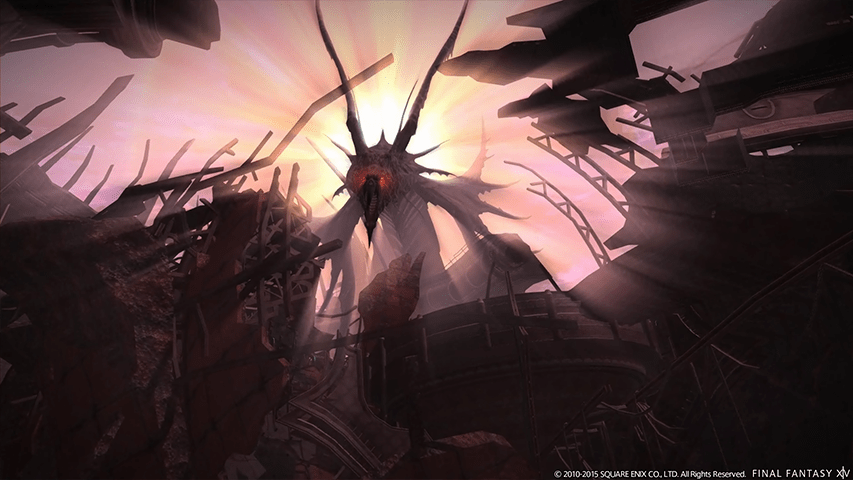
FFXIV is very much the same for me. Sure, I have to wait between content patches, and a lot of what there is to do in the interim is slowly work on getting incrementally better gear, but the next content they’re going to drop is almost certainly going to be amazing, and well worth the wait. It’s a game where I can take it slowly and enjoy myself OR push the line and grind out the best of the best, and in either case get to enjoy the really great content that’s coming up next. It will all still be around, and it will all still be relevant. Heavensward would have had nowhere near the impact if I hadn’t played through all of the main story content, and while some people have raged against the need to play through the main story to access Heavensward content, the game would be poorer for skipping you past that considered, crafted wait.

XIV_Midgardsormr_-_Front

I feel like in FFXIV, as in KOTOR, there’s a designer ghosting alongside me, excited to show me the next cool thing as soon as it’s ready. It’s like a really great bartender, flitting around the bar and pulling liquors and bitters and mixes out, grinning to himself and nodding as he takes tastes of what he’s making for you, then setting it down in front of you, assured that good work has been done and that it’s there for you to enjoy.

I love the effort and the craftsmanship, and I don’t think I’d want to rush it. The wait makes the experience really sing, and gives me pause to appreciate the work.


Source: Digital Initiative
Craftsmanship

AggroChat #67 – The Astebreed Show

Astebreed 2015-07-25 12-08-56-63

This week we record yet another AggroChat Game Club game featuring the game Astebreed, which is an interesting mix of strange Anime Storytelling and Bullet Hell shooter. What makes the game very unique is that you are a mech… with a sword as well as your laser weapons. As far as the story goes, I think several of us were equally confused so we rely on Tam to decode it all for us… because he apparently was able to follow it the entire way. We have a lot of conversation about the tone of the game, the boss fights, the controls that may or may not have worked… and the total package.

Since adding Grace and Thalen to the podcast they were not in the initial rotation of AggroChat picks, so we did the most gamer thing ever… and rolled some dice before the show to graft them into the rotation. That means for the month of August Grace got to pick a title and we will be playing the bird dating sim… Hatoful Boyfriend… and Kodra was happier than I have ever heard him be. He loves this game, and drove us slightly mad with it when he was playing it. Now we are going to get to experience this madness for ourselves, and I am willing to bet that Game Club Seven is going to be one of the more interesting episodes of AggroChat in our history.

Intuition

I’m awful at memorizing things. Anything requiring rote memorization was always the worst for me. My mind wants fundamentals that I can work out a solution to on the fly, not a preset pattern that I need to simply know.

hiragana

So, I’m working on teaching myself Japanese. I have two syllabaries (Hiragana and Katakana), each larger than the English alphabet, and a few thousand Kanji to memorize. There’s nothing more fundamental to work with here; these are the fundamentals that I’m going to build the rest of my understanding of the language on. On top of that, the entire structure of the language is different from what I’m used to, so these fundamentals are really important.

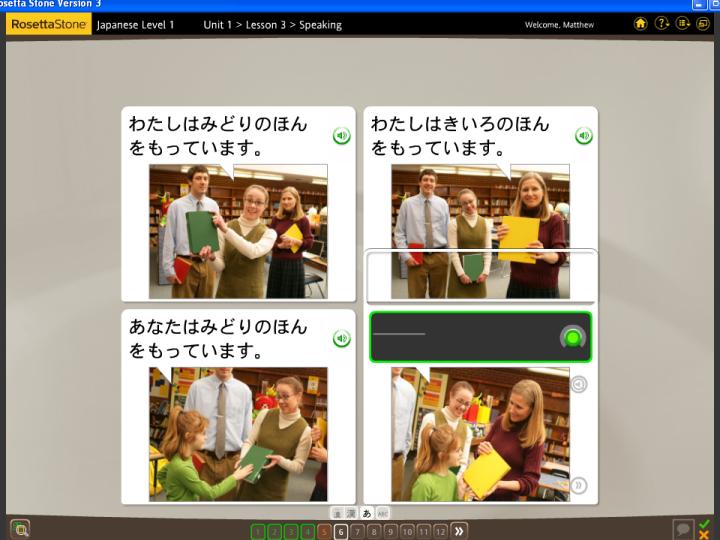
At the same time, I’m learning how to parse sentences using Rosetta Stone. If you’re not familiar with how the software works, it uses spoken and written dialogue paired with images to slowly build understanding by forcing you to intuitively understand the differences between one dialogue/image pair and another. Rather than explaining directly how to, say, express a plural noun, it simply shows you two pictures and reads off two sentences, and the differences between the sentences are how you form understanding. It’s described as a very natural learning environment, “how babies learn”, and I’m inclined to agree. It works very well at a very basic level, and it does so without using English as a go-between language.

The first three images give me enough context to figure out the appropriate sentence for the fourth.

The first three images give me enough context to figure out the appropriate sentence for the fourth.

For me, it’s the ideal way of learning a new language. By forcing myself to separate from English, I have to go from concept to Japanese word, rather than mentally translating. Rather than using English as a go-between, I’m using my own intuition, and it’s surprisingly effective. I can’t really explain grammar rules yet, certainly not in English, but I can make sense of some sentences and I’m working on building my vocabulary to the point where I can communicate reasonably.

The whole experience parallels FFXIV for me in a number of ways. I’ve never been good with rotation-based classes, where I memorize what moves I use in what order and work on executing that string precisely and effectively. I play a Summoner, and I couldn’t tell you beyond broad guidelines what I’m doing at any given moment. I push out a ton of damage, but I intuitively understand what I need to do and when things need to happen– there’s no counting in my head or working out a set ability order, it’s all done by feel. On the other hand, I’ve memorized a lot of the fundamentals– my cast times, my ability ranges, my cooldowns, and these form the building blocks for my intuition to kick in. Thinking back, it’s also how I approached math in school. Formulae made more sense to me when I could derive them in ways that made sense to me, but I was never good with the ones that I had to “just memorize”. It makes me want to track back the things that I’ve struggled with learning in the past.

11356373_1634075703514330_115557706_n

Kind of a scattered post today, but I’ve been interested in how much more effective my attempts at learning Japanese have been in a week or so than my (many, many) attempts at learning Spanish. My mom would roll her eyes if she read this.


Source: Digital Initiative
Intuition