New to Nexus 2: Combat, Abilities and You!

In part 2 of my quickstart guide to WildStar I want to talk more in-depth about combat, abilities, and AMPs.

Interrupts and Interrupt Armor

New to Nexus 2: Combat, Abilities and You!

An enemy with 2 interrupt armor.

One of the core features of combat in WildStar is the interrupt system. By stopping an enemy’s cast, not only do you avoid whatever bad thing they were trying to do to you, but you also create a brief moment of opportunity during which they will take extra damage from your attacks. The game signals this by changing the color of their health bar, and showing a countdown overlay to indicate the duration of their vulnerability. Taking advantage of this while questing will help you kill big enemies faster, and give you practice with the system.

New to Nexus 2: Combat, Abilities and You!

On the left, both interrupt armor have been destroyed but the enemy has not yet been interrupted. On the right, a third interrupt has been cast and the enemy is vulnerable.

Dungeons and raids make interrupting a requirement, either because the boss abilities are devastating, or because you need the damage bonus to kill things before the enrage timer. Boss mobs and some strong or elite mobs in the world also add a twist to the interrupt mechanics: interrupt armor. Interrupt armor shows up as a shield with a number in it, to the right side of an enemy’s health bar. That is the number of interrupts that need to be applied before an actual interrupt can go through. For example, if an enemy has 2 interrupt armor that means you need a total of 3 interrupts to actually stop it from casting. The first 2 break the armor, and the last one  stops the cast. What this means in practice is that in group content, everyone usually brings at least one interrupt on their bars and will have to coordinate to break the interrupt armor.

New to Nexus 2: Combat, Abilities and You!

The default nameplates are on the left. On the right I’m using the addon Optiplates, which can make tracking interrupt armor easier.

A few more notes on interrupt armor. There’s a great addon called Interruptor that will show a small bar when an enemy is casting that indicates how many interrupt armor are remaining. It is very useful for group content when you’ll need to coordinate 3 or more interrupts. Also sometimes an enemy will have infinite interrupt armor. That means they can’t be interrupted at all. The number of interrupt armor can also change during a fight, and a good rule of thumb is if the number of interrupt armor suddenly gets a lot lower, it is probably a signal that you will need to interrupt something important soon!

Innate Abilities
New to Nexus 2: Combat, Abilities and You!

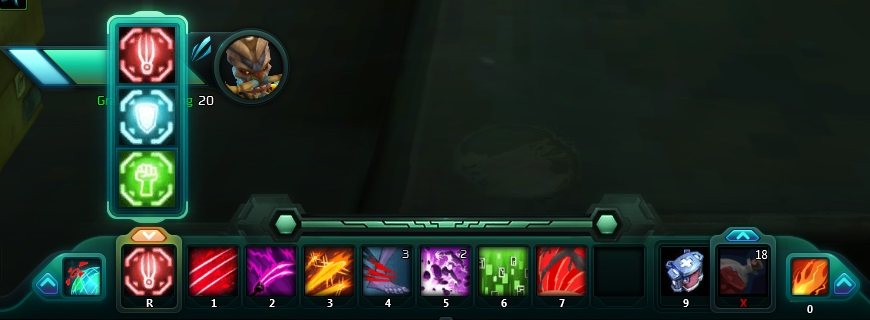
My stalker’s action bar, showing my expanded innate ability choices.

Each class has a special ability that is always available on their action bars (default “R”), their “innate” ability. These define the overall flavor and functionality of each class, and are important to maximizing your potential. When I first started my spellslinger, I had no idea what I was supposed to do with this ability and ignored it for several levels, all while struggling to kill things quickly enough. Don’t be like me! Read the tooltip of your innate ability and get in the habit of using it! Some general information for each class:

Spellslinger: Spell surge buffs the damage and healing of many of your abilities. It uses spell power to activate, and using surged abilities continues to deplete your spell power. Use it often, it is a big damage/healing boost!

Medic: Energize buffs shield healing. Using it replenishes your actuators and gives a situational bonus depending on your current health. Since the assault and support power buff is only given if you are above 30% health, be mindful of your health bar when you use this ability!

Stalker: You get your choice of 3 nano skins which give passive buffs. Activating any of them will activate your stealth mode. The lethal skin buffs your crit chance and damage done after exiting stealth. The evasive skin is your tanking skin, which gives defensive and threat buffs. The agile skin gives movement, dash, and lifesteal bonuses, and has a faster movement speed while stealthed.

Engineer: You get to choose between 2 combat modes for your innate. Provoke is your tank mode, which gives passive threat and defensive buffs. Activating it gives a defensive cooldown and a volatility boost. Eradicate mode is your damage mode. Activating it will give volatility regeneration and  do some extra aoe damage.

Warrior: You get your choice of 2 stances (select one by clicking the small arrow on top of your innate on the action bar). Juggernaut is your tank stance, which gives passive threat and defensive buffs. Activating it gives an additional defensive cooldown and threat boost. Onslaught is your dps stance. Activating it resets many of your cooldowns and increases your damage output.

Esper: You have a straightforward cooldown button. Spectral form gives you a defensive bonus (absorb shield  and interrupt armor) paired with boosted psi point generation.

The LAS

You might have heard people talking about this LAS thing, or seen an endgame class guide that mentioned it. But what is it? LAS stands for “Limited Action Set”, and it is shorthand to refer to your “build” (default “B” to open) or ability choices. WildStar limits you to 8 abilities at a time. Once you’ve learned more than that, you’ll have to start making choices about which ones to use and which to ignore. The game tries to give some guidance by splitting abilities into 3 categories, Assault (damage), Support (healing or tanking), and Utility (movement abilities, interrupts, buffs etc.).

New to Nexus 2: Combat, Abilities and You!

My spellslinger’s LAS. Mouseover the bars to see what bonuses you get for tier 4 and tier 8 for each ability.

For questing, you are going to want to focus on mainly damaging abilities, with some utility sprinkled in. I like to keep at least one interrupt and one movement ability on my bars while out in the world. Depending on your play style you might want to throw a heal on your bars in addition to or instead of the movement ability.

You might have noticed that your abilities on your action bar are locked. You can assign them to different positions from the LAS menu. To remove an ability from your bar completely, click the small arrow just to the right of the ability’s icon on the list.

As you level, you gain ability  points that can be spent to increase the power of your abilities. This is what the rows next to each ability icon on the LAS menu are for. At low levels, it makes sense to assign points to the abilities you use the most or that give the biggest damage boost. Once you reach level 25 you can start spending extra ability points to unlock a special boost. These, indicated by the wider bars at tier 4 and tier 8, usually change the way the ability works in some way. Often they give some synergy with another ability, so be sure to read the tooltips so you get the most out of those bonuses!

AMPs

AMPs are WildStar’s answer to talent trees. Happily, the days where you needed to purchase or find individual AMP unlocks are a thing of the past. Unfortunately, that means you have an awful lot of choices to think about while you’re still learning the game. AMPs are located on a secondary tab on the LAS menu (“B”).

New to Nexus 2: Combat, Abilities and You!

My engineer’s AMPs. You can see she’s focused on assault abilities, with some hybrid support.

Individual AMP choices are too class-specific to cover here, but there are some basic rules of thumb. The AMP wheel is divided into 6 parts. Three of them represent assault, support and utility, while the wedges in-betwen are, well, in-between (damage/support, damage/utility, support/utility). When you are starting out it is fairly safe to stick to the wedge that represents your main role to begin with. The utility wedge is where PvP-centric AMPs can be found.

You start adding AMP points from the innermost ring and work your way out, unlocking tiers 2 and 3 by spending points within that wedge. Tier 1 AMPs are just static boosts to specific stats, which cost 1 AMP point each. Tier 2 contains AMPs that start modifying your abilities or adding situational bonuses. These  cost 4 points each. Finally, tier 3 AMPs are either powerful boosts, or unlock abilities for your LAS. Abilities cost 2 points, the rest of the AMPs in tier 3 cost 6 points. Note that if you unlock an ability via AMPs you will need to confirm your AMP choices before you can add the ability to your action bar.

While you are leveling, you can choose AMPs that look interesting to you or give bonuses to abilities that you use frequently. Once you get close to level 50, I recommend checking the class forums and taking a look at some of the endgame builds that people post there. I like to have an idea of what those endgame builds look like even when I’m still low level. It lets me focus my build toward that goal, and get practice using the abilities I know I’ll be using at 50. Sometimes this can backfire though, since most of those builds are dependent on having lots of ability and AMP points to spend that you just don’t have access to before level 50.

New to Nexus 2: Combat, Abilities and You!

Notice the cost of an amp reset. It keeps getting more pricey as you level. The tiny arrows circled in pink let you swap between different saved action sets instead of buying a reset.

You can swap out abilities at any time, but to reset your AMPs once they are confirmed you will need to pay a fee that scales with your level. Luckily even at low levels you get multiple action sets, and at max level you can have up to 5. At the very least, you can keep one for PvE and one for PvP, or one for DPS and one for healing/tanking. The bottom of your LAS menu will show which set you are using, and there are small arrows to switch between available sets.

AMP and Ability Point Unlocks

You can have a total of 48 ability points and 57 AMP points, and you will not get your full amount of points simply by leveling to 50. As you play you may find items that give you additional AMP or ability points, use them! I know in particular some of these were added as path rewards. Keep an eye out for them, since they are the way you get points beyond the simple “one per level”. Once you are level 50 there are some additional ways to obtain these. AMP and ability points, as well as extra action sets can be bought from the elder gem vendor in your capital city. Points can also be earned by defeating veteran dungeons, participating in PvP, and by gaining reputation with the various end-game factions. Finally, these can sometimes randomly drop from level 50 enemies, and can be bought and sold on the commodities exchange. End-game builds assume you have all points unlocked, but this can take weeks or months of work. Don’t be ashamed to lay down some plat instead if you have it to spare and you want to speed up the process!

New to Nexus 2: Combat, Abilities and You!

The Exile elder gem vendor in Spaceport Horizon, Thayd


New to Nexus 2: Combat, Abilities and You!

New to Nexus 2: Combat, Abilities and You!

In part 2 of my quickstart guide to WildStar I want to talk more in-depth about combat, abilities, and AMPs.

Interrupts and Interrupt Armor

New to Nexus 2: Combat, Abilities and You!

An enemy with 2 interrupt armor.

One of the core features of combat in WildStar is the interrupt system. By stopping an enemy’s cast, not only do you avoid whatever bad thing they were trying to do to you, but you also create a brief moment of opportunity during which they will take extra damage from your attacks. The game signals this by changing the color of their health bar, and showing a countdown overlay to indicate the duration of their vulnerability. Taking advantage of this while questing will help you kill big enemies faster, and give you practice with the system.

New to Nexus 2: Combat, Abilities and You!

On the left, both interrupt armor have been destroyed but the enemy has not yet been interrupted. On the right, a third interrupt has been cast and the enemy is vulnerable.

Dungeons and raids make interrupting a requirement, either because the boss abilities are devastating, or because you need the damage bonus to kill things before the enrage timer. Boss mobs and some strong or elite mobs in the world also add a twist to the interrupt mechanics: interrupt armor. Interrupt armor shows up as a shield with a number in it, to the right side of an enemy’s health bar. That is the number of interrupts that need to be applied before an actual interrupt can go through. For example, if an enemy has 2 interrupt armor that means you need a total of 3 interrupts to actually stop it from casting. The first 2 break the armor, and the last one  stops the cast. What this means in practice is that in group content, everyone usually brings at least one interrupt on their bars and will have to coordinate to break the interrupt armor.

New to Nexus 2: Combat, Abilities and You!

The default nameplates are on the left. On the right I’m using the addon Optiplates, which can make tracking interrupt armor easier.

A few more notes on interrupt armor. There’s a great addon called Interruptor that will show a small bar when an enemy is casting that indicates how many interrupt armor are remaining. It is very useful for group content when you’ll need to coordinate 3 or more interrupts. Also sometimes an enemy will have infinite interrupt armor. That means they can’t be interrupted at all. The number of interrupt armor can also change during a fight, and a good rule of thumb is if the number of interrupt armor suddenly gets a lot lower, it is probably a signal that you will need to interrupt something important soon!

Innate Abilities

New to Nexus 2: Combat, Abilities and You!

My stalker’s action bar, showing my expanded innate ability choices.

Each class has a special ability that is always available on their action bars (default “R”), their “innate” ability. These define the overall flavor and functionality of each class, and are important to maximizing your potential. When I first started my spellslinger, I had no idea what I was supposed to do with this ability and ignored it for several levels, all while struggling to kill things quickly enough. Don’t be like me! Read the tooltip of your innate ability and get in the habit of using it! Some general information for each class:

Spellslinger: Spell surge buffs the damage and healing of many of your abilities. It uses spell power to activate, and using surged abilities continues to deplete your spell power. Use it often, it is a big damage/healing boost!

Medic: Energize buffs shield healing. Using it replenishes your actuators and gives a situational bonus depending on your current health. Since the assault and support power buff is only given if you are above 30% health, be mindful of your health bar when you use this ability!

Stalker: You get your choice of 3 nano skins which give passive buffs. Activating any of them will activate your stealth mode. The lethal skin buffs your crit chance and damage done after exiting stealth. The evasive skin is your tanking skin, which gives defensive and threat buffs. The agile skin gives movement, dash, and lifesteal bonuses, and has a faster movement speed while stealthed.

Engineer: You get to choose between 2 combat modes for your innate. Provoke is your tank mode, which gives passive threat and defensive buffs. Activating it gives a defensive cooldown and a volatility boost. Eradicate mode is your damage mode. Activating it will give volatility regeneration and  do some extra aoe damage.

Warrior: You get your choice of 2 stances (select one by clicking the small arrow on top of your innate on the action bar). Juggernaut is your tank stance, which gives passive threat and defensive buffs. Activating it gives an additional defensive cooldown and threat boost. Onslaught is your dps stance. Activating it resets many of your cooldowns and increases your damage output.

Esper: You have a straightforward cooldown button. Spectral form gives you a defensive bonus (absorb shield  and interrupt armor) paired with boosted psi point generation.

The LAS

You might have heard people talking about this LAS thing, or seen an endgame class guide that mentioned it. But what is it? LAS stands for “Limited Action Set”, and it is shorthand to refer to your “build” (default “B” to open) or ability choices. WildStar limits you to 8 abilities at a time. Once you’ve learned more than that, you’ll have to start making choices about which ones to use and which to ignore. The game tries to give some guidance by splitting abilities into 3 categories, Assault (damage), Support (healing or tanking), and Utility (movement abilities, interrupts, buffs etc.).

New to Nexus 2: Combat, Abilities and You!

My spellslinger’s LAS. Mouseover the bars to see what bonuses you get for tier 4 and tier 8 for each ability.

For questing, you are going to want to focus on mainly damaging abilities, with some utility sprinkled in. I like to keep at least one interrupt and one movement ability on my bars while out in the world. Depending on your play style you might want to throw a heal on your bars in addition to or instead of the movement ability.

You might have noticed that your abilities on your action bar are locked. You can assign them to different positions from the LAS menu. To remove an ability from your bar completely, click the small arrow just to the right of the ability’s icon on the list.

As you level, you gain ability  points that can be spent to increase the power of your abilities. This is what the rows next to each ability icon on the LAS menu are for. At low levels, it makes sense to assign points to the abilities you use the most or that give the biggest damage boost. Once you reach level 25 you can start spending extra ability points to unlock a special boost. These, indicated by the wider bars at tier 4 and tier 8, usually change the way the ability works in some way. Often they give some synergy with another ability, so be sure to read the tooltips so you get the most out of those bonuses!

AMPs

AMPs are WildStar’s answer to talent trees. Happily, the days where you needed to purchase or find individual AMP unlocks are a thing of the past. Unfortunately, that means you have an awful lot of choices to think about while you’re still learning the game. AMPs are located on a secondary tab on the LAS menu (“B”).

New to Nexus 2: Combat, Abilities and You!

My engineer’s AMPs. You can see she’s focused on assault abilities, with some hybrid support.

Individual AMP choices are too class-specific to cover here, but there are some basic rules of thumb. The AMP wheel is divided into 6 parts. Three of them represent assault, support and utility, while the wedges in-betwen are, well, in-between (damage/support, damage/utility, support/utility). When you are starting out it is fairly safe to stick to the wedge that represents your main role to begin with. The utility wedge is where PvP-centric AMPs can be found.

You start adding AMP points from the innermost ring and work your way out, unlocking tiers 2 and 3 by spending points within that wedge. Tier 1 AMPs are just static boosts to specific stats, which cost 1 AMP point each. Tier 2 contains AMPs that start modifying your abilities or adding situational bonuses. These  cost 4 points each. Finally, tier 3 AMPs are either powerful boosts, or unlock abilities for your LAS. Abilities cost 2 points, the rest of the AMPs in tier 3 cost 6 points. Note that if you unlock an ability via AMPs you will need to confirm your AMP choices before you can add the ability to your action bar.

While you are leveling, you can choose AMPs that look interesting to you or give bonuses to abilities that you use frequently. Once you get close to level 50, I recommend checking the class forums and taking a look at some of the endgame builds that people post there. I like to have an idea of what those endgame builds look like even when I’m still low level. It lets me focus my build toward that goal, and get practice using the abilities I know I’ll be using at 50. Sometimes this can backfire though, since most of those builds are dependent on having lots of ability and AMP points to spend that you just don’t have access to before level 50.

New to Nexus 2: Combat, Abilities and You!

Notice the cost of an amp reset. It keeps getting more pricey as you level. The tiny arrows circled in pink let you swap between different saved action sets instead of buying a reset.

You can swap out abilities at any time, but to reset your AMPs once they are confirmed you will need to pay a fee that scales with your level. Luckily even at low levels you get multiple action sets, and at max level you can have up to 5. At the very least, you can keep one for PvE and one for PvP, or one for DPS and one for healing/tanking. The bottom of your LAS menu will show which set you are using, and there are small arrows to switch between available sets.

AMP and Ability Point Unlocks

You can have a total of 48 ability points and 57 AMP points, and you will not get your full amount of points simply by leveling to 50. As you play you may find items that give you additional AMP or ability points, use them! I know in particular some of these were added as path rewards. Keep an eye out for them, since they are the way you get points beyond the simple “one per level”. Once you are level 50 there are some additional ways to obtain these. AMP and ability points, as well as extra action sets can be bought from the elder gem vendor in your capital city. Points can also be earned by defeating veteran dungeons, participating in PvP, and by gaining reputation with the various end-game factions. Finally, these can sometimes randomly drop from level 50 enemies, and can be bought and sold on the commodities exchange. End-game builds assume you have all points unlocked, but this can take weeks or months of work. Don’t be ashamed to lay down some plat instead if you have it to spare and you want to speed up the process!

New to Nexus 2: Combat, Abilities and You!

The Exile elder gem vendor in Spaceport Horizon, Thayd


New to Nexus 2: Combat, Abilities and You!

New to Nexus 2: Combat, Abilities and You!

In part 2 of my quickstart guide to WildStar I want to talk more in-depth about combat, abilities, and AMPs.

Interrupts and Interrupt Armor

New to Nexus 2: Combat, Abilities and You!

An enemy with 2 interrupt armor.

One of the core features of combat in WildStar is the interrupt system. By stopping an enemy’s cast, not only do you avoid whatever bad thing they were trying to do to you, but you also create a brief moment of opportunity during which they will take extra damage from your attacks. The game signals this by changing the color of their health bar, and showing a countdown overlay to indicate the duration of their vulnerability. Taking advantage of this while questing will help you kill big enemies faster, and give you practice with the system.

New to Nexus 2: Combat, Abilities and You!

On the left, both interrupt armor have been destroyed but the enemy has not yet been interrupted. On the right, a third interrupt has been cast and the enemy is vulnerable.

Dungeons and raids make interrupting a requirement, either because the boss abilities are devastating, or because you need the damage bonus to kill things before the enrage timer. Boss mobs and some strong or elite mobs in the world also add a twist to the interrupt mechanics: interrupt armor. Interrupt armor shows up as a shield with a number in it, to the right side of an enemy’s health bar. That is the number of interrupts that need to be applied before an actual interrupt can go through. For example, if an enemy has 2 interrupt armor that means you need a total of 3 interrupts to actually stop it from casting. The first 2 break the armor, and the last one  stops the cast. What this means in practice is that in group content, everyone usually brings at least one interrupt on their bars and will have to coordinate to break the interrupt armor.

New to Nexus 2: Combat, Abilities and You!

The default nameplates are on the left. On the right I’m using the addon Optiplates, which can make tracking interrupt armor easier.

A few more notes on interrupt armor. There’s a great addon called Interruptor that will show a small bar when an enemy is casting that indicates how many interrupt armor are remaining. It is very useful for group content when you’ll need to coordinate 3 or more interrupts. Also sometimes an enemy will have infinite interrupt armor. That means they can’t be interrupted at all. The number of interrupt armor can also change during a fight, and a good rule of thumb is if the number of interrupt armor suddenly gets a lot lower, it is probably a signal that you will need to interrupt something important soon!

Innate Abilities

New to Nexus 2: Combat, Abilities and You!

My stalker’s action bar, showing my expanded innate ability choices.

Each class has a special ability that is always available on their action bars (default “R”), their “innate” ability. These define the overall flavor and functionality of each class, and are important to maximizing your potential. When I first started my spellslinger, I had no idea what I was supposed to do with this ability and ignored it for several levels, all while struggling to kill things quickly enough. Don’t be like me! Read the tooltip of your innate ability and get in the habit of using it! Some general information for each class:

Spellslinger: Spell surge buffs the damage and healing of many of your abilities. It uses spell power to activate, and using surged abilities continues to deplete your spell power. Use it often, it is a big damage/healing boost!

Medic: Energize buffs shield healing. Using it replenishes your actuators and gives a situational bonus depending on your current health. Since the assault and support power buff is only given if you are above 30% health, be mindful of your health bar when you use this ability!

Stalker: You get your choice of 3 nano skins which give passive buffs. Activating any of them will activate your stealth mode. The lethal skin buffs your crit chance and damage done after exiting stealth. The evasive skin is your tanking skin, which gives defensive and threat buffs. The agile skin gives movement, dash, and lifesteal bonuses, and has a faster movement speed while stealthed.

Engineer: You get to choose between 2 combat modes for your innate. Provoke is your tank mode, which gives passive threat and defensive buffs. Activating it gives a defensive cooldown and a volatility boost. Eradicate mode is your damage mode. Activating it will give volatility regeneration and  do some extra aoe damage.

Warrior: You get your choice of 2 stances (select one by clicking the small arrow on top of your innate on the action bar). Juggernaut is your tank stance, which gives passive threat and defensive buffs. Activating it gives an additional defensive cooldown and threat boost. Onslaught is your dps stance. Activating it resets many of your cooldowns and increases your damage output.

Esper: You have a straightforward cooldown button. Spectral form gives you a defensive bonus (absorb shield  and interrupt armor) paired with boosted psi point generation.

The LAS

You might have heard people talking about this LAS thing, or seen an endgame class guide that mentioned it. But what is it? LAS stands for “Limited Action Set”, and it is shorthand to refer to your “build” (default “B” to open) or ability choices. WildStar limits you to 8 abilities at a time. Once you’ve learned more than that, you’ll have to start making choices about which ones to use and which to ignore. The game tries to give some guidance by splitting abilities into 3 categories, Assault (damage), Support (healing or tanking), and Utility (movement abilities, interrupts, buffs etc.).

New to Nexus 2: Combat, Abilities and You!

My spellslinger’s LAS. Mouseover the bars to see what bonuses you get for tier 4 and tier 8 for each ability.

For questing, you are going to want to focus on mainly damaging abilities, with some utility sprinkled in. I like to keep at least one interrupt and one movement ability on my bars while out in the world. Depending on your play style you might want to throw a heal on your bars in addition to or instead of the movement ability.

You might have noticed that your abilities on your action bar are locked. You can assign them to different positions from the LAS menu. To remove an ability from your bar completely, click the small arrow just to the right of the ability’s icon on the list.

As you level, you gain ability  points that can be spent to increase the power of your abilities. This is what the rows next to each ability icon on the LAS menu are for. At low levels, it makes sense to assign points to the abilities you use the most or that give the biggest damage boost. Once you reach level 25 you can start spending extra ability points to unlock a special boost. These, indicated by the wider bars at tier 4 and tier 8, usually change the way the ability works in some way. Often they give some synergy with another ability, so be sure to read the tooltips so you get the most out of those bonuses!

AMPs

AMPs are WildStar’s answer to talent trees. Happily, the days where you needed to purchase or find individual AMP unlocks are a thing of the past. Unfortunately, that means you have an awful lot of choices to think about while you’re still learning the game. AMPs are located on a secondary tab on the LAS menu (“B”).

New to Nexus 2: Combat, Abilities and You!

My engineer’s AMPs. You can see she’s focused on assault abilities, with some hybrid support.

Individual AMP choices are too class-specific to cover here, but there are some basic rules of thumb. The AMP wheel is divided into 6 parts. Three of them represent assault, support and utility, while the wedges in-betwen are, well, in-between (damage/support, damage/utility, support/utility). When you are starting out it is fairly safe to stick to the wedge that represents your main role to begin with. The utility wedge is where PvP-centric AMPs can be found.

You start adding AMP points from the innermost ring and work your way out, unlocking tiers 2 and 3 by spending points within that wedge. Tier 1 AMPs are just static boosts to specific stats, which cost 1 AMP point each. Tier 2 contains AMPs that start modifying your abilities or adding situational bonuses. These  cost 4 points each. Finally, tier 3 AMPs are either powerful boosts, or unlock abilities for your LAS. Abilities cost 2 points, the rest of the AMPs in tier 3 cost 6 points. Note that if you unlock an ability via AMPs you will need to confirm your AMP choices before you can add the ability to your action bar.

While you are leveling, you can choose AMPs that look interesting to you or give bonuses to abilities that you use frequently. Once you get close to level 50, I recommend checking the class forums and taking a look at some of the endgame builds that people post there. I like to have an idea of what those endgame builds look like even when I’m still low level. It lets me focus my build toward that goal, and get practice using the abilities I know I’ll be using at 50. Sometimes this can backfire though, since most of those builds are dependent on having lots of ability and AMP points to spend that you just don’t have access to before level 50.

New to Nexus 2: Combat, Abilities and You!

Notice the cost of an amp reset. It keeps getting more pricey as you level. The tiny arrows circled in pink let you swap between different saved action sets instead of buying a reset.

You can swap out abilities at any time, but to reset your AMPs once they are confirmed you will need to pay a fee that scales with your level. Luckily even at low levels you get multiple action sets, and at max level you can have up to 5. At the very least, you can keep one for PvE and one for PvP, or one for DPS and one for healing/tanking. The bottom of your LAS menu will show which set you are using, and there are small arrows to switch between available sets.

AMP and Ability Point Unlocks

You can have a total of 48 ability points and 57 AMP points, and you will not get your full amount of points simply by leveling to 50. As you play you may find items that give you additional AMP or ability points, use them! I know in particular some of these were added as path rewards. Keep an eye out for them, since they are the way you get points beyond the simple “one per level”. Once you are level 50 there are some additional ways to obtain these. AMP and ability points, as well as extra action sets can be bought from the elder gem vendor in your capital city. Points can also be earned by defeating veteran dungeons, participating in PvP, and by gaining reputation with the various end-game factions. Finally, these can sometimes randomly drop from level 50 enemies, and can be bought and sold on the commodities exchange. End-game builds assume you have all points unlocked, but this can take weeks or months of work. Don’t be ashamed to lay down some plat instead if you have it to spare and you want to speed up the process!

New to Nexus 2: Combat, Abilities and You!

The Exile elder gem vendor in Spaceport Horizon, Thayd


New to Nexus 2: Combat, Abilities and You!

A New Tabletop Campaign

I’ve wrapped up the first arc of my Shadowrun campaign and, thanks largely to the timing and the Star Wars hype going around, I’m getting started with a new game before picking up Shadowrun again. I’m running the Fantasy Flight Star Wars system, which I’m excited to run. It’s a somewhat unwieldy system with three “core” books, so I’ve slimmed things down a little bit to make it a bit more accessible. For the most part, my players will only be using the new Force and Destiny book.

A New Tabletop Campaign

The premise should be fun. Set right around the time of Episode IV, the party is a collection of Force-sensitives who were slated to train at the Jedi Temple but avoided the Purge and have been hiding out ever since. They’ve been raised on Coruscant by a loyal and savvy local businessman (Dexter Jettster, of Dex’s Diner) and kept out of harm’s way. It’s a reasonable arrangement, with the kids helping out at the diner and picking up some tricks in secret. It keeps everyone together and with roughly aligned goals even if they have wildly different personalities; they’re more like a family than a party of convenience.

I’m looking forward to running in parallel with the original trilogy, writing for and showing off a different view of events as the movie plots play out (elsewhere in the galaxy). I like the “party of nascent Jedi” concept, too, especially since with this setup I can lean on the interesting mythology and have it be relevant to all of the characters, but not force everyone to be the usual berobed lightsaber-wielding knights.

Systemically, I’m also interested in seeing how the game plays out. It’s a much, much less deadly game than Shadowrun is in general, which makes for some interesting choices. It should feel like it’s a lot less necessary to make extremely detailed plans and avoid risk at all costs, and I think that’ll be a good break from the sometimes-oppressive Shadowrun setting, where one wrong move and horrible things happen to everyone.

I really like that the system has clearly-defined degrees of success, along with a non-binary resolution system. There’s more to a roll than whether you simply succeeded or failed, and it’s entirely possible to fail but still have something good happen or succeed and still have something go wrong. It makes even failed rolls interesting as a player, and gives me as the DM a lot more hooks to attach interesting things to.

The big concern I have is writing time. I usually write campaigns for about three to six months prior to the first session, and I’m compressing that time into about three weeks. I’m taking next week off of running game because there’s an Infinity tournament that day, but it also gives me more time to get a lead on writing this campaign. Because I don’t have time to extensively map out every possible set of actions that the group can take (notably, I’ve done this in the past and as I’ve mentioned previously, throw out about 80% of everything I write), I’m adopting a style of writing that I used for the previous Star Wars game I ran. Instead of a highly detailed tree, I’m essentially writing little “blobs” of content and connecting them on the fly, adapting to what the group is doing and sometimes stringing them together. My biggest worry about this approach is that it can lead to a “monster of the week” sort of feel, though I think even that can be fun for a little while.

I’ve got a big group for this one– seven or eight players– and I suspect there will be some amount of cycling that goes on as some people can make it some days but not others. It’s a good, balanced group, though, and one of the nice things about FFG’s Star Wars system is that it splits the usual party roles up enough to prevent certain common problems from arising. There won’t be a disaster because the one Face character isn’t around, and they’re not going to suddenly have a combat disaster because the healer can’t make it that night. I should be able to run just fine even if any one or two characters are missing, which is perfect.

I’m really looking forward to running this one. It’s got some cool moments already, and I look forward to dropping the party on Taris once again.