Thalen Reads The Rhesus Chart #Blaugust2016

Don't be silly Bob. Everybody knows vampires don't exist - Dominique O'Brien
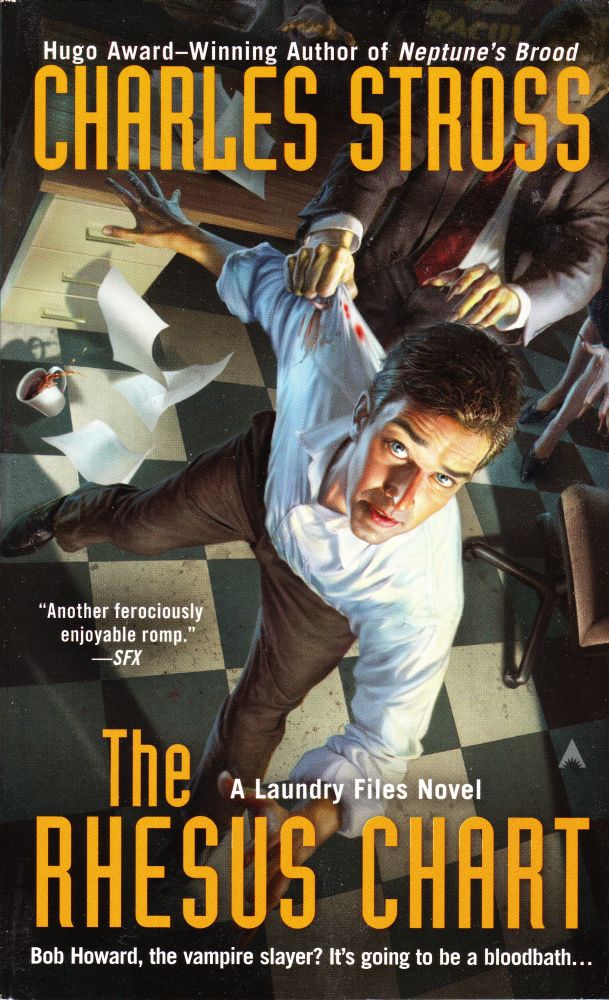
Today, we're going to catch up with a review of a book that I read most of a year ago, but wanted to talk about here. Let's check out The Rhesus Chart by Charles Stross.


For this one, we're going to need to lay down a little ground work as it is the 5th book in a series which started in 2004. A lot has happened over those years which I'm not going to go super deep into, but I at least want to talk about the setting and the state of the world and the main character when this book starts.

Charles Stross, for those not aware, is the gentleman who created the Dungeons & Dragons monsters known as the slaadi. These frog-like devotees of true chaos would not be terribly out of place in the Laundry Files, which are set in a world mostly identical to our own apart from the fact that magic exists as a branch of applied mathematics. The protagonist, Bob Howard, is a computer scientist who was recruited into the British organization (The Laundry) that deals with the supernatural after his master's thesis "nearly summoned up an undead alien god in Wolverhamption."  Many of the supernatural beings of myth exist, though often in a form rather different (and more disturbing) than popularly imagined.

Over the years Bob has faced zombies, unicorns, Santa Claus, an evangelical church dedicated to resurrecting a being from beyond, and more. He works under a manager who is in fact a being called the Eater of Souls summoned into human form. His wife also works within the Laundry as a "combat epistemologist" and violinist with a company-provided instrument with utterly terrifying offensive capabilities.

I wouldn't necessarily recommend reading The Rhesus Chart on its own; a lot of what makes this series work so well is seeing Bob develop over time from a fairly typical IT guy in a government bureaucracy into a guy who's seen and done some terrifying things (and is now middle management in a government bureaucracy). In many cases dealing with that bureaucracy is more challenging than the explicitly supernatural aspects of the series and is what grounds the series solidly in the real world. This is a setting where, after facing and driving off a horror from beyond, Bob then has to justify the expenses incurred in doing so to his manager.  That said, the important stuff is explained as you go, so you don't have to know anything from the previous books to pick this one up.

This is also a series not afraid to get very dark. Bob has seen some shit over the years, and in the background since the first book is the specter of CASE NIGHTMARE GREEN. As technology advances and Earth's population increases magic becomes easier to perform, on purpose or entirely by accident. Eventually, a critical point will be reached and the stars will come right. It can't be stopped, only prepared for. Quite a lot of Bob's development over the series has come with more knowledge of what the world's governments are doing to try to be prepared and it is, in Stross's own words, 'deeply scary'.

So why, with all of the other strange things that the Laundry has dealt with over the years, is everyone so adamant that vampires don't exist? Especially since, as we quickly discover, they do. Vampirism spreads via a fractal data visualization rather than a bite in this case, but the effects are pretty much what we're used to: burned by sunlight, craving for blood, increased strength, mind control abilities, and so forth. And a group of bank IT professionals have contracted it.

From there, Bob becomes involved thanks to a decision on the part of the Laundry's management that the organization needs to get creative and innovative by imitating Google's 20 percent time, but with vetted projects and without any working hours allocated to it. Bob's chosen project is to develop a data mining system to prove that vampires don't exist. Instead, it turns up a rash of odd deaths that lead straight to the aforementioned newly minted vampires, one of whom is in fact his ex-girlfriend from many years back. If this seems to be a very unlikely coincidence, there's a reason for that.

Part of the reason nobody believes vampires exist is because vampires are both extremely territorial and very serious about remaining hidden from the rest of the world. Think the Masquerade, but instead of vampires poncing around being Princes and Sheriffs and such, they murder each other at the earliest convenience. Bob has been drawn into a complicated conflict between a pair of very old vampires which is finally coming to a head.

As I said before, I recommend starting at the beginning with The Atrocity Archives and working your way through the series to get to this book, but if you like urban fantasy and want to see a more British and more Cthulhoid take on it than, say, the Dresden Files, this is definitely a book worth checking out.

Thalen Reads The Rhesus Chart #Blaugust2016

Don't be silly Bob. Everybody knows vampires don't exist - Dominique O'Brien
Today, we're going to catch up with a review of a book that I read most of a year ago, but wanted to talk about here. Let's check out The Rhesus Chart by Charles Stross.


For this one, we're going to need to lay down a little ground work as it is the 5th book in a series which started in 2004. A lot has happened over those years which I'm not going to go super deep into, but I at least want to talk about the setting and the state of the world and the main character when this book starts.

Charles Stross, for those not aware, is the gentleman who created the Dungeons & Dragons monsters known as the slaadi. These frog-like devotees of true chaos would not be terribly out of place in the Laundry Files, which are set in a world mostly identical to our own apart from the fact that magic exists as a branch of applied mathematics. The protagonist, Bob Howard, is a computer scientist who was recruited into the British organization (The Laundry) that deals with the supernatural after his master's thesis "nearly summoned up an undead alien god in Wolverhamption."  Many of the supernatural beings of myth exist, though often in a form rather different (and more disturbing) than popularly imagined.

Over the years Bob has faced zombies, unicorns, Santa Claus, an evangelical church dedicated to resurrecting a being from beyond, and more. He works under a manager who is in fact a being called the Eater of Souls summoned into human form. His wife also works within the Laundry as a "combat epistemologist" and violinist with a company-provided instrument with utterly terrifying offensive capabilities.

I wouldn't necessarily recommend reading The Rhesus Chart on its own; a lot of what makes this series work so well is seeing Bob develop over time from a fairly typical IT guy in a government bureaucracy into a guy who's seen and done some terrifying things (and is now middle management in a government bureaucracy). In many cases dealing with that bureaucracy is more challenging than the explicitly supernatural aspects of the series and is what grounds the series solidly in the real world. This is a setting where, after facing and driving off a horror from beyond, Bob then has to justify the expenses incurred in doing so to his manager.  That said, the important stuff is explained as you go, so you don't have to know anything from the previous books to pick this one up.

This is also a series not afraid to get very dark. Bob has seen some shit over the years, and in the background since the first book is the specter of CASE NIGHTMARE GREEN. As technology advances and Earth's population increases magic becomes easier to perform, on purpose or entirely by accident. Eventually, a critical point will be reached and the stars will come right. It can't be stopped, only prepared for. Quite a lot of Bob's development over the series has come with more knowledge of what the world's governments are doing to try to be prepared and it is, in Stross's own words, 'deeply scary'.

So why, with all of the other strange things that the Laundry has dealt with over the years, is everyone so adamant that vampires don't exist? Especially since, as we quickly discover, they do. Vampirism spreads via a fractal data visualization rather than a bite in this case, but the effects are pretty much what we're used to: burned by sunlight, craving for blood, increased strength, mind control abilities, and so forth. And a group of bank IT professionals have contracted it.

From there, Bob becomes involved thanks to a decision on the part of the Laundry's management that the organization needs to get creative and innovative by imitating Google's 20 percent time, but with vetted projects and without any working hours allocated to it. Bob's chosen project is to develop a data mining system to prove that vampires don't exist. Instead, it turns up a rash of odd deaths that lead straight to the aforementioned newly minted vampires, one of whom is in fact his ex-girlfriend from many years back. If this seems to be a very unlikely coincidence, there's a reason for that.

Part of the reason nobody believes vampires exist is because vampires are both extremely territorial and very serious about remaining hidden from the rest of the world. Think the Masquerade, but instead of vampires poncing around being Princes and Sheriffs and such, they murder each other at the earliest convenience. Bob has been drawn into a complicated conflict between a pair of very old vampires which is finally coming to a head.

As I said before, I recommend starting at the beginning with The Atrocity Archives and working your way through the series to get to this book, but if you like urban fantasy and want to see a more British and more Cthulhoid take on it than, say, the Dresden Files, this is definitely a book worth checking out.

Thalen Reads Little Fuzzy

Because if the Fuzzies are sapient beings, the Company's charter is automatically void. - Gerd Van Riebeek
This week we're having a look at a science fiction classic from 1962, H. Beam Piper's Hugo nominated novel Little Fuzzy. Far from the high tech starship filled fare that some fans seem to think science fiction used to entirely consist of, Little Fuzzy is a story of corporate overreach, legal maneuvering, and the question of just what defines sapience.

Thalen Reads Little Fuzzy

The story of Little Fuzzy takes place on the planet Zarathustra, a Class III uninhabited planet wholly owned for some years now by the Zarathustra Company, a corporation which has profited greatly from the riches of the frontier planet. Prospector Jack Holloway returns home from a days work to find a small furry humanoid creature has wandered into his hut. Befriending it, Jack takes to calling it 'Little Fuzzy' and adopts it as a sort of pet. It quickly becomes apparent, however, that Little Fuzzy is much more intelligent than a dog or cat. He and his family show many signs of being sapient, and the question of their sapience is central to the story.

If Fuzzies are sapient, that means that Zarathustra is not a Class III uninhabited planet at all, but a Class IV inhabited planet. This would make the Zarathustra Company's charter null and void. Unsurprisingly, the higher-ups in the Zarathustra Company are horrified by this thought and decide to do their utmost to suppress and discredit any evidence of Fuzzy sapience.

Little Fuzzy is a book with hardly any physical conflict whatsoever; apart from one extremely important moment, all of the fighting over the fate of the Fuzzies and of the Company's charter takes place through legal maneuvering and sneakiness. At times I thought the Company was being overly sloppy, but when you consider the degree of effective omnipotence they've enjoyed in Zarathustra it becomes more believable that they would underestimate the abilities of a septuagenarian prospector and his friends.

Although the concept of space colonization is integral to the story, advanced technology is hardly in evidence at all. Apart from the veridicator, a high-tech lie detector, future tech is mentioned in passing if at all. Jack's rifle, for instance is not described as any more advanced than a typical real-life hunting rifle. Character interaction is what matters here, not fancy imaginary thingamajigs.

I can't recommend Little Fuzzy enough; this was a great book with enjoyable characters, a couple of clever twists, and some fascinating philosophical questions at its heart. You should absolutely read it, especially as it's in the public domain. See for yourself the fate of the Fuzzies, and the planet Zarathustra.

Thalen Reads Little Fuzzy

Because if the Fuzzies are sapient beings, the Company's charter is automatically void. - Gerd Van Riebeek
This week we're having a look at a science fiction classic from 1962, H. Beam Piper's Hugo nominated novel Little Fuzzy. Far from the high tech starship filled fare that some fans seem to think science fiction used to entirely consist of, Little Fuzzy is a story of corporate overreach, legal maneuvering, and the question of just what defines sapience.


The story of Little Fuzzy takes place on the planet Zarathustra, a Class III uninhabited planet wholly owned for some years now by the Zarathustra Company, a corporation which has profited greatly from the riches of the frontier planet. Prospector Jack Holloway returns home from a days work to find a small furry humanoid creature has wandered into his hut. Befriending it, Jack takes to calling it 'Little Fuzzy' and adopts it as a sort of pet. It quickly becomes apparent, however, that Little Fuzzy is much more intelligent than a dog or cat. He and his family show many signs of being sapient, and the question of their sapience is central to the story.

If Fuzzies are sapient, that means that Zarathustra is not a Class III uninhabited planet at all, but a Class IV inhabited planet. This would make the Zarathustra Company's charter null and void. Unsurprisingly, the higher-ups in the Zarathustra Company are horrified by this thought and decide to do their utmost to suppress and discredit any evidence of Fuzzy sapience.

Little Fuzzy is a book with hardly any physical conflict whatsoever; apart from one extremely important moment, all of the fighting over the fate of the Fuzzies and of the Company's charter takes place through legal maneuvering and sneakiness. At times I thought the Company was being overly sloppy, but when you consider the degree of effective omnipotence they've enjoyed in Zarathustra it becomes more believable that they would underestimate the abilities of a septuagenarian prospector and his friends.

Although the concept of space colonization is integral to the story, advanced technology is hardly in evidence at all. Apart from the veridicator, a high-tech lie detector, future tech is mentioned in passing if at all. Jack's rifle, for instance is not described as any more advanced than a typical real-life hunting rifle. Character interaction is what matters here, not fancy imaginary thingamajigs.

I can't recommend Little Fuzzy enough; this was a great book with enjoyable characters, a couple of clever twists, and some fascinating philosophical questions at its heart. You should absolutely read it, especially as it's in the public domain. See for yourself the fate of the Fuzzies, and the planet Zarathustra.