On RNG

It’s interesting to see the level of randomness we’ll accept in our games. This post is somewhat inspired by the running jokes regarding the luck of Bel and Tam.

One of the complaints Tam and I shared about Darkest Dungeon was the tendency toward “cascading failure”. It was my experience that an enemy crit might lead to your entire team getting stressed, which might make one go crazy and start attacking a party member who would then get more stressed and go crazy, until your entire party is dead. This remains a problem even if the enemies aren’t much of a threat otherwise. Darkest dungeon revels in its randomness, and it was a bit much for me. I figured it would be a good opportunity to examine how other games use randomness.

Two Extremes

On one side, we have roguelikes. On the other hand, there are a lot of examples of games with no randomness whatsoever, like Super Mario Brothers. For the purposes of this conversation, I’m ignoring the second category, but there are a lot more of them than you might think at first. Most scrolling shooters, bullet hell or otherwise, have fixed patterns, with the only changes coming from reaction to the player’s position. Most platformers are similar, even modern ones like Rayman, Ori, and Super Meat Boy. (As an aside, Super Meat Boy is such a wonderful example of a lot of game concepts that I’m probably not going to stop comparing things to it until people no longer remember what it is.) Instead of talking about those, let’s start somewhere else familiar.

More Super Meat Boy

Ultimate Illusion

It’s not hard to see where the Final Fantasy series took its original inspiration from, and so it’s not a large surprise that it ended up with random elements to replace the dice rolling that tabletop RPGs use. As a result, there’s turn order, damage variance, spell effectiveness, enemy target selection, enemy attack selection, encounter rate, encounter type, and probably other things that I’m forgetting that are randomly determined. Even with all of this, Final Fantasy is not random enough that it feels unfair. You know that your fighter or monk is going to reliably do a certain amount of damage, enough to kill an enemy in X number of hits. You know that if you use fire spells on undead enemies, most of them will take more damage than usual. You can even have a good idea of how much damage enemies do, so you know when you need to heal. Even though there’s some amount of randomness inherent in all of these things, it isn’t overwhelming.

Final Fantasy 1

Genre-Defining

Roguelikes (so-named because of the game Rogue) feel like the above does not go far enough. Some of my favorite games fall into this category, like Risk of Rain, the Pokemon Mystery Dungeon series, and Diablo (think about it). Hallmarks here include all of the above, plus random (or semi-random) level design, random items, and getting set back dramatically if you die. The goal in this is to ensure that every time you play the game it’s a little different. The large death penalty also encourages learning, instead of memorization; your growing skill as a player is supposed to be the driving factor behind making further progress. There are enough games calling themselves roguelikes with progression systems that this isn’t always true.

My problem with some games like this is that it’s possible to get an RNG overdose. Using Risk of Rain as an example, if you’re playing one of the close-range characters and don’t have a decent source of healing by about 20 minutes (on normal), you might be doomed due to circumstances that are mostly outside of your control. Likewise if you’re the commando (the character you start with) and haven’t found something that helps you deal with groups, you’re going to have a hard time. Roguelikes in general tend to be somewhat bad about this, it’s possible to have lost and not even know for a period of time. In Risk of Rain in particular, this time is unlikely to be longer than about 10 minutes. In Darkest Dungeon, it sometimes wasn’t as kind. (Ex: “You didn’t bring enough shovels, but you don’t know that yet!”) They also have the problem outlined in the opening, where defeat comes from a series of unlucky rolls in a very short amount of time.

Risk of Rain
Then there’s the engineer, in which case you don’t care about items.

Sliding Scale

This doesn’t seem like an easy problem to solve. In games of this style, things have to vary enough to be interesting, without screwing the player over completely. You might argue that “screwing the player over completely” is the point, but I don’t buy that, and that mentality is why most of these games struggle to expand their audience. I think one of the best solutions is the ability to choose how difficult the game is, but this isn’t perfect. Diablo doesn’t make you play on Hardcore mode, but it’s there as an option. Pokemon Mystery Dungeon only makes you start at square one (Level 1, no items) for the bonus dungeons.

I haven’t given up on roguelikes as a whole, and I’m always interested to see how the next one handles some of these issues. The fact that other people like even the games I think are too random proves that there’s an audience that enjoys that. Steam certainly has plenty to choose from.


Source: Ashs Adventures
On RNG

Taking Ownership

There’s a really common business concept that I’ve heard a lot of, mostly through my time making games. It’s often suggested that you should “take ownership” of your work, and that doing so gives you more investment and makes you care about it more.

https://www.etsy.com/listing/229464652/hand-painted-coffee-mug-this-is-my

https://www.etsy.com/listing/229464652/hand-painted-coffee-mug-this-is-my

It’s an effective strategy from a leadership perspective, but it’s not without cost. To truly allow someone to take ownership of something, they need to have the freedom to shape it in their own way. In a lot of endeavors, this is fine, but as nice as it is to have an invested employee building something for you, if you really do need it a specific way there’s a good chance you’ll be robbing them of ownership.

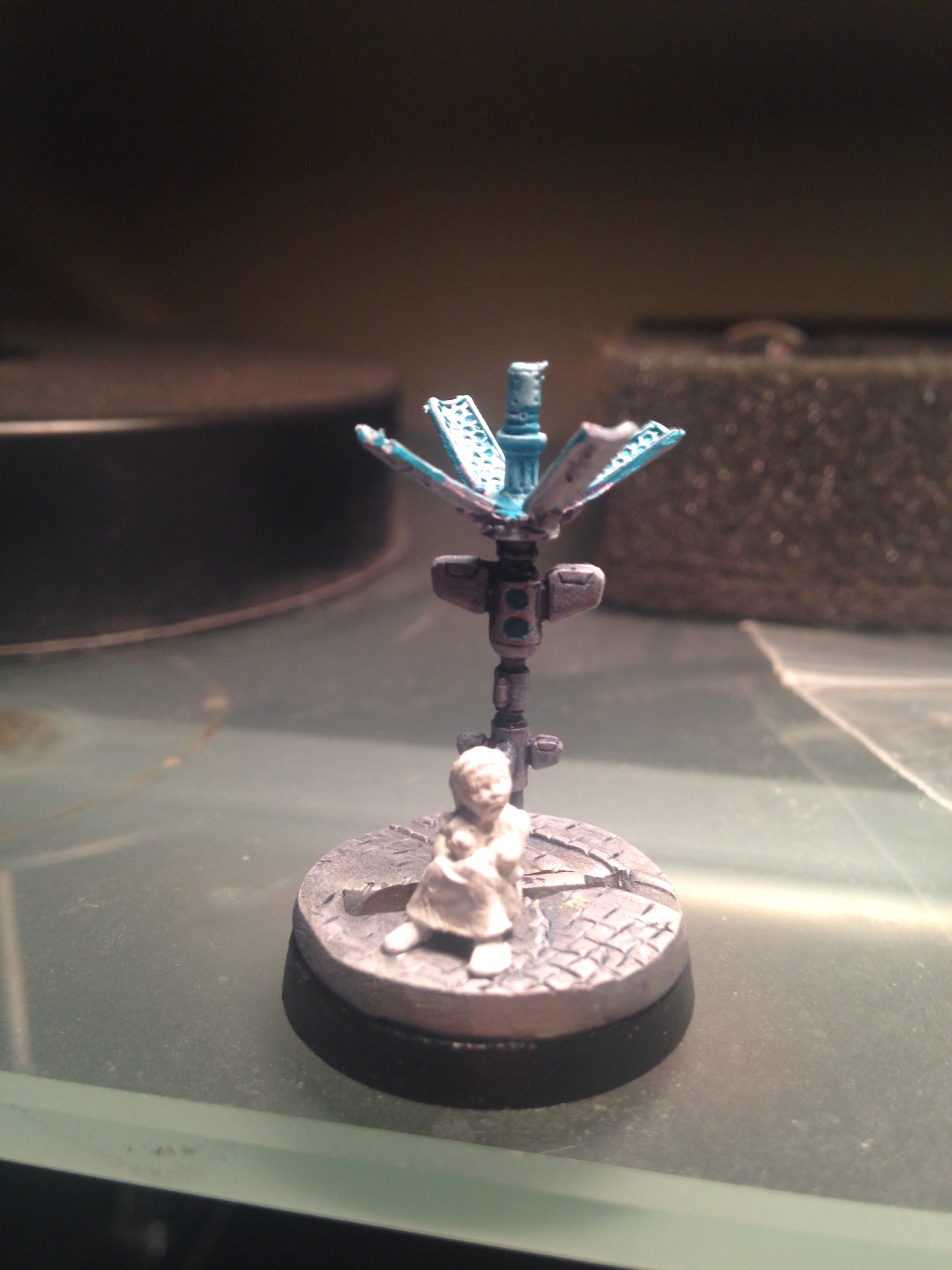
To look at it from a different angle: a big part of my attachment to the minis games I play is the personal touches I give my collection. Even beyond painting them, I do a lot of careful work in assembly, often significantly converting a model, to put my own personal touch on it. I can’t remember the last time I assembled a mini precisely how it appears on the box, and in some cases I’ve done some conversions so extensive that the mini in question is almost totally unrecognizable. I do my best to be careful about the minis being confusing on the table top, but the personal touch is important to me.

SAO's Yui, work in progress

SAO’s Yui, work in progress

One of my recent projects is an extensive conversion of an ALEPH Steel Phalanx force to SAO characters. I’ve carefully constructed a playable list from the minis I have (and a couple of additions), and am converting the entire group to match the main cast of the show. Prior to this, I’ve never liked Steel Phalanx, it’s a faction made up of characters that don’t really resonate with me. By turning them from characters I couldn’t care less about to characters I’m interested in, I’ve been inspired to do a lot of work converting and painting the entire team, and I suspect I’ll have a lot of fun actually playing them, too.

The Infinity community (as represented on the forums) has been publicly supportive of this project (and others!), but I’ve gotten the occasional bit of criticism– why change the models that are sculpted the way they are for a particular reason, or why make your games more confusing with bizarre proxies or heavily altered pieces? It’s a similar type of criticism I’ve recieved from a recent Ariadna team I put together, which was based on my Shadowrun campaign and is about half-comprised of non-Ariadna minis that fit the Shadowrun characters but aren’t necessarily part of Ariadna as a faction– potentially confusing for someone, even if I’m very consistent about how I use them.

Volt Securities and Interdiction, my (commissioned) Ariadna force.

Volt Securities and Interdiction, my (commissioned) Ariadna force.

The reality is that without my own personal touch on these groups of minis, I wouldn’t own them, or they’d collect dust on a shelf. At any given time, I usually have a handful of minis that I haven’t assembled, sitting around in boxes because I picked them up from a tournament victory, as part of a sale, to round out another order, or just on a whim, and I haven’t made a personal connection with them that gives them value to me beyond game pieces. When I put my own spin on them, they have meaning for me even when I don’t like them. I often go as far as telling myself my own stories about them, determining fictional personalities and stories about the groups I put together, which inspires paint schemes, details, and even extends to list construction.

When I was growing up, I once complained to my dad that the essays I had to write in school were boring and meaningless. He suggested that I use the essay prompts as a way of springboarding into a topic I *was* interested in– his actual phrasing was more like “use the prompt just long enough to lead you into something you actually want to talk about, then talk about that”, which appealed to my teenage subversive side, but the end result was the same. My writing quality jumped immensely after that, partly because the satisfaction of “tricking” the teachers into letting me write about whatever I wanted gave me a smug sort of glee, but also because once I was writing about something I actually cared about, I put more effort in the work. On several assignments, I was told later that I didn’t exactly adhere to the prompt as such, but that it was a good enough essay that the teacher would let it slide. I took ownership of my writing and the improvements were noticeable, though the end result was often not what had originally been envisioned.

265993921711885580_bexvnq4x_c1

The same is true elsewhere as well. My writing, my minis, and my work all get a lot more care and effort put into them when I can take ownership and make them my own, but it also means they’re very likely to be significantly different from the standard set of expectations. As a team leader, I take care to be aware of this double-edged sword. I can give someone a lot of freedom to work out how they want to do things, but if I then come back and “make corrections” or otherwise deny then the freedom to add their personal touch, especially after the fact, I’m both sabotaging my own credibility and damaging the work of my team member. When I delegate a task out to someone on my team, it’s important that I support their efforts, even if they’re not what *I* would choose to do, so long as they’re effective. If I want something done my way, I had better be prepared to do it myself, or I can’t expect to draw upon the additional motivation and value that comes from someone “taking ownership”.


Source: Digital Initiative
Taking Ownership

Playing as Women

Chaos in Motion

ffxiv 2015-06-03 20-46-13-39 Last night I had no real intentions of doing anything serious.  I started off the night on my gaming machine upstairs, but had every plan to eventually filter downstairs to the sofa with my laptop for some more casual gaming while watching television.  For a period of time I was spending my Wednesday nights helping out the second free company static raid, but as they started getting more people interested I became scarce by intention.  I never really wanted to be part of two different raid groups, but was willing to help so long as my presence was really needed.  Last night however they had four absences, so while I did not intend to do anything I stepped in to help out as best I could.  What made last night all the more important is that it was the inaugural raid night of my good friend Wulf, the paladin tank from our World of Warcraft raid.  The only problem being that even with me being pulled in we were still sitting at only five players.

So we shifted around our sights on simply knocking out some early content and opted to queue for Garuda Extreme instead.  It is at this point I realize that while I know how to do these fights…  I suck at explaining them.  Wulf is very much a tank that likes to know all of the information about something before going into the fight.  I on the other hand tend to be very much an “adjust to things on the fly” player, and as a result I only ever have a vague cliffs notes versions of fights in my head.  There are a lot of things I “know” about a fight, but I don’t really “know I know them”.  This makes me the least reliable source of information for someone who craves to make order out of the chaos.  To make matters more tenuous we were pugging in three players on each attempt, and Wulf was being hit by the dreaded instance server lag that sometimes hits me in FFXIV.  All things considered we had a great night and managed to take down Garuda Extreme for him as well as Binding Coil of Bahamut Turn Four.  I am hoping he enjoyed himself at least a little, even though most of the night was pretty much unbridled chaos.

Playing as Women

johanna Over the last few months I have come to a bit of a realization, that apparently my brain works slightly differently than I thought it did.  For years now I have thought that I simply did not like playing female characters in video games.  When I attempted to do so I felt like I just could not get into playing the characters as much as I could the male counter part.  All this time I thought it was simply me favoring a character that was “more like” me personally, much the same way as I tend to create all of my MMO characters as some sort of idealized version of my self.  It turns out I am apparently completely wrong about the motivation behind this.  Granted when it comes to a character like Sheppard in Mass Effect I will always still prefer the one that is more like me.  I’ve come to the realization after a series of tests of this theory…  that I simply have a problem playing female characters with horrible armor and weapon choices.  If you give a female character proper armor and really good weapons then I seem to be perfectly happy bashing things in the face as them.

Zarya Admittedly the trend of placing women in video games in ridiculous outfits has always bothered me on some level, but I had no clue it was my actual impediment for enjoying playing women characters.  The realization of this slowly started creeping in when I found myself really enjoying the newest Tomb Raider awhile back, after never really being able to get into the original during college.  Since I am not really big into narrative game play, I was trying to figure out what made the difference all the sudden… and the only thing I could land upon was “because she is a badass”.  The original one always bothered me because it seemed to focus more on showing off her pointy polygon boobs more than anything else.  Then when I was presented with a character like Zarya, I immediately thought…  “I would  totally play as her, she is a badass” and I had a similar reaction yesterday upon seeing Johanna in Heroes of the Storm.  Give me a woman decked in armor and wielding a badass weapon… and I will happy play as her any day of the week.  Give me a wilting flower in what is essentially a bra and panties… and you can have all of my “NOPE!”.

Finding my Groove

HeroesOfTheStorm_x64 2015-06-03 22-03-50-29 Last night after the raid in Final Fantasy XIV I decide to poke my head into Heroes of the Storm to check out what Johanna looked like in game.  I had intended to do the “try” option to poke around as her for a bit, when Damai asked if I wanted to play for a bit.  Now I have been poking around in this game since alpha, and played a significant amount when the game went into beta and I finally had people to play with.  That said over the last several months I have not played at all, and was completely out of touch with the current state of the various heroes.  Previously my champion had been Muradin because I could build him tanky or I could build him extremely “murdery”.  The problem being that I was just “off” on playing him because it feels like maybe his survival got a whack from the nerfbat.  I was spending more than my fair share of time running back in from the nexus because I kept dying to stupid crap that I would have been able to survive when I played the game last.

HeroesOfTheStorm_x64 2015-06-03 23-26-08-94 Damai mentioned that he wanted to switch to playing support so that he could work on one of his quests… and I had honestly forgotten this was a thing that Heroes of the Storm had.  I had the quests “Play 3 Games as a Warrior” which I was already doing and “Play 3 Games as Diablo Character” so I opted to play some Sonya.  This was a champion that I got through a hero bundle that I purchased, and had never really spent much time playing her.  My god..  I think I have found my champion because upon switching over to her I started having a blast last night.  I went ahead and ponied up for the more armored “Wrath” set look from the store, and it is pretty badass that she is wielding Ashkandi in one hand and Quel’Serrar in the other.  What I like the most about her is that she quite literally uses “Fury” as a mechanic meaning you are not gated by running out of mana, but you are instead gated by having to earn fury through combat just like a World of Warcraft Warrior.  We played a half dozen games or so before I decided to head on to bed.  I could have easily stayed there playing another half dozen more.  The state of the game is extremely fun, and I need to grab Damai and do this more often.  At some point I am absolutely going to have to also pick up the Shatterstar themed skin since I am a sucker for all things New Mutants/X-Force.


Source: Tales of the Aggronaut
Playing as Women

Tam Suggests: Knights of Pen and Paper

KoPP_1_Packshot_2013-04-10

I’ve been playing a lot of mobile games lately, for a couple of reasons. The big one is that it’s a hugely underappreciated segment of games that’s increasingly the most relevant part of the industry, and the other is that I spend a lot of time away from my computer, and lightweight mobile games are increasingly my go-to.

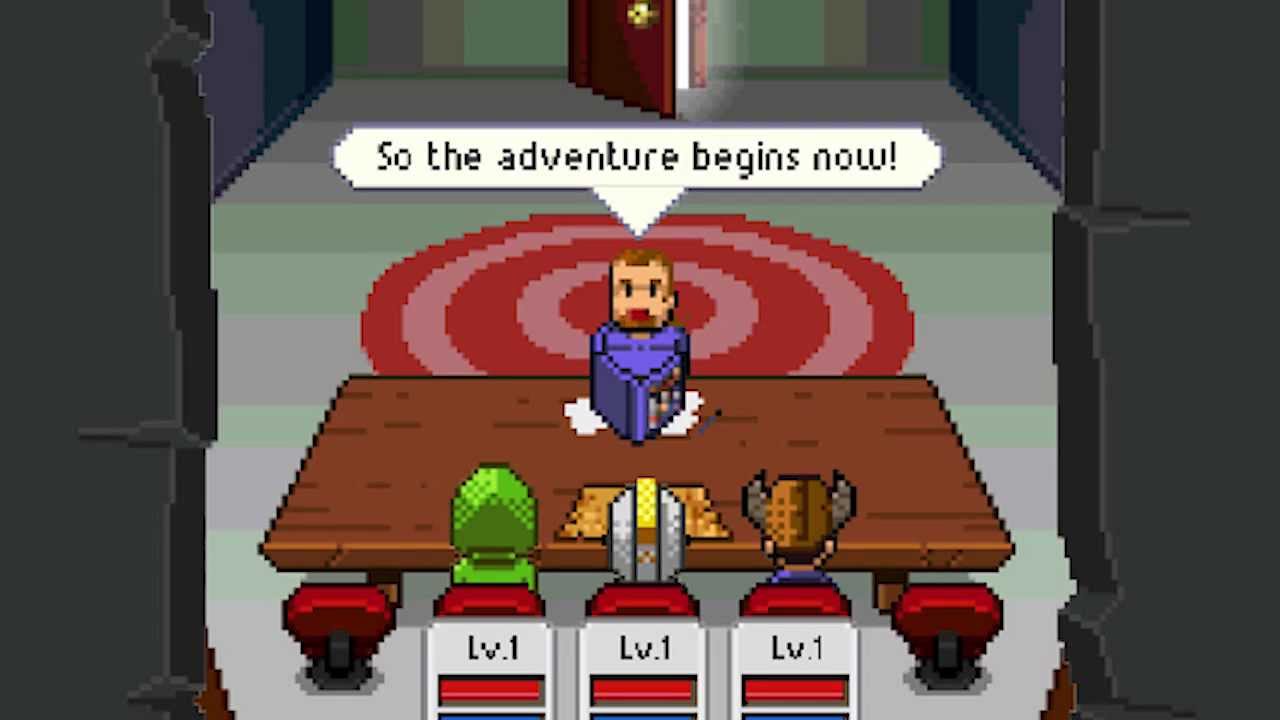
At the recommendation of a few people, I picked up Knights of Pen and Paper, a turn-based RPG in which you play as a bunch of people sitting around a D&D game with a DM. It does the whole pixel art thing, trying to evoke a classic feel in its characters and monsters. It’s hearkening back to NES-era graphics and gives the vibe that it’s a DM running a game with some rough edges while itself being a polished, solid experience.

maxresdefault (1)

It takes a lot to pull off what they’re trying to do, and I think it works really well. The DM sprite narrates quests and adventures to me, and my party is made up of five other characters, all playing particular classes. I get to pick who’s playing, and different people have different special strengths for me to choose– I’ve got the pretty, popular girl who gets discounts at shops, I’ve got the studious, top-of-the-class girl who’s pretty good at everything, I’ve got a guy in a band, I’ve got the pizza guy who dropped in to play a game, and I’ve got an artist girl who’s lucky. Each of these characters is playing a particular class, which I also get to pick– I’ve got the choice of Paladin, Warrior, Cleric, Druid, Rogue, Wizard, and there are other classes I can unlock with quests.

The setup is entirely charming, and the writing is often really funny. I can have random encounters as I travel from place to place, and the DM always sounds vaguely surprised or disappointed when nothing awful happens to me. When I get into an encounter, various players make outraged comments or jokes about cheating. The writing is lighthearted and fun, but still moves things forward. It hits a sweet spot in between telling a coherent story and making nods to the kinds of ad-libbed nonsense that happens in real pen-and-paper games.

Knights-of-Pen-and-Paper-Character-Selection-Screen

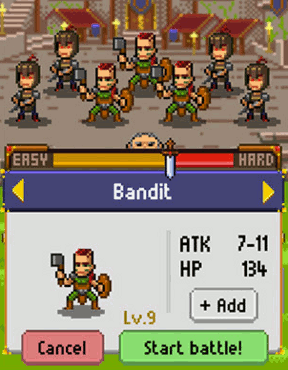
Gameplay is split into two pieces– quests and the overworld. In the overworld, I can choose to go shopping, travel around, take on a new quest, swap my party around, rest, etc, all by talking to the DM. When I take a quest, I have to travel to wherever the quest is located and then fight encounters there, which is where things get interesting. First off, I get to pick how challenging the encounter is. I can customize most quest battles to be as easy or hard as I want, selecting appropriate enemies and adding them to the encounter. More challenging encounters are more rewarding, and certain boss fights and random encounters have a set difficulty. Quests will often ask me to fight a certain number of enemies of a particular type, and I can fight them all at once or take them on more slowly, depending on how my health and mana are doing.

knightsofpenandpaper

Recovering health and mana is done by resting, or through spells. My choice of classes determines what abilities I have to work with, and building a balanced party is important, but the means with which you go about it is entirely up to you– there are a lot of combinations that work, and if you have one that will be strong later but is weak to start, you can still make it work by lowering the difficulty of your encounters early on.

Knights_of_Pen_and_Paper

In combat, every character gets a turn, and you can see initiative order (determined semi-randomly, of course), so you can prepare in advance. Each character gets an action, which can be a basic attack or one of their special abilities, which cost mana. The effect is that I feel like I’m playing a D&D party, each person reacting to the situation at hand and lending their unique skills to the group.

After finishing Hero Emblems, I wanted another fun RPG-style game, and Knights of Pen and Paper absolutely fits the bill. It’s definitely worth your time, and I look forward to playing more of it and exploring what it’s got to offer. It’s got a lot of systems that I haven’t really talked about because I don’t know much about them, but suffice it to say you can equip your characters, you have a party inventory, and you can upgrade your gear and abilities as you level up and get more money, all of which change how you play. There’s a ton of optional content and (apparently) a lot of hidden unlocks, so exploring random quests is entirely worthwhile (and levels up your characters!).

I’m enjoying it a lot, hopefully you will too. There’s even a sequel!


Source: Digital Initiative
Tam Suggests: Knights of Pen and Paper