Successful Organization With Three (double-edged) Swords

swords03

Organizing people is hard. No matter the number of people, organization is the place where many otherwise noble endeavours fall down. I’ve had the privilege of being a part of and sometimes helping form and lead a goodly number of organizations of varying types, ranging from professional teams of 5-10 people all the way up to massive disconnected virtual teams of up to 100. They’ve all had their strengths and weaknesses, and some have fallen apart while others have come together to accomplish something awesome. Having an organization fall apart can be painful, and it’s worse when everyone involved (particularly those in charge) are trying to hold everything together. A group that works well can stay close for years or decades, and a group where everyone is invested but still winds up shredded can linger for a long time.

I’d like to talk a little bit about what I’ve learned while trying to bring people together to accomplish various goals. I’ve been reading a lot of management books as part of my studies, and they often talk about what it takes to be a successful leader. While I think that’s important, I think that the organization itself is more important than its leader, because if it can’t function without its leader it wasn’t a very solid organization to begin with.

In the various things I’ve read, there’s been a few recurring concepts that are touted as important things for a leader to develop. I think they make a good set of pillars for an organization as well, but I also think they’re double-edged swords. Everything requires moderation, and these ‘swords’ can help your organization cut through obstacles in its path or they can shred your group to pieces.

Here are the ‘swords’ that need to be wielded by successful organizations:

communication-minunderstand-communication-cake-demotivational-posters-1308257790

Communication

This is the first, most important thing. Everyone in the group needs to be able to communicate. The more open the communication, the better, to a point. Organizations with insufficient communication see drama, siloing, and inefficiencies borne of a lack of spread knowledge. We live in a world where a quick chat with someone should be a couple of keystrokes away, but we often fall into patterns of noncommunication for various reasons.

A healthy organization needs to be able to communicate, which is more than just status reports. Praise and criticism need to be available, and the most successful groups I’ve worked with are able to handle both. This isn’t something a leader can accomplish on their own; it requires that the group develop an atmosphere where speaking one’s mind, whether that’s to praise someone, provide constructive criticism, or ask for help is not just allowed but encouraged. Sometimes, this communication may need to be private or anonymous, but the the very best groups it doesn’t need to be, and either way it should exist.

Communication has a downside, though. There is a time to talk and a time to act, and any organization needs to know the difference. Planning is very important, but it’s vital not to get bogged down. One of my rules as a raid leader is that any explanation of any boss fight can last no longer than thirty seconds. I’ve (frequently) made exceptions to this, and they’ve always been mistakes. Often we face encounters that require more than thirty seconds of explanation, but this doesn’t change the rule. I’ll explain everything I can in thirty seconds, we’ll take a crack at it, fail, and move forward with another thirty seconds of explanation. More than that and people lose interest.

As the stakes get higher (in, say, a professional environment with money on the line), that threshold increases, but there’s still a limit to how much talking can occur before most people tune out. Agile development operates on a similar concept, with “sprints” being a small subset of a larger picture and covering that attention threshold. In the raid, we explain a bit, pull, wipe, then course correct. In Agile development, you plan a bit, execute for a few weeks, then come back, see what worked, then course correct. Same strategy, broader application.

sw_leadership

Direction

This is almost as important as communication, and is kind of a “well, duh” concept. A group needs a task, a goal that it’s working towards. This can be as specific as “complete this assignment” or “defeat this boss” or it can be as vague as “make a place to call home” or “support each other through hard times”. A really solid group can be pointed in a direction and go, getting everything necessary done along the way.

An idea that I’ve found difficult to internalize is that a lot of times, simply telling people what to do is extremely effective. I’ve been a part of and even led a lot of groups that have fallen apart because the directing force is too weak. Sometimes it’s trying too hard to accommodate everyone’s schedules, or it’s overly worried about what everyone in the group wants to do, and winds up doing nothing. I personally spend a lot of time trying to work out what everyone in my groups wants if I’m leading them, and sometimes I just need to tell people what’s going on and let them figure out the details for themselves. The key to this is to respect and appreciate the people on your team, understanding that they’re often trying to make things work. A secret I’ve found out about myself, and that I suspect is true of others, is that when I’m told where to be, what to do, and when, and I have to change my plans to make that work, I’m a lot more invested in what happens, so I’m more into it.

The dark side of this is twofold. When direction is wielded as a weapon, it leads to micromanagement or closed communication. People in the organization should be capable of knowing what needs to be done and doing it without needing excessive oversight– if this isn’t the case, that’s what training is for. If direction is used to excessively shut out avenues of communication or topics raised, it closes communication lines. Obviously some suggestions, comments, and ideas won’t work or aren’t appropriate, but there’s a line between staying focused and clamping down that shouldn’t be crossed.

Demotivational-pictures-motivation

Motivation

Motivation is the last ‘sword’, and it’s the trickiest one. It’s important that everyone in the group is motivated, but it’s also important that the motivation is genuine and not forced. When I posted a few weeks ago about limiting my raid’s focus on a given encounter to two weeks at a time and no more (there’s that direction thing again), it was the result of a vibe I was getting that mirrored my own feelings. We weren’t making progress because we were all bored of the same thing, but we wanted to raid together and so were all forcing the motivation.

In the past few weeks, we’ve hit other targets, and beaten every single one. We’ve progressed through a ton of bosses that we’d never seen before, and when we returned to the original boss we’d been fighting, we instantly made progress into a portion of the fight we’d never really cracked open. I’m confident that we’ll have the boss down soon, just from the break and the breather we’ve had.

My motivation for the “two weeks” rule was partly selfish. I was getting bored of the same boss week after week, and at the time I wondered if I was misreading the vibe I was getting– projecting my lack of motivation onto everyone else. As the group’s leader, I’m not sure there’s a difference. Motivation in a group often trickles down from the leadership, and I think it’s significantly more important as a leader to motivate yourself than try to motivate your team when you aren’t fully invested yourself.

This can backfire on you– you need to be empathetic to your group’s needs and desires beyond your own– this much is obvious. Trying to force motivation is the more insidious trap, though. Every group needs to be motivated, but trying to force it feels shallow and will quickly make your team bitter, which undermines both your communication and your direction. Motivating people is often about being motivated yourself and letting that energy flow outwards, rather than trying to create it from nothing. In a good group, however, this can often become a positive feedback loop, which is ideal.

tip-of-an-iceberg

This is just scratching the surface of my take on managing an organization, but hopefully it was interesting for someone.


Source: Digital Initiative
Successful Organization With Three (double-edged) Swords

Happier Without Meters

Deliberate Exclusion

ffxiv 2015-05-02 20-24-37-37 One of the puzzles I have been trying to sort out the entire time I have been back in Final Fantasy XIV is why exactly the community as a whole seems to be friendlier to other players.  I’ve talked about the various literal “social engineering” missions that the development staff have made in order to spin things that would normally be a negative as a positive.  When I see the new player bonus in a dungeon I actually get excited rather than frustration over having to potentially teach someone new mechanics.  Quite honestly I am wondering if it is something far more simple than anything, a line in the sand that the folks running the game drew long ago and have since reinforced numerous times.  In Final Fantasy XIV running a DPS log parser is not only unsupported by the game, but it is actually an actionable offense.  This has had an interesting chilling effect on some of the elitism that you normally see in communities.

Since simply mentioning parsed logs in private free company chat can end up with a GM knocking down your door…  it changes the way folks interact with the data gained from log parsers.  That is to say people are still parsing the logs, but the first rule of “FFXIV-APP” is there is no “FFXIV-APP”.  This means that no one gets called out in the middle of a pug for having “weak dps” and no one is standing around in “trade chat” linking their latest boss kill.  The players that do parse, do so quietly and in secret and I believe in the end this makes the “meters” less of a competition and more of a personal diagnostic tool.  It seems that once you take this competition out of a community it has some pretty wide reaching trickle down effects.  I’ve always thought of dps meters as a distraction, and back during Burning Crusade and Wrath of the Lich King, we had rules against mentioning them or linking them in raid chat.  I largely just found the automated spam annoying, but it also seemed to cause players to focus on things that were less important than the mechanics of a fight.

Accidental Experiment

Wow-64 2015-05-05 21-51-46-49

The problem is that meters are a double edged sword.  Eons ago while the earth was still cooling I needed a add-on called Omen in World of Warcraft to let me know how I was doing on threat.  Later on these features got rolled into Recount, and Skada and the rest of the meters.  As a result I simply got used to running the meters all of the time, but after a point they were no longer needed.  Tank threat became a non-issue with the introduction of Vengeance to help mitigate the lower damage that tanking characters generally had.  Once introduced into my life I started feeling like I needed meters all the time to let me know how things were going.  I became addicted to the metrics and numbers associated with raiding, and as such spent a good deal of my time staring at bars and percentages rather than actually playing the game.  Some weeks back I talked about being frustrated with the current state of my mods, and actually went so far as to start installing several of the addons that I had been using.

One of the addons that ended up getting pulled was Recount, because I had this plan of switching over the Skada.  The funny thing is that I got interrupted during the middle of what I happened to be doing, and while Recount absolutely got installed…  I never went so far as to install another meter.  The first time I noticed was during a raid a few weeks back, but since I was so used to NOT having meters in Final Fantasy XIV it didn’t bother me terribly much.  This combined with the fact that I knew someone in the raid was going to parse our logs anyways caused me to simply ignore the fact that they were not there any more.  The end result was that I felt generally happier about my night of raiding.  I spent more time in the moment of the game play rather than focusing on how I was doing versus this player or that in the meters.  I decided to just go with this and run without meters for awhile to see if it improved my overall outlook on the raid.

Happier Without Meters

ParsedMeters The funny thing is that I actually think it did.  World of Warcraft stopped being a competition for me and more of an experience.  Sure the fights are still nowhere near as engaging or enjoyable for me as the ones in Final Fantasy XIV but I am spending more time “in” the fight and less time worried about other non-important things.  The funny thing about this is that apparently it had other effects on my game play as well.  The constant concern about how I happened to be doing may have been actually holding me back from actually doing well.  I figured I was still firmly in the middle of the pack dps wise, until after the Flamebender Ka’graz fight one of our mages said something that made me curious.  He said something to the effect of “I can’t  believe I was beat by a protection warrior”.  To which point I confessed that I had installed my meters some time ago, and had no clue how I was actually doing anymore.  To which my raid leader responded “Well, Bel, You Did Well” and linked me the url of the live parse.

There are a lot of mitigating factors behind my performance and I know this.  For starters I recently got the four piece set bonus and for gladiators it essentially increases everything useful to us by 20%.  More than that I think the absence of meters caused me to stop worrying about every button press and rely more on what I knew I should be doing when I should be doing it… instead of trying to second guess myself all of the time.  In essence I stopped caring about my performance and just started playing the damned game, and while it most definitely improved my levels of happiness it also seems to have actually improved how I was performing.  I am just not a hyper competitive person about most things, and accidentally eliminating that stimulus from my game experience seems to be a net positive for me.  I know that there are always going to be meters tracking my performance but I also feel like so long as they are not in my face all of the time I can try and ignore them.  Now I am not suggesting that you uninstall your meters, and that it is some new path to happiness.  However for me it seems to have given me a new lease on a game I was starting to hate playing.


Source: Tales of the Aggronaut
Happier Without Meters

Axe to Grind

Lung Infections Suck

cottonwood I’ve been in a strange place the last few days, where I am still recovering from what has turned out to be an infection in my lungs.  It has been allergies central around here and unsurprisingly my lungs have reacted negatively to it.  I had been dragging along for awhile with what felt like a constant persistent dry cough.  Last Friday I finally decided to go to the doctor when I coughed up a small bit of blood.  Turns out my lungs were actually in far worse shape than I thought.  Since then I have been on a pretty heavy dose of prednisone and am on the mend, but man…  I have to say I am still drained as hell.  I attempted to go to work like normal yesterday but ended up coming home about halfway through the day.  Today I am making another attempt to go a full day, so I am hoping the strength stays with me.  What is so strange about this one is just how drained I feel as a result of simply existing.

Why are my lungs betraying me you might ask?  The above photo is not intentionally abstract but instead my my phones camera attempting to focus on what are ultimately hundreds of tiny particles of Cottonwood seed.  This is what we jokingly refer to as summer snow, and with all the rain we have been getting the Cottonwoods have been blooming in overdrive blanketing the law with a mat of white fabric and making the air look like it is quite genuinely snowing.  Thankfully I have a day or two of reprieve thanks to the recent round of storms, but I am sure as soon as things dry up again the bloom will begin a new.  Normally this happens around my birthday in June but I guess all the moisture moved up the time table.  In any case it sucks to live through and I am just hoping that I can limp through until it has finished.  In the meantime I will continue to take this high dose pack of prednisone and antibiotics and pretend to be a normal human being.

Axe to Grind

ffxiv 2015-05-11 22-18-55-06 For months now we have been slowly keying folks through the various primal fights in our Final Fantasy XIV free company.  While a chunk of us have been sitting on the Ifrit step, the final of the original set of Extreme primals… it seemed like every time we set out to attempt it we were missing a seventh or eighth that also had it unlocked.  So we would once again shift focus and do another round of Garuda or another round of Titan to get people caught up.  Last night, finally after a new round of Titaneers we managed to get eight people on at the same time with the ability to do Ifrit.  Now I realize I could have been pugging my way through the primal encounters, and with all of the mount farming parties this is a relatively straight forward prospect.  There is just something rewarding about doing a fight that is new to you, with nothing but your free company surrounding you.  It makes the kill that much sweeter and the experience that much more magical as you accomplished a new mission with friends.  Once again we went into the fight without much research, but managed to pick up the basics extremely quickly.

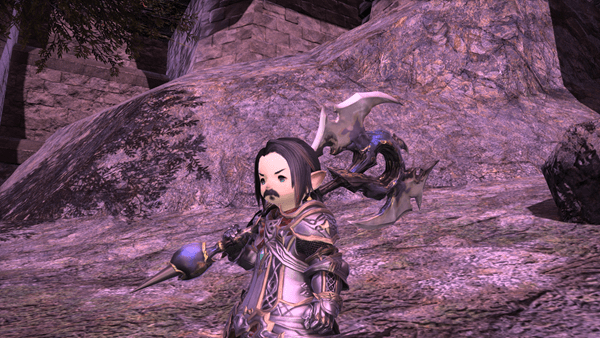
ffxiv 2015-05-11 20-43-37-55 It took us several attempts but by the end of our first night ever working on the boss we had downed an Ifrit and moved on to other things.  I cannot tell you how happy it makes me to get this quest out of my log.  I know the big push for this at least from Ashgar’s side was to get the sweet axe I am pictured holding in the first picture.  For those who have completed some of the later story, you will recognize this as the axe that Moenbryda wields.  It is just one of many weapons you get as a reward for defeating the original trio of Primals, but I went with the axe because it is probably one of the more unique appearances in the game.  Now I doubt if it will ever offset my usage of my Malignant Mogaxe, but it is still pretty awesome to have it as an option for when I decide to change up my outfit a bit.  Glamouring/Transmogging/Wardrobes are one of the simple pleasures of a modern MMO.  The ability to look like you want to look is what makes these games fun to play for me.  Gone is the era of looking exactly like every other player in the game, and here to stay is the ability to craft your own appearances.  After playing Everquest and being able to tell every single item a player was wearing based on its color and appearance…  I have to say I am happy to be living in modern times.

Back to Nael

ffxiv 2015-05-08 19-17-57-51 Yes I realize this is not a picture of Nael Van Darnus but I didn’t snap any pictures from our attempts on Turn 9 last night.  Instead this is a picture of me rocking the Garuda bow because I finally feel like I have an outfit floofy enough to support it.  This weekend I managed to finish getting my 120 set from World of Darkness which makes up a chunk of the outfit above.  Since picking up the Garuda bow I have been looking for a reason to use it, and finally I think the gold and white in the Bogartyr coat works well enough with the gold and white on the bow.  Now if anyone tells me that is really blue and black I will reach through the internet and punch them in their soul.  A few weeks back we set down on a new mission, which involved alternating between working on coil and working on other things.  Since then we have finished the original three primals, Leviathan Extreme and Odin and as a result feel like we are no longer beating our heads against the wall that is turn nine.  Coming back to Nael tonight felt far more fresh than it has in a long time.

I was somewhat concerned that we would have lost progress, but in truth we picked up right where we left off and started making fast progress.  Everything about the fight is smoother now and we have been making it into the final dance phase every single attempt.  The awesome thing about this is that it feels like last night we were finally getting the pattern down.  In fact the last few attempts we were making it to the dive bombs phase consistently.  Now if we can just master where the dive bombs need to go… I have a feeling we will be clearing turn nine finally and moving on to the final coil.  I love my static group, and I love the way folks just keep plugging away without getting frustrated.  We have been on this boss for a very long time, and no one seems to have any diminished desire to KEEP doing the boss, or keep trying to succeed.  In fact everyone seems to keep doing little things here or there to tweak their performance and make things work more smoothly.  I love my free company, and I love the raid we have built around it…  my hope is that we can keep trying to get more people into the mix and maybe with Heavensward expand to a third static because the two we have now are just awesome.


Source: Tales of the Aggronaut
Axe to Grind

Back But Don’t Play

Supporting Kickstarter

wasteland2 This morning I am going to tackle the second talkback topic for the Newbie Blogger Initiative because it is actually one that has been on the hearts and minds of the AggroChat folks for the last few weeks.  For the April AggroChat Game Club game I chose Darkest Dungeon, and since then the topic of playing “unfinished” games has been somewhat of a recent discussion among us in private.  The fact that the game was unfinished caused numerous problems, not the least of which was the simple fact that we were never quite sure if this or that functionality was intended… or just unfinished.  So I feel like I was not able to give it a really solid testing, because I don’t know what might change between now and when the studio deems the game “finished”.  The prompt however for this talkback is pretty straight forward but my answer is going to be a bit more nuanced.

Early Access and Kickstarter – Do you support unfinished games?

So for the first part… yes I wholeheartedly support the backing of unfinished games.  I’ve backed more than I can count at this point through either Kickstarter or company specific initiatives.  I think Kickstarter is a pretty awesome thing, and it has caused a lot of things that I care about to see the light of day.  I’ve backed both software and physical merchandise projects through it, and have been relatively happy with pretty much every project I have ended up chipping in on.  Kickstarter does a lot of things, but the biggest one to me is that it allows me to vote with my dollar on what I think is going to be an idea worth making.  I rarely back very far into a given product tree, and the end result is me usually getting a cut price copy of the game at launch.  While many of these games offer a double platinum early access alpha program…  that is not so much what I am interested at least not any more.

Tired of Alphas

Once upon a time I wanted to be playing every single game I could get my hands on.  I reveled in the fact that I had alpha and beta tested most of the MMOs out there.  For a period of time this was something that was achievable because at any given moment there were a very limited number of Alpha and Beta test programs available.  Somewhere along the line I noticed that playing an Alpha seriously adversely effected my chances of staying with a game for very long after release.  In essence I would burn myself out playing the Alpha, so that when launch happened the game felt very old and tired to me.  The pinnacle of this problem happened for me with Elder Scrolls Online.  I seriously cared about the release of this game, and I took my Alpha testing duties seriously.  I was told at one point that I was in the top 1% of all bug reporters in the game, and every single time we played I spent most of my time reporting and re-reporting issues I saw.

The problem here is that I had been alpha and beta testing builds of this game for a good year before the game actually launched.  So while I only managed to play about three months after the launch of the title, in truth that was around 17 months of me actually playing the game.  Huge chunks of the content I had literally seen hundreds of times, and remembered each of the different incarnations.  The additional problem is I had trouble letting go of the past.  There were some changes made in that game that I considered “for the worse” and myself and many of the other early testers rather vehemently pined for the imagined “good ole days” of early alpha.  Memory is always an incomplete state, and what we remembered was this or that feature that stood out in an ocean of an otherwise broken game.  The final product was so much better than the one we were requesting they return to, but we got hung up on the minutiae of this or that feature that we missed.  Basically I learned that Alpha testing ultimately ruined my enjoyment of the final product… and it only took me twenty some years to wake up to this fact.

Back But Don’t Play

Ultimately I have a very nuanced stance on Kickstarter.  I am more than happy to donate money towards a cause that I believe in like the creation of a brand new Wasteland experience on the PC, or any of the other games I have backed that let me wallow in the nostalgia of my youth.  Generally speaking I now back just far enough into it to give myself a cut rate copy of the game at launch.  Then when I get said copy and any bonus trappings… it seats neatly in my Steam account until I am ready to play it.  I might boot it up periodically to check on its progress, but ultimately I am not going to start the game for real until I see that note from the developer talking about how the game has launched.  The problem is this also means I am phenomenally bad at tracking the progress of games on Kickstarter.  I almost always have a message that needs to be responded to about this or that game but this is what works for me.  It lets me feel like I am backing things that I believe in, but also gives me the piece of mind of not actually starting a game play session until the game is “finished”.

As far as other games that are in a permanent state of development like Minecraft…  once again my feelings are a bit more nuanced.  Paying to play an alpha does not really bother me, if the experience and the enjoyment itself is worth paying to play said alpha.  I got into Minecraft for example during its pre-beta days when you could pick up a copy for well under $10.  I have gotten easily $1000 worth of enjoyment out of that game.  Similarly while I don’t play them nearly as often I have gotten more than enough happiness out of both Trove and Landmark to recuperate any costs I might have put into them.  Ultimately backing an unfinished game, and playing said unfinished game is not an entirely bad idea… so long as you go into it with the thought process that you are playing something that isn’t quite done yet.  Early Access games are in essence paid betas, and if you can live with that… awesome…  if not wait for the release of the game.  I personally have found that the games I played heavily in Alpha and Beta get more enjoyable over time, and going back a year after launch I end up really enjoying myself.  So that is to say that the games I ruined through Alpha testing…  are not in a permanent state of ruined as evidenced by my recent travels into Guild Wars 2, Wildstar, and Star Wars the Old Republic.  Ultimately you have to figure out what works for you, and the amount or risk you are willing to take.  If I feel like I am going to care about a game, I try my best not to burn out before launch.


Source: Tales of the Aggronaut
Back But Don’t Play