On Extremely High-Value Targets

A little while back, I mentioned the trouble our Shadowrun crew was getting into. Here’s how it went:

Erase Police Records

Through sheer blind luck, I managed to roll my way out of getting arrested by the police, and got hired by them instead. (I still got the data I wanted too, but we ended up not using it. Pity.) Turns out that being allowed (even paid) to walk in is a great way to make sure that certain records aren’t there when you leave. This was done largely as a favor to the Prodigies, the NPCs that Tam is writing about.
On Extremely High-Value Targets

Protect Shipment

As a side benefit to the above, we managed to get to the docks a little early, arriving in time to set up an ambush. Turns out they weren’t quite prepared to deal with a jet and a ninja. This one went way, way better than expected, as we managed to keep the gangs from running off with the shipment and making enough noise that the police showed up in large numbers, just as we were leaving…

Break Into Mansion

…which meant that there was no police detail at the mansion when we arrived. This is really what we came to Boston for in the first place: our investigations led to us looking for data on Project Alchera, and this was allegedly where it was located. As expected, we ran into quite possibly the most hated shadowrunner team in Boston, as we knew they’d been keeping tabs on us. Turns out the Prodigies had a grudge too, and Alice managed to wreck the place with a rather large fireball (at some cost to her own well-being). We did manage to clean up the entire opposing shadowrunner team, which means we’re leaving the Boston scene a little nicer than we found it. After some additional nonsense involving cutting communications and thinking we were just going to get the data and get out, we ran into Alchera II.
On Extremely High-Value Targets
Alchera II turned out to be a very cybered-up woman. She was in a tank and appeared unconscious, so our initial thought was to save her. Then she woke up, and everything went to hell. Lashing out with very odd powers, she blew up electronic devices in her immediate vicinity, while also attacking everything available on the Matrix, which included the technomancer of the Prodigies, Nick. Her downfall was her arrogance: she tried to do too many things at once and ended up taking counterattacks both in the matrix and her physical body. An EMP accompanied her death, so we may not have gotten all of the data, but we got enough to work from. Among other things, we found out that there were 8 more of these things.

Get the Magic Box

Unfortunately, we had to leave the formerly burning, soaking wet building in kind of a hurry, as our jet was being shot at on the way out. We’re currently lying low (or as low as it’s possible to get in a VTOL), so we’ll have to take care of this last job while on the road. There’s also the matter of getting paid for the jobs we did do…

On Making the Jump

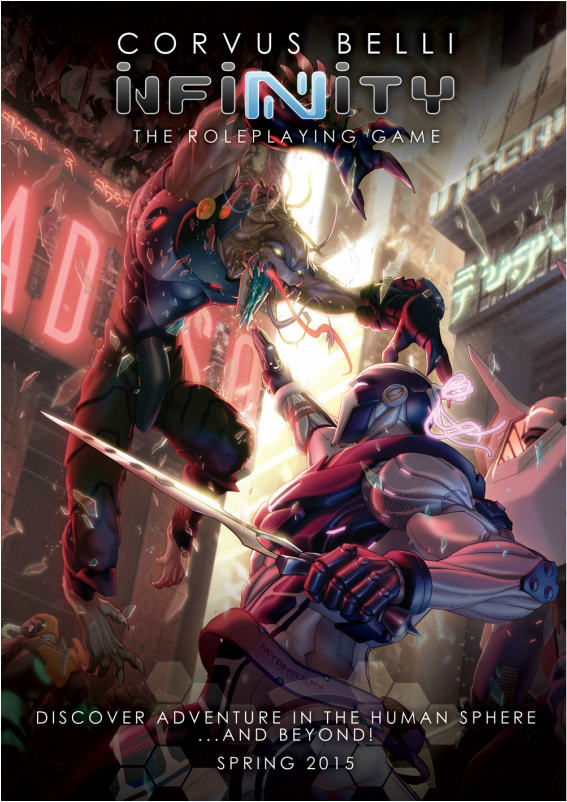
As I write this, the Kickstarter for Battle Chasers: Nightwar is just out of the gate, and the one for an RPG based on the Infinity Miniatures game should be launching at some point soon (allegedly Tuesday). I find the timing interesting, because these are both cases of properties branching out to slightly different fields. Cross-media is getting me in trouble, but it’s almost always interesting.

On Making the Jump
The date is obviously not still accurate.

Comic->Video Game

On reflection, this isn’t an uncommon transition (although it usually goes Comic->Movie->Game). I was actually directed to this initially without knowledge that Battle Chasers had been a comic. The art (both concept and prototype) is awesome, and I found it a bit familiar. Then I found out that Joe Madureira was the artist and knew why. This one seems to have a few Ex-Vigil staff on board, but it remains to be seen if they can do a turn-based RPG as well as they did Zelda. (I’m not going to listen to any arguments that Darksiders is not Zelda.)
On Making the Jump

Wargame->Tabletop RPG

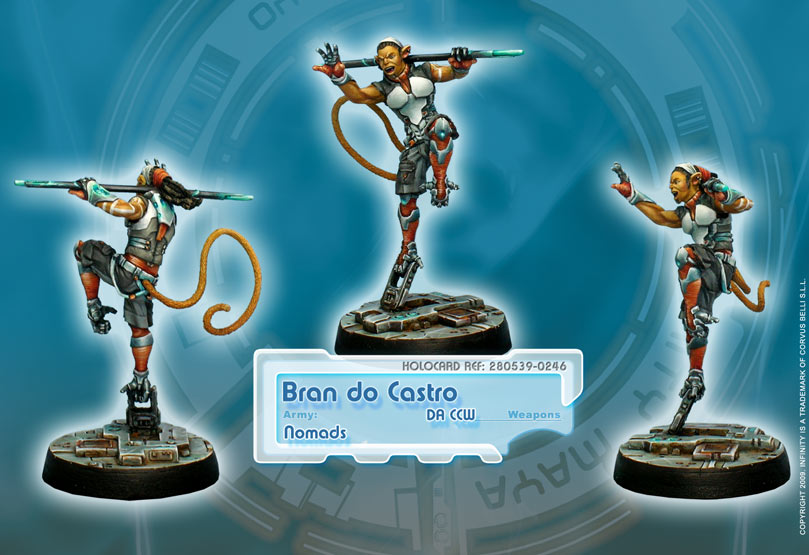
On even further reflection, I’ve seen this one before too, from Iron Kingdoms. Iron Kingdoms is in a bit of an odd place here, because it started as a d20 Campaign setting and underwent this process in the opposite direction. The resulting minis game (Warmachine/Hordes) ended up as the more popular product. Infinity is actually somewhat similar, in that it grew out of a home-brew campaign setting. Aware of this, Tam attempted to work the rules into a workable system, but it didn’t go very far. (This was before the customizable spec-ops rules existed). Some of the unique characters in the Nomads faction were the original PCs.
On Making the Jump
The current Iron Kingdoms rules are a direct conversion of the Warmachine/Hordes rules, with some additions made for things player characters do that minis usually don’t, like talking to people, or actually recovering from injury. The result is that minis from the wargame are perfectly valid enemies once you give them more than a single hit point. (There are exceptions. Named Casters are generally not going to be reasonable opponents, for instance.) The Infinity rules seem to be going a slightly different route. It’s using a system not based on the minis game, but instead just preserves elements of it. Ability resolution is familiar, but not identical; it still uses d20s in a blackjack-like way, but from there the games diverge greatly. I missed the playtests, so I don’t know that much about it, but it’s a custom system that uses 2d20s to generate a number of successes.
On Making the Jump
While Corvus Belli (The company that produces Infinity) isn’t directly responsible for the RPG, they are producing materials to go with it. I really look forward to seeing what happens with it. The original Bran Do Castro seems to like it, so here’s hoping I do too.

On Making the Jump

As I write this, the Kickstarter for Battle Chasers: Nightwar is just out of the gate, and the one for an RPG based on the Infinity Miniatures game should be launching at some point soon (allegedly Tuesday). I find the timing interesting, because these are both cases of properties branching out to slightly different fields. Cross-media is getting me in trouble, but it’s almost always interesting.

On Making the Jump
The date is obviously not still accurate.

Comic->Video Game

On reflection, this isn’t an uncommon transition (although it usually goes Comic->Movie->Game). I was actually directed to this initially without knowledge that Battle Chasers had been a comic. The art (both concept and prototype) is awesome, and I found it a bit familiar. Then I found out that Joe Madureira was the artist and knew why. This one seems to have a few Ex-Vigil staff on board, but it remains to be seen if they can do a turn-based RPG as well as they did Zelda. (I’m not going to listen to any arguments that Darksiders is not Zelda.)
On Making the Jump

Wargame->Tabletop RPG

On even further reflection, I’ve seen this one before too, from Iron Kingdoms. Iron Kingdoms is in a bit of an odd place here, because it started as a d20 Campaign setting and underwent this process in the opposite direction. The resulting minis game (Warmachine/Hordes) ended up as the more popular product. Infinity is actually somewhat similar, in that it grew out of a home-brew campaign setting. Aware of this, Tam attempted to work the rules into a workable system, but it didn’t go very far. (This was before the customizable spec-ops rules existed). Some of the unique characters in the Nomads faction were the original PCs.
On Making the Jump
The current Iron Kingdoms rules are a direct conversion of the Warmachine/Hordes rules, with some additions made for things player characters do that minis usually don’t, like talking to people, or actually recovering from injury. The result is that minis from the wargame are perfectly valid enemies once you give them more than a single hit point. (There are exceptions. Named Casters are generally not going to be reasonable opponents, for instance.) The Infinity rules seem to be going a slightly different route. It’s using a system not based on the minis game, but instead just preserves elements of it. Ability resolution is familiar, but not identical; it still uses d20s in a blackjack-like way, but from there the games diverge greatly. I missed the playtests, so I don’t know that much about it, but it’s a custom system that uses 2d20s to generate a number of successes.
On Making the Jump
While Corvus Belli (The company that produces Infinity) isn’t directly responsible for the RPG, they are producing materials to go with it. I really look forward to seeing what happens with it. The original Bran Do Castro seems to like it, so here’s hoping I do too.

On Unusual Polyhedrons

Two years ago, after about a year of public playtesting, Fantasy Flight Games released the Star Wars: Edge of the Empire RPG, the first in a series of planned core books in a brand new system. Star wars RPGs had been on a bit of a hiatus, the most recent prior system was Saga Edition, which was d20-based. Wizards of the Coast decided to drop the license in 2010, and Fantasy Flight picked it up shortly thereafter. My initial impression of the system was mixed, but now that there’s a bit more source material I like it a lot more.

The assumed setting for all three of the core books is a bit after A New Hope. This means that the Empire is in power, Rebels are seen as a dangerous threat (since they did just manage to destroy the Death Star), and force sensitives are both rare and persecuted. There are 3 core books so far, each focusing on a different aspect of the setting. Edge of the Empire focuses on the less-than-legitimate business of things like smugglers and bounty hunters. Age of Rebellion focuses on the Rebellion itself, which mostly means Soldiers and Politicians. Force and Destiny focuses on force sensitives, both with and without lightsabers.

On Unusual Polyhedrons

Ace Custom

One of the immediately noticeable things about the game is that it uses a unique dice mechanic. There are 3 types of die with positive symbols (boost, ability, proficiency), 3 with negative (setback, difficulty, challenge), and a force die that isn’t explicitly positive or negative. The symbols on the dice are…

On Unusual Polyhedrons Success – This determines if an action is successful. As long as you have one or more of these in the final result, you can do whatever you were initially attempting to do. The number can determine the degree of success in some cases, like additional damage for attacks.
On Unusual Polyhedrons Advantage – Independent of success, this symbol represents good things happening. In combat this can be used to generate critical hits (how many you need depends on the weapon) and other weapon features, and out of combat it represents something advantageous happening. this remains true even if you fail the roll.
On Unusual Polyhedrons Triumph – This is found only on the Proficiency die, and it represents really good things. This counts as a success, and also a super-advantage. An attack with one of these can usually generate a critical hit or special feature with just one, and outside of combat the door is wide open for the GM to let amazing things happen to you.

Die Color Sides On Unusual Polyhedrons On Unusual Polyhedrons
Boost Light Blue 6 2 3
Ability Green 8 5 5
Proficiency Yellow 12 10 (includes On Unusual Polyhedrons) 8

On Unusual Polyhedrons Failure – Each failure symbol on a roll cancels one success. The roll is still considered failed if it generates an equal number of success and failure symbols (because it then has 0 uncancelled successes).
On Unusual Polyhedrons Threat – This one represents bad things. It cancels advantage, and if you have any of these remaining, something unfortunate happens even if you succeeded on the roll. This might be something as simple as suffering strain, or it might increase the difficulty of future checks.
On Unusual Polyhedrons Despair – Found only on the Challenge die, this is the negative version of Triumph, but these do not cancel each other (it’s possible for a roll to generate both). This counts as a failure and also means something very bad happens. How bad exactly is up to the GM.

Die Color Sides On Unusual Polyhedrons On Unusual Polyhedrons
Setback Black 6 2 2
Difficulty Purple 8 4 6
Challenge Red 12 9 (includes On Unusual Polyhedrons) 8

On Unusual PolyhedronsOn Unusual Polyhedrons Force Points – Found only on the force die, these are used mostly for force powers. It’s worth noting that the force die contains an equal number of light and dark side points (8 each), but has dark side on 7 faces and light side on 5. It’s assumed that player characters are mostly light-side, so there are penalties for fueling your powers with dark side force points.

Stay on Target

Task difficulty is almost never represented as a static number, and is instead represented as a number of difficulty dice. Your ability is likewise represented as some number of dice, usually a mix of ability and proficiency dice. All of these are rolled together to determine the success or failure of an action. Boost die are usually added if circumstances are favorable; Setback die are added when situations are unfavorable. Particularly bad situations might result in upgrading the difficulty of the check (turning difficulty dice into challenge dice). Certain abilities may also let you upgrade your own checks, turning ability dice into proficiency dice.

On Unusual Polyhedrons
The real benefit of this is that rolling the dice goes beyond determining “degree of success” which most dice pool systems fall into. To take Shadowrun as an example: for most checks it makes no difference whether you beat the threshold by 0 or 3, unless your GM is tracking hidden thresholds for rolls. (I’m pretty sure Tam does this, but I’ve never asked him directly.) Even on rolls where the number of successes does matter, there’s not a lot of fine control. Unless you roll a glitch, which is pretty rare for moderately-sized dice pools, you’re either going to fail, win, or win big. By separating additional positive or negative effects from the actual success/failure of the roll, Star Wars opens up other possibilities for narratively interesting situations. Maybe you fail to get the information you want out of a contact, but he likes you and tips you off to something else. Maybe you successfully evade the guards, but accidentally leave traces of your passage behind. Maybe you evade the guards and they wander off to investigate something far away from you.

Most rolls of the dice are going to tell you a little bit more than “you pass” or “you fail, and that’s probably my favorite part about the system. I’m going to back to reading this book where they put the swords and magic back in.