Design Philosophy (Part 2: Why is there Bad Design?)

I made an attempt yesterday to define “good design”. By extension, I tend to think that things that don’t fit the definition fall somewhere on the spectrum, where some omissions might make “great design” merely “okay design” or “passable design” and flagrant violations would start to fall into the realm of “bad design”.

Design Philosophy (Part 2: Why is there Bad Design?)

Some things are badly designed. This can be a result of omission or ignorance or error on the part of the designer, or it can be intentional. What I want to look at a bit more today is why some things are designed badly. Something can be designed badly and still be “good” on the whole, and it’s important to remember that good design isn’t the end-all-be-all, nor is something good necessarily well-designed. Design isn’t the only consideration in the creation of something, but I think it’s important to be able to tell the difference between a good thing with good design and a good thing with bad design.

So, definition of good design again:

Good design is when the thing in question accomplishes what is desired in an efficient, reliable, intuitive, thorough, positive, and inspiring way without contradicting its own goals, being dishonest or misleading, or being unnecessarily obtrusive or overwrought.

Let’s take an easy example: air travel. Getting on planes is inefficient and a generally frustrating experience. It contradicts its own goals of getting people from place to place effectively, it’s often misleading, and it’s certainly obtrusive.

Why?

The easy answer, and the one you hear a lot from frustrated passengers at airports, is “because the people running things are idiots”. This is rarely actually the case. A process that huge and with that many people involved that runs for decades does not continue that way because the people in charge aren’t good at their jobs. Air travel is specifically designed to be unpleasant in a variety of annoying but not enraging ways. It is intentionally designed badly.

Design Philosophy (Part 2: Why is there Bad Design?)

Again, why?

I’ve talked elsewhere about follow-the-money problems, and air travel is a pretty clear one. Most of the additional purchases you can make beyond simply buying your ticket involve removing the various annoyances that you have to put up with. The markup on these is huge, and involves relatively low overhead for the airline. Loading the plane is inefficient and obtrusive, and so you can pay money to get on sooner, ensuring that you don’t have to deal with the annoyances of waiting in line or worrying over whether you’ll have a place to put your bag. Seats get increasingly uncomfortable to encourage you to upgrade your seat to something a bit more comfortable. Sitting closer to the front of the plane means you get off sooner, and are more likely to get your connecting flight. All of this is *designed*.

There are other considerations as well. You can board earlier if you check in ahead of time on most airlines. This is another designed thing– the airlines don’t want no-shows, so they incentivize you to check in early, so they have an accurate headcount and no empty seats on the flight. If you help them get an accurate headcount sooner, they will remove a layer or two of annoyances from your trip.

So, that’s how we get bad design in things we don’t like. What about bad design in things we do like?

Since I was already talking about flying, it’s time for me to get controversial. World of Warcraft has flying mounts. They effectively function like cheat codes– you press a button and you can fly like a GM does. Because the flight mechanics are very simple and offer no opportunity for gameplay (there’s no combat in the sky), flight simply allows you to go up in the air and bypass whatever you care to, skipping mobs and obstacles to get to a particular goal. It’s probably the single most damaging thing to WoW’s gameplay that they’ve ever done, and it’s extremely telling that they “take it away” for every new expansion. It shouldn’t surprise anyone that this happens– with flight enabled all the time, there’s very little game to play, just fly down, click, fly up.

Design Philosophy (Part 2: Why is there Bad Design?)

“But players love it!” you say. “I love it! Don’t tell me flight in WoW is bad design when I’m having so much fun with it!”

Here’s where it gets interesting. WoW’s flight model is bad design– it contradicts the goal of players playing the game instead of bypassing it, it creates a situation in which you’re (unintuitively) better off not playing the game than playing it, it misleads players into thinking the ground game is boring (it is, in fact, the only game), and it forces the rest of the game to be significantly overwrought just to accommodate flight. As above, it’s a cheat code, there’s little to no skill involved in flying, there’s no associated gameplay, it’s effectively an invincibility code and terrain hack all in one, with a pretty wrapper and nice effects.

It is, however, fun. Cheating is fun. Create an item that can be used to instantly kill any target and everyone would flock to it. In Destiny, the “loot caves” were immensely popular. Cheating is even more fun if it’s apparently sanctioned by the game. How can flight be cheating if it’s something the designers put in there? Well, everyone makes mistakes. Consider the outcry when Destiny shut down its loot caves, how angry players were. Imagine that multiplied ten thousandfold, if Blizzard were to come out and say “hey folks, you know what, flight was a mistake and we’re removing it to make the game better”. Pandora’s box is open, there’s no going back, even if in every interview where it comes up Blizzard devs all but say outright that flight was a terrible mistake that they wish they’d never put in the game.

I mentioned that good design inspires later design. It’s very, very telling that nearly no major MMO has implemented WoW-style flying mounts, with the exception of FFXIV (which operates on a slightly different content model anyway). Other games have included flight, but it’s been more limited, and generally included more gameplay. WoW’s flight didn’t inspire; it was a cautionary tale.

But, it’s fun, so it stays. For some people, WoW is a better game for including this feature; good design or no. It trades good design and the game’s mechanical integrity for player satisfaction.

Design Philosophy (Part 2: Why is there Bad Design?)

Another, more common example of bad design in WoW, and one that they changed: the old talent trees. These were badly designed because they were unintuitive, not very thorough (depending on the class), EXTREMELY misleading and dishonest, and very much overwrought. Talent trees presented a set of options that the game portrayed as equally good, when the reality was that there was a “right answer” and a whole lot of pitfalls along the way. For a long time, players and designers alike considered this “good design”, as being able to separate the wheat from the chaff was considered a skill.

The problem was, the optimal builds were posted online and if you weren’t following one of those, you were probably playing badly, or at the very least noticeably sub-optimally. The choices were illusions, there was a right answer and then a lot of mistakes, not a genuine series of choices. If the talent trees had been permanent and unalterable (as similar things were in earlier games), the problem would have been exposed FAR sooner. MMOs preceding WoW often had extensive “build planners”, so you could figure out what permanent choice you made as you levelled up and didn’t ruin your character by making an incorrect choice. Also bad design, and while WoW’s talents improved upon it, it still only went from “appalling” to “not great”.

But, all of that being said, up until the point Blizzard specifically came forward and said their talent system was bad design and they were removing and replacing it entirely, players would argue that it was a demonstration of skill, a sign of knowledge and expertise, and a way of separating the “good players” from those players who foolishly thought that because a game presented them with apparently equivalent choices that they could feel comfortable picking any of them.

I’m picking on WoW here, but a lot of games fail at this. They present a bunch of choices with similar costs or requirements, but the efficacy of those choices is wildly uneven. Sometimes games will be honest with you and say that this choice will make the game harder; more often they do not.

Design Philosophy (Part 2: Why is there Bad Design?)

These last two were good (or well-loved) things designed badly by mistake. What about something designed badly on purpose that we like?

It’s hard to find good examples of this, because things that we like tend to cloud our vision as far as good design goes. Microtransaction games are extremely popular, and often sacrifice good gameplay design in order to squeeze more money out of players. The ones that do this more acceptably are largely just better at hiding it, though they’re still making the same design sacrifices.

I want to look a bit more into why we might design something badly on purpose in the next part of this.


Design Philosophy (Part 1: What is “Good Design”?)

Design is important. Not just in games, but in everything. Design is how we make whatever is happening in our minds into reality, and it is also how we consciously improve. It’s an important part of things being functional, of things working, and of things being fixable when broken. It helps things work and it helps us understand what’s wrong when things don’t work. Design is important, and because of this, good design is inherently worth pursuing, and bad design something to be avoided.

Design Philosophy (Part 1: What is “Good Design”?)

But it’s not enough just to say that something needs to be designed well. If we don’t know what good design is, we can’t recognize it. Good design is not simply “does [thing] do what it was intended it to do”, because there are reasons to intentionally design something badly. It’s worth recognizing the difference between something that is designed well and something that is intentionally designed badly, because they’re ultimately very different things. So, what is good design? Here’s an attempt at a general statement:

Good design is when the thing in question accomplishes what is desired in an efficient, reliable, intuitive, thorough, positive, and inspiring way without contradicting its own goals, being dishonest or misleading, or being unnecessarily obtrusive or overwrought.

It’s a mouthful; I’ll break it down:

  • Good design accomplishes what is desired.
    • This is pretty simple. If an gorgeously artistic spoon does not hold liquid, it is not a well-designed spoon, no matter how pretty it is.
  • Good design is efficient.
    • Efficiency is a big part of what separates “design” from “good design”. A user interface that requires you to navigate fifteen layers of menus to find what you’re looking for is a design, but a UI that is more carefully arranged or predictive is a superior design, because it helps you get to what you’re looking for quickly.
  • Good design is reliable.
    • It’s not enough that a designed thing should accomplish its goal. It needs to be able to do so repeatedly, in such a way that it can be trusted. A game might be fun, but if it crashes constantly or behaves erratically, that is a problem.
  • Good design is intuitive.
    • Watch a child pick up Legos for the first time. They fit together in an obvious way, pegs up, and as you add more pieces the complexity level rises, but each new piece works off of the same principles introduced already. Similarly, certain doors that open only one way have a horizontal “push” bar across the width of the door, and a vertical “pull” handle on the far edge. These make it obvious how to interact with the door, because the horizontal bar is easy to push, and the vertical handle is situated to provide maximum leverage for pulling. Even without signage, it is clear whether one needs to push or pull the door.
  • Good design is thorough.
    • It’s important to address the various ways in which a thing can be used. A game that provides features for deaf or colorblind players is naturally better designed. An automatic door that only triggers from one side doesn’t take into account people approaching it from unexpected directions.
  • Good design is positive.
    • What I mean by this is that the experience of interacting with something should uplift and please the user. A well-designed set of controls is not only usable, but a joy to use; the new PS4 controller is comfortable and pleasing just to hold and use, compared to the original Xbox controller that was equally functional, but not satisfying or pleasing to hold for most players.
  • Good design is inspiring.
    • By this I mean that it sets a standard for future design. The iPod’s interface had a massive impact on mobile device interfaces, inspiring the iOS interface which in turn has had a huge impact on other mobile devices. Compare the experience of the system interface on a Nintendo DS with the system interface of an iPhone; one you want to see everywhere, the other feels dated and clunky.
  • Good design does not contradict its own goals.
    • A fairly obvious one that tends to only come up with more complex designs. Altering a business process with the goal of saving money is not a good design if it requires enough additional overhead to run that it obliterates the money savings. More controversially, a diet plan that rewards good behavior with “cheat days” in which the good behavior can be eliminated on the “cheat day” is poorly designed.
  • Good design is neither dishonest or misleading.
    • If a design suggests that a choice you may choose to make is just as valid as another choice, then both choices should be equally viable in practice. Similarly, a design should be clear about its own capabilities and neither suggest functionality that it lacks nor obscure functionality that it has.
  • Good design is neither obtrusive nor overwrought.
    • Rube Goldberg machines are amusing, but are intentionally inefficient, take up a lot of unnecessary space, and use a lot of moving parts (with a lot of potential failure points) to accomplish something often very simple. They’re fun, but (intentionally) not good design. Similarly, a door with a recording that shouted “PUSH” or “PULL” depending on which side of it you were on would be obtrusive.

These things, together, set a high bar for good design. Good design is hard, and it’s much rarer than you might expect, especially because so much research has been done to figure out what makes good design, both from a mathematical and from a psychological standpoint. A lot of things fall shy of the mark, and I think it’s worthwhile and sometimes even important to understand the difference between poor execution and poor design.

Tomorrow I’m going to look into that a bit more; if we know what makes for GOOD design, why do we have BAD design? What would motivate us to create bad design intentionally, and why does that happen?

Virtual Reality

Next Big Thing

Virtual Reality

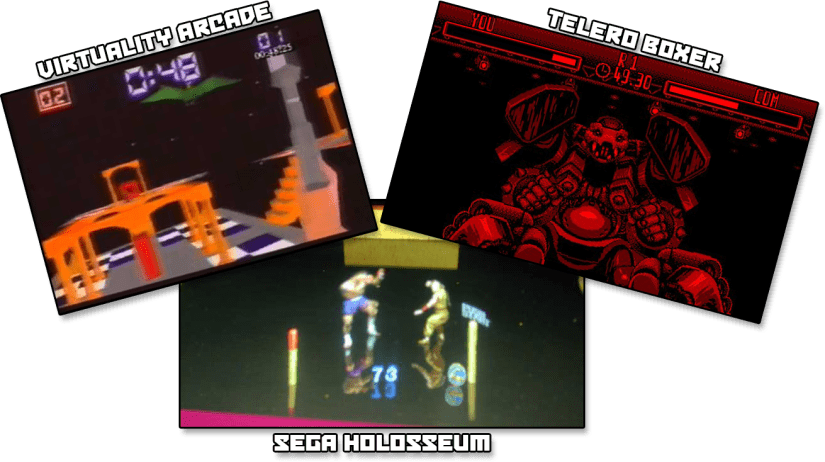
It feels like for the majority of my life, “Consumer Virtual Reality” has been roughly five years away…. or at least that is what the pundits are consistently saying.  Granted I have been hearing this for the last three decades of my life.  The 90s were really the era of this being the big thing, thanks to the popularity of movies like Lawnmower Man and the weekly reminder of just how amazing the Holodeck could be on Star Trek the Next Generation.  The problem has been however that what we are actually capable of delivering, versus what we are expecting…  has been a pretty huge gulf to cross.  The first time I touched anything I would consider virtual reality, were the extremely expensive Virtuality arcade machines from the roughly 1991.  You can see a screenshot of the type of graphics it delivered above.  Sure it felt cool to be wandering around a fully immersive 3D world, but the amount of disconnect between your actions and the half dozen polygons that represented your hand… was pretty massive.  The funny thing about this game is that apparently it was built on the Amiga 3000 as a hardware platform, which I guess only serves to show you just how advanced that system really was.

I guess for me Virtual Reality has been this failed promise for so long that I have doubted that it would actually really arrive.  I threw in a few other examples in the collage above like Sega Holosseum from 1991 that chose to go down the smoke and mirrors route of creating the approximation of holograms, rather than trying to wrap you in a virtual landscape.  In many ways it worked better, and playing the game felt like the 3D Chessboard from Star Wars.  Then we had the famous Nintendo false step of the Virtual Boy from 1995, that came with the least ergonomic way of playing the game.  I think the suggested method was to sit it on a kitchen counter or something…. and lean over to use it.  However for MOST of the people I knew that had one they would end up laying on the couch and letting the console rest on their face.  There were a bunch of negative effects of seeing the equivalent of gameboy quality graphics in red and black…. and the few times I used it I wound up with a nasty headache.  Around 2003 I remember a good friend of mine having 3D glasses that hooked to the PC and provided 1024×768 screens for each eye, but this ended up working the hell out of the video card… and the framerates suffered.  So basically…  there have been a lot of technologies that have arrived telling me that Virtual Reality is here….  only to not really be the case.

Arrived at a Cost

Virtual Reality

It was roughly around this time last year that I got to play with the Oculus Rift for the first time.  At Pax South I was scheduled to do a media demo of Elite Dangerous, and the marketing guy asked if I had ever used a Rift, and upon hearing that I had not shuttled me towards one of the two machines that had them.  Granted there were around ten machines in total in the booth, and only two of them were hooked up and capable of using the Rift which immediately made me a bit suspicious.  Firstly… I suck horribly at space shooters…. and they loaded up a dog fighting scenario for me to play where I was put up against a computer ship.  The demo ended when either I killed the ship… or it killed me.  Needless to say my demo probably took twice the amount of time needed as the other players, but it was really somewhat amazing the first moment when I realized that while chasing this ship…. I could look up through the top of the canopy to trace its movement.  There was still the strange uncanny valley as I watched a set of hands move in the cockpit that were not my own.  The computer was furiously trying to guess what my hand movements might look like based on the controls I was pressing on the real world HOTAS setup.  After I destroyed the ship I asked the Marketing folks some questions, one of which was what sort of hardware they were running this demo on.  Not surprisingly they had it running on an Nvidia Titan X which is still currently a roughly $1200 video card….  so I started to temper my expectations.

Yesterday the prices were released for the first generation of the Oculus Rift released for public consumer consumption.  Granted at this point there have been several development kit models available for those daring enough to brave the potential issues of dealing with beta hardware.  I guess in my mind the price point that seemed reasonable was around $300, because that is what the Samsung Gear unit retails for… and what the supposed price point of the Sony PS4 VR unit will be.  I was not insanely shocked however when the pre-order price ended up at roughly double that amount $599.  If that $600 price tag were a turn key solution that you simply plugged into the HDMI out on your existing PC, then I guess in truth that would probably be well worth it.  However for the bulk of us…  we are likely running hardware that is significantly less snazzy than their requirements.  The minimum requirements listed are a Nvidia GTX 970 which is essentially a $350 video card.  However I would not expect full performance in games like Elite Dangerous on anything lower end than a 980 ti…  which pushes you into the roughly $650-700 price range on a video card.  So before you have touched the rest of your computer set up at all… you are out $1300 in just the Rift and a high end video card.  As much as I love this pipe dream, it is simply too expensive of one for me to even indulge the thought of.

Reality Sets In

The problem I have is that I have a $200 video card, not a $600 video card… and it is unlikely short of winning the lottery that I will ever be able to bring myself to spend that sort of money.  I am sure as time goes on, people will get better at writing VR game experiences, and additionally the cost of the hardware itself will come down by the time it reaches the third or fourth generation of the Rift.  For the time being, Nvidia gave some numbers that said rendering a game for a VR headset requires roughly seven times the amount of resources.  So essentially I have ruled out the Oculus Rift as something I will ever be able to afford.  I know my friend Scopique has been playing with some android VR options that supposedly allow you to create ghetto VR for the PC, and I am anxious to see how well these work out for him.  Personally I think my first likely footsteps into this is in the form of the Playstation VR, and I linked in a video above to show off that unit and a few of the games.  I already have the necessary hardware, namely in the form of a Playstation 4, and if the headset itself ends up being around $300 or even a little more… that becomes within the realm of possibility.  Given that I managed to get my PS4 for only $200, that would make the total outlay for the system in the $500-600 price range which seems reasonable.

Essentially I am going to be happy as hell for anyone who manages to pony up the money to get a Oculus Rift.  I’ve been watching another friend Qelric do videos every now and then showing off her beta hardware.  I hope she can somehow end up getting one of the production units, so I can continue to live vicariously through her experiences.  The problem is…  that pricetag… is pretty damned steep regardless.  The other big problem I have with the Rift so far is that I am not really seeing the killer apps other than Elite Dangerous.  Most of the games she has played with feel more like “tech demos” rather than fully fleshed out rich gaming experiences that would sell a unit.  RIGS on the other hand on the PSVR seems like exactly the sort of fun multiplayer hardware pushing experience that will get someone to add a headset to their Christmas list.  I think the Oculus Rift right now is a true “enthusiast” experience, but isn’t quite “consumer virtual reality” just yet, and it is going to take manufacturers building games for the platform to finally make it worth the purchase price.  In the time between however… I am going to continue being interesting in every bit of news I can find.  From what I am hearing the units are apparently sold out through May 2016 delivery, so it seems like plenty of folks are willing to plunk down for purchase, and I am anxious to see the sort of experiences especially the youtubers and streamers showcase using the magic box.

Board Games

I have a weird relationship with board games. I recently played a number of them over the holidays with friends and family, and I was reminded of how much fun I can have with them, when played casually and as an accompaniment to conversation, rather than a primary focus. That having been said, however, I don’t often play board games, and it took me jumping back into Starcraft 2 to really think about and understand why.

Board Games

I jumped back into Starcraft 2 for the Legacy of the Void campaign, playing through the Zerg campaign in order to catch up with the story. I really enjoy the SC2 campaigns, because they do some interesting RPG things as you progress, and they showcase a lot of interesting mechanics that don’t come up in regular, standard matches. Having played through the campaigns, and feeling better about my Starcraft skills, I jumped into some multiplayer and vs-AI matches to try to extend the fun.

I played about ten or fifteen matches, total, before getting bored. I still know Protoss openings, and it didn’t take long for me to figure out how to adapt them to the new units in the expansion. What bored me was that every opening was the same, dominant strategies were already known and I either used them or lost, and there wasn’t really any room for creativity, because the first steps of each match were all very similar. If I were playing against players who weren’t as skilled as I was, I could feel free to experiment more, but because both the matchmaking and the AI tune themselves to keep up with my skill, I basically have to play at the top of my game all the time. I have to play competitively or I lose, generally badly enough to not have any idea if the strategy I was employing would have even worked, had I executed it more adeptly.

Board Games

This brings me back to board games. I have a number of friends who are extremely competitive board gamers, and playing games with them tends to be an extremely one-sided affair. It’s either a game I know well, like Agricola, or City of Thieves, or Galaxy trucker, or it’s a game I don’t know at all, or have played maybe once or twice. If it’s a game I know well, I basically don’t get to experiment because I have to play at the top of my game and focus hugely on competitive strategies. If it’s a game I don’t know, I lose. Often, in a game like Through The Ages or Race for the Galaxy, I can lose HOURS before I realize I’ve lost.

As a result, I tend to only really enjoy cooperative games, because unequal skill or experience doesn’t make the game one-sided. There are precious few board games I’ve seen where the experienced player won’t simply dominate a new player; it takes a few games before a new player can even begin to hold their own, much less try something creative. Similarly few board games offer a “catch-up” mechanic for players who fall behind– there is a reason why Mariokart is so popular a party game.

Board Games

On the other hand, I play minis games, where the experienced player tends to dominate the new player, where catch-up mechanics rarely exist, and where they’re purely competitive. It took me a bit to understand why I like competitive minis games, and why I don’t like competitive board games. It’s all in the opening moves. In a minis game, there’s a strategic layer that I take part in before the game even starts, where I pick my list and deploy it. The terrain, the starting player, etc are all akin to the randomization most board games have, but beyond that I have a level of creativity that applies before I even start playing, and that can be different, sometimes vastly so, from game to game.

It’s worth noting that I tend to check out of minis games that boil down to dominant strategies with same-y openings. I stick with Infinity because I can continually come up with different lists doing different things, and the variance in effectiveness between them is mostly determined by my skill, not the list itself. Conversely, I’d reached a point in Warmachine where I was playing lists that did virtually the same exact thing for the first turn of every game, which got boring quickly. Similarly, without the opportunity for strategy-layer customization prior to a game starting, I’m playing purely tactics in a board game, playing out the relatively similar first turns and reacting to the changing game state.

Board Games

I should pause a moment to describe the differences, as I see them, between strategy and tactics. This could be a post by itself (and might well be, later), but essentially, strategy is the planning you do before you take actions, and tactics are the actions you take in response to what’s happening in front of you. Nearly every board game is a purely tactical game– you don’t get to make decisions prior to the game starting; indeed, randomization often specifically blocks you from doing this. A game like Galaxy Trucker is actually predicated on you being unable to strategize effectively– you have to build a ship with what you can grab, rather than meticulously planning it out.

Pure tactics, as it turns out, kind of bore me. I tend to feel like purely tactical board games can devolve quickly into simply taking the optimal action at every juncture, and while this is a fairly complex web in most cases, it’s still a very solvable one. While it may take a lot of memorization and understanding of game mechanics to know what the optimal actions are, once you know them they aren’t going to change. With the strategic layer added in, it’s often possible to change your situation to the point where optimal actions (and sometimes the junctures themselves) may change, and I find that a lot more compelling.

Board Games

That having been said, I do find myself returning to board games that are played casually, or cooperatively. I particularly like games that defy being played more than casually– Codenames is a great example of a game like this, that’s technically a competitive team game but doesn’t have optimal strategies other than “be good at communication”. I don’t mind that there’s no strategic layer, because the competitive part of it is really just ornamental. Similarly, games like Shadowrun: Crossfire and Eldritch Horror aren’t heavily affected by one player being more experienced than the others (unlike, say, Battlestar Galactica, where one or two out-of-band players can dominate or destroy the experience).

On the whole, I’m somewhat reticent to jump into board games with friends I know are competitive. I have an automatic flinch reaction to the sentence “Hey, want to play [board game] with me? It’s one of my favorites!” because in a lot of cases I know that what is going to happen is I’m going to lose and, like in Starcraft, lose badly enough that I’ll have no idea if my strategy might have worked if executed well. Losing that badly– badly enough to learn next to nothing– doesn’t endear me to the game. Because I have no knobs to turn or levers to pull before the game starts, jumping back into that game just restarts the chain of optimal decision points, and maybe I’ll make the right ones this time.